Nonprofits have a complicated growth challenge. Charitable giving is reaching new highs, but attracting and keeping supporters is getting harder.
In 2025, U.S. charitable giving reached $617.2 billion, a 5.7% increase over the previous year. The headline is encouraging, but it doesn’t tell the whole story. Growth in giving doesn’t necessarily mean more people are getting involved, and organizations can’t build long-term stability on fundraising totals alone.
According to Candid’s analysis of the latest Giving USA findings, the sector is seeing substantial growth in total contributions alongside changes in where that money comes from. For nonprofit leaders, this raises a bigger question: how can organizations turn strong giving totals into lasting relationships with supporters?
The answer has implications for fundraising, brand positioning, content, and digital strategy. Nonprofits need to attract new donors, give them compelling reasons to contribute, and create experiences that encourage them to stay involved long after the first gift.
Here are four shifts worth watching.
1. Moving Beyond Creating First-Gift Frenzy to Retaining Long-Term Supporters
Fundraising campaigns often revolve around a clear moment: a year-end appeal, a matching-gift challenge, a major event, or an urgent need. These moments can be effective at generating donations, but they don’t automatically build a relationship that lasts.
The challenge becomes clearer when you look at donor participation. The Fundraising Effectiveness Project’s 2025 data found that new-donor retention remained essentially flat, highlighting the persistent challenge of turning a first gift into a second.
For nonprofits, this makes retention a strategic priority rather than a follow-up task.
One common mistake is assuming that donors will remain engaged simply because they care about the cause. People can support a mission and still lose touch with the organization behind it. They may forget to give again, become overwhelmed by appeals, or feel uncertain about what their previous contribution accomplished.
A first-time donor might respond to a compelling story, a personal connection, or a timely appeal. Whether they give again depends on what happens next. Do they hear how their contribution made a difference? Do they understand the organization’s progress? Do communications reflect their interests and previous involvement? Is there a clear next step beyond donating again?
These are marketing and experience questions as much as fundraising questions.
A more connected donor journey should account for the entire relationship:
- Discovery: Help potential supporters understand the mission, the need, and why the organization matters.
- First contribution: Make donating straightforward, with a clear explanation of how the gift will be used.
- Stewardship: Follow up with meaningful updates about the work their support made possible.
- Continued engagement: Offer relevant ways to participate, whether through another donation, volunteering, events, advocacy, or sharing the mission.
- Long-term support: Recognize loyalty and help donors understand the ongoing value of their involvement.
This doesn’t require a complicated automation system. Even a thoughtful sequence of welcome messages, impact updates, and relevant follow-ups can make the relationship feel more intentional.
Look at where supporters disengage. Review the first few weeks after a donation. Check whether thank-you messages feel personal and whether impact updates arrive while the gift is still fresh in the donor’s mind. Segment communications where possible, so a first-time donor doesn’t receive exactly the same experience as someone who has supported the organization for years.
Retention improves when supporters can see the relationship continuing, even when they aren’t being asked to give.
2. Donor Expectations Are Changing
Research into donor expectations points to another important consideration. Bloomerang’s Mission Retainable report explores the gap between what donors expect from nonprofits and how organizations maintain those relationships.
Communication Preferences: Find out how your supporters actually want to hear from you. For example, Bloomerang found that while text messaging is the third most preferred communication channel among donors, only 13% of fundraisers use text messaging.
Seamless User Experience: Users expect a seamless experience across email, your website, donation platforms, member portals and so on. If your legacy systems don’t talk to each other or require multiple logins, you need to persuade leadership to earmark a budget for an upgrade. Don’t let bad UX erode your credibility and your donations.
Clear Opt-Outs for Recurring Donations: This might feel counterintuitive, but forcing members to take unusual measures to stop a recurring donation creates frustration and makes donors less likely to return. A little bit of friction makes sense (“Are you sure you want to…?”), but overcomplicating opt-outs erodes trust and quickly becomes a dark UX pattern. You don’t get a free pass on bad user experience just because you have an altruistic mission.
A better alternative: Make it easy for supporters to pause and resume donations rather than tempting them to rage unsubscribe altogether.
Refresh Your Gift Offerings: Research what your supporters (or potential supporters) actually want, rather than recycling the same gifts year after year. Do your supporters really need more address labels and tote bags? Some swag even creates a perception of waste—waste of donated funds and ecological waste—which may be undermining the very mission your donors want to support.
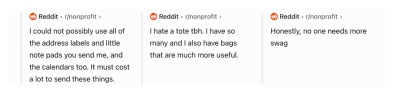
Before selecting this year’s swag evaluate the following:
- Research donor sentiment toward different gift types on platforms like Reddit. Affectionately poking fun at a gift might make for good publicity. But negative sentiment does not.
- Consider the distinctiveness, quality, utility, and repeat value of a gift.
- Evaluate the option of digital gifts including members only access to special content.
- Consider whether donors want gifts at all. Are they happier knowing a larger amount of the proceeds went to support your mission?
3. Nonprofit Positioning and Storytelling Need to Work Harder
Nonprofits have an advantage that many commercial brands would love to have: a mission that matters. But having a meaningful mission doesn’t guarantee that people will understand it, remember it, or choose to support it.
Many organizations are competing for attention around urgent issues, overlapping causes, and similar fundraising messages. Words like impact, community, change, and hope can communicate good intentions, but they don’t necessarily explain what makes one organization’s work distinctive.
That is where positioning comes in.
A strong nonprofit brand makes it easier for people to understand what the organization does, who benefits, why its approach matters, and what their involvement can accomplish. The mission remains central, but the messaging gives audiences a clearer picture of the organization’s role within it.
Storytelling is a major part of that work.
A broad statement about reducing food insecurity, expanding educational access, or protecting the environment can explain the mission. A specific story can show what that work looks like in practice. It gives audiences a person, a place, a challenge, or a tangible result to connect with.
Effective nonprofit content often combines three elements:
- The human story: Show the people, communities, or environments affected by the work, with care for their dignity and privacy.
- The evidence: Use credible outcomes, data, and progress updates to demonstrate what the organization is accomplishing.
- The invitation: Give people a clear way to participate, whether through donating, volunteering, attending an event, or spreading the word.
The balance matters. Stories without evidence can leave people wondering about the actual impact. Statistics without context can feel distant. And emotional messaging without a clear next step may generate attention without creating action.
Nonprofits should also think beyond individual campaigns. A consistent narrative across the website, social media, email, events, and fundraising materials makes the organization easier to recognize and understand.
The 2025 Pulse of Donor Relations report, based on insights from more than 1,000 professionals, offers additional context on the practices and challenges shaping donor relationships. For nonprofit marketing teams, donor relations should be part of the broader brand experience: the way an organization communicates with supporters helps shape how those supporters understand and remember its mission.
When the messaging is clear and consistent, every campaign has a stronger foundation to build on.
4. Nonprofit Marketers are Finding Ways to Use AI Responsibly
Nonprofits often work with limited budgets, lean teams, and ambitious goals. That makes tools that save time or improve productivity particularly appealing.
AI is already finding a place in that workflow. In The State of Modern Fundraising, more than 80% of surveyed nonprofit professionals reported using AI in their daily work. Common applications include content creation, note-taking, donor research, segmentation, and wealth screening.
For marketing teams, the potential applications are broad.
AI can help turn a long program report into a first draft of a donor newsletter. It can generate alternative subject lines, adapt messaging for different audience segments, summarize campaign performance, or help teams organize research before developing a new campaign.
These uses can reduce the time spent on repetitive tasks and give small teams more room to focus on strategy, creative development, and supporter relationships.
But faster production doesn’t automatically lead to better communication.
A generic AI-generated appeal can sound like every other fundraising email in someone’s inbox. Automated personalization can feel impersonal if it relies on shallow assumptions. And a tool that invents details about program outcomes can undermine the trust an organization has worked hard to build.
Nonprofits need a clear process for using AI responsibly.
- Start with tasks where the technology can provide a useful first draft or help organize information.
- Keep people involved in decisions that require context, empathy, and judgment.
- Verify facts, protect donor data, and review language that makes claims about beneficiaries or program outcomes.
Data quality matters, too. Personalization is only useful when the information behind it is accurate, relevant, and collected appropriately.
For organizations evaluating new tools, the best place to start is with a specific workflow problem.
- Is the team spending too much time repurposing content?
- Is donor segmentation difficult to manage?
- Are campaign reports hard to turn into actionable insights?
Identify the bottleneck first, then decide whether AI can help solve it.
For a practical starting point, Carney’s guide to marketing tools that offer nonprofit discounts can help teams explore software options while keeping budget constraints in mind.
AI can make nonprofit marketing more efficient, but the human connection still has to come through in the final experience.
Where Nonprofit Growth Goes From Here
The fundraising environment offers reasons for optimism. Giving is strong, technology is creating new opportunities, and organizations have more ways to communicate with supporters than ever before.
The challenge is turning those opportunities into durable relationships.
That means connecting acquisition to retention, giving the mission a clear and recognizable voice, telling stories that make impact tangible, and using technology to make communication more relevant without losing its human quality.
For nonprofit marketing teams, four priorities stand out:
- Build connected donor journeys. Plan what happens before, during, and after a contribution instead of treating every appeal as a standalone campaign.
- Make impact easier to understand. Pair compelling stories with credible evidence and clear explanations of how support contributes to the mission.
- Create a consistent brand experience. Align the organization’s messaging across its website, campaigns, social channels, and donor communications.
- Use technology with purpose. Choose tools that solve real workflow problems and give the team more time to focus on relationships.
Sustainable growth depends on more than a strong fundraising season. It depends on whether people continue to understand, trust, and care about the work an organization is doing.
At Carney, we help organizations connect their mission, content, and digital presence to build stronger systems for attracting, engaging, and retaining the people who make their work possible. From strategy and storytelling to technology and digital experiences, the opportunity is to make every interaction contribute to a stronger relationship.
Want to explore what that could look like for your organization? Let’s talk.