Key Takeaways:
- Answer questions, not just keywords. AI search is built around questions and follow-up queries, so structure content around the problems your audience actually wants to solve.
- Give AI something worth citing. Original research, first-hand experience, expert opinions, and proprietary data make your content harder to replace.
- Build authority beyond your website. AI-generated answers can draw from publishers, professional profiles, review platforms, forums, directories, and video content.
- Keep the technical basics in place. Clear site structure, internal links, crawlability, and accurate structured data still matter. Google says its existing SEO best practices remain relevant to AI Overviews and AI Mode.
- Think beyond individual platforms. ChatGPT, Gemini, Google, and other AI experiences will continue to change. Build a brand that can be understood and trusted across all of them.
The first time ChatGPT recommends your competitor instead of your brand, you’ll realize search has changed.
Search is still part of the journey, but the journey itself looks different now.
People still Google things. But they’re also asking ChatGPT for software recommendations, comparing answers in Perplexity, and skimming Google’s AI Overviews before they ever click a link. The search journey used to be fairly predictable. Today, it rarely follows a straight line.
For marketers, that’s a big shift.
Ranking well on Google is still valuable, but it’s no longer the only goal. Increasingly, brands need to create content that’s easy for AI tools to understand, trust, and reference.
This shift is creating a new challenge for marketers: AI SEO.
What Is AI SEO?
AI SEO is the practice of improving a brand’s visibility across traditional and AI-powered search experiences.
The terminology gets a little messy here because several terms are being used to describe overlapping ideas:
SEO covers visibility across traditional and AI-powered search.
AEO (Answer Engine Optimization) focuses on structuring information so it can directly answer questions.
GEO (Generative Engine Optimization) focuses on increasing the likelihood that a brand or source is retrieved, referenced, cited, or represented in generative answers.
AI SEO is the broader, less standardized umbrella that can include all of the above.
You may also see these terms used interchangeably, but they aren’t always describing exactly the same work.
And while the terminology keeps evolving, the practical goal is fairly straightforward: create content that AI systems can understand and that people actually find useful.
Unlike traditional search engines, AI tools don’t simply return a list of links. They synthesize information from multiple sources into a single response, which means your content needs to be both discoverable and genuinely useful.
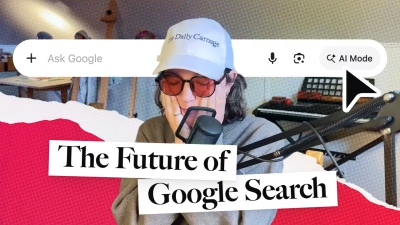
🎥 Want the quick version? Shannon breaks down AI SEO and what marketers need to know in this episode of The Daily Carnage.
1. Answer Questions, Not Keywords
Traditional SEO often encouraged marketers to chase keywords. AI search puts more emphasis on the questions behind those searches.
Instead of building an article around “AI SEO checklist” alone, think about the questions someone is actually asking:
- How do I rank in ChatGPT?
- How do I appear in Google AI Overviews?
- What is Generative Engine Optimization?
If those questions naturally shape your article, the keywords tend to follow.
Google’s own guidance makes a similar point from a different angle: its AI Overviews and AI Mode continue to rely on foundational SEO practices and helpful, reliable, people-first content.
That’s also why some of the best AI content doesn’t feel “SEO optimized.” It feels like it was written by someone who knows the topic inside and out.
2. Become a Source Worth Citing
One of the biggest shifts with AI search is what happens after visibility.
On Google, earning a click is often the goal, but in ChatGPT or Perplexity, your content may influence the answer even if the user never visits your website.
That makes AI citations worth paying attention to.
Original research, first-hand experience, proprietary data, and expert opinions all make your content more valuable than another article summarizing what everyone else has already said.
Recent analysis of Google AI Overviews also shows why traditional rankings aren’t the whole story. Content can be cited based on its relevance to a specific part of a query, including sources that aren’t necessarily the top traditional result.
Ask yourself one simple question:
If someone else were writing about this topic, would they reference my article?
If the answer is no, keep digging.
3. Cover the Topic Completely
Large language models understand relationships between concepts, not just individual keywords.
If you’re writing about AI SEO, readers will naturally expect to learn about semantic SEO, structured data, AI search visibility, Google AI Overviews, and how LLMs discover information.
The goal isn’t to include every related term. It’s to create a resource that helps readers understand the topic without leaving with unanswered questions.
Depth beats repetition every time.
This also gives search engines more context about what your site knows well. A connected group of useful resources can demonstrate topical expertise more effectively than a collection of unrelated articles.
4. Write for Humans First
One interesting thing about AI search is that many of its best practices were already best practices.
- Short paragraphs.
- Clear headings.
- Logical structure.
- Helpful examples.
If a reader can quickly understand your content, AI models usually can too.
Think about the articles you actually finish reading. They’re rarely the longest ones. They’re the ones that make complex ideas feel simple.
That’s the standard worth aiming for.
And don’t limit this thinking to text. Google specifically recommends supporting textual content with high-quality images and videos when they’re useful to the page.
5. Give Search Engines More Context
Great content should be clear for readers first, but the technical foundation behind it helps search engines understand what that content is about.
Using structured data, schema markup, descriptive titles, and clear page hierarchy helps search engines interpret your content more accurately. None of these tactics guarantee AI citations, and Google does not require special AI-specific schema markup for AI Overviews or AI Mode.
It’s also worth paying attention to your internal linking strategy. When related articles connect naturally, they reinforce your expertise on a topic instead of existing as isolated pieces of content.
6. Keep Your Content Alive
AI search favors relevance.
An article published in 2024 isn’t automatically outdated, but one filled with obsolete tools, old screenshots, and stale statistics becomes less useful over time.
The brands winning organic search rarely publish and forget. They revisit, expand, and improve their strongest content as the industry evolves.
Your strongest content deserves ongoing attention. Updating and improving existing articles can be just as valuable as creating new ones.
7. Make Your Expertise Easy to Find
Marketers have talked about E-E-A-T for years, but AI search makes those signals increasingly relevant.
Content backed by expertise, credible sources, and real-world experience is easier to trust—and trust matters when AI systems decide which information to use.
That doesn’t mean every article needs original research. Sometimes, simply adding expert commentary, citing reliable sources, or sharing practical lessons from your own work is enough to make your content more valuable.
The key is making that expertise visible.
8. Don’t Optimize for ChatGPT
Optimizing for one platform is a short-term strategy. ChatGPT, Gemini, Claude, Google, and other AI experiences will continue changing how they retrieve and present information.
Instead, focus on creating the clearest, most useful resource on the topic.
Google’s latest guidance reinforces this point: there are no additional technical requirements or special optimizations required specifically for AI Overviews or AI Mode. Strong SEO fundamentals remain the foundation.
Focusing on useful, trustworthy content gives your brand a stronger foundation as search platforms continue to change.
9. Build Your Brand Beyond Your Website
This is the part of AI SEO that is easiest to overlook.
Your website is only one source of information about your brand.
AI-generated answers can draw from publishers, professional profiles, review platforms, forums, directories, social platforms, video content, and other third-party sources. Recent research on AI visibility has found strong associations between brand mentions on platforms such as YouTube and visibility across AI search experiences.
That makes off-site consistency important.
Make sure your company and product descriptions are consistent across major profiles. Keep business listings accurate. Make sure key people are clearly associated with your brand and areas of expertise. Look for credible third-party coverage, independent reviews, expert appearances, and useful discussions outside your own blog.
The question becomes bigger than “Does my website rank?”
Can AI systems find the same story about my brand wherever they look?
That’s an entity problem as much as an SEO problem.
A Simple AI SEO Checklist
Before you publish your next article, ask yourself:
- Does it answer the reader’s primary question quickly?
- Does it add something original to the conversation?
- Does it cover the topic thoroughly without repeating itself?
- Is it easy to scan and understand?
- Does it demonstrate expertise?
- Is the information current?
- Is the technical foundation solid?
- Are the brand, people, and products described consistently across the web?
- Would another marketer genuinely bookmark or reference it?
If you can answer “yes” to most of those questions, you’re already closer to AI-ready content than many brands chasing the latest SEO trend.
How Carney Turns AEO Research Into Action
AEO research becomes useful when it moves beyond monitoring where a brand appears and starts informing what the brand does next.
At Carney, that means looking at the questions audiences are asking, the sources AI systems surface, the competitors appearing in those answers, and the signals surrounding the brand across search and third-party platforms.
From there, the work can become concrete: strengthen a content gap, clarify an entity relationship, update an outdated resource, build authority around a topic, or create something original that gives AI systems a better source to reference.
AEO research should lead to better marketing decisions—not another dashboard to check.
Final Thoughts
The conversation around AI SEO can make search feel like something entirely new. But many of the fundamentals marketers have relied on for years still matter.
Understand your audience. Publish genuinely useful content. Build authority over time. Keep your information accurate. Make your expertise easy to verify.
What’s changing is how that content gets discovered.
Whether someone finds your brand through Google Search, an AI Overview, ChatGPT, Perplexity, a YouTube video, or a third-party article, the brands that consistently earn attention will be the ones creating resources worth reading—and information worth referencing.