
The Daily Carnage
The savvy marketer's hub for industry news, insights, resources, and culture.
Today’s Issue
Issues
View All
How to Write a Call to Action: Increase Your Conversions with 16 Proven Tips for Creating CTAs
DECEMBER 13, 2020What’s the most compelling CTA you’ve ever seen? Was it in one of Sara McLachlan’s ASPCA commercials? Those will stir up an emotional response to say the least. Or how about Wikipedia’s call for donations? Whatever it is, it probably struck you regardless of whether or not you converted. Take a look at these 16 proven tips for creating CTAs from Databox.
- Attract a user with a clear and concise CTA. Don’t beat around the bush with your Call To Action. The key word is ‘Action’; make sure visitors on your site know exactly what action you wish for them to take. Don’t forget to make clear why following through on the CTA will benefit them.
- Use action verbs in your CTA. Again, ‘Action’ is the winning word. Don’t be vague with your CTA. Do you want them to download something? Subscribe? Donate? Share? Start with a verb so the reader knows exactly what to do.
- Match your CTA and landing page intent. If your visitor clicks your CTA, take them to a page where they can execute on the action. If your CTA offers a discount code, then take them to a page where they can claim or redeem the discount. Don’t make them feel like they’re sitting through a timeshare presentation. Give them what they want.
- Keep a neutral tone in your CTA text. Being pushy with a CTA won’t help you. The visitor knows they don’t have to follow through with your CTA. If you’re pushy, you’ll only push them away. Present the CTA, but don’t force them into it.
- Create curiosity and anticipation in your CTA. Build urgency or scarcity. Visitors may feel they can come back and follow through with your CTA whenever they please. This probably won’t drive the kind of result you want. Let them know your CTA should be addressed now.
Now click the ‘Read More’ button and don’t miss a single tip!
The Evolution of Content Marketing: How It’s Changed and Where It’s Going in the Next Decade
DECEMBER 9, 2020Every couple of years (barring 2020) we get to watch the world’s greatest athletes compete for gold in the Olympic Games. These athletes shatter the records of their predecessors and inspire us all with their incredible feats. Then a few years go by and someone else does the same thing. The world is committed to progress and achievement, and it’s not slowing down. Today, Hubspot is showing us the evolution of content marketing: how it’s changed and where it’s going in the next decade.
How Content Marketing Evolved in the Past Decade
Google’s Zero Moment of Truth study in 2011 found that 88% of shoppers start their buying process with research and discovery. This underlined the importance of SEO as a crucial step for brands to get their messages in front of consumers. Furthermore, the strategy of ‘keyword stuffing’ became old hat as Google shifted its ranking algorithm.
During the same decade, social media rose to prominence like nothing the world had seen before. The ways people interact with search engines vs social media is much different. Search engines offer answers to more pointed questions, but on social media content finds its way to you. The difference is the individual pursuing the content vs the content pursuing the individual. Bite-sized, attention-grabbing pieces of content spread like wildfire on social media and became an effective marketing method.
How Content Marketing Will Evolve in the Next Decade
Video shows no signs of stopping. Video is taking hold with various formats optimized for different viewing experiences. 85% of brands today use video for marketing whereas only 24% did in 2016. Video is a mainstay of the mobile experience, and it’s transforming social media in many ways.
Speaking of mobile, the majority of Google searches take place on mobile devices. Marketers know the importance of optimizing for mobile as well as desktop. As the capabilities of mobile devices change, so will the opportunities for mobile content. For instance, many companies are investing in virtual reality experiences and capabilities that are becoming mainstream.
Keep reading for more of what this next decade holds.
7 B2B Email Marketing Best Practices
DECEMBER 8, 2020Ever see someone wearing a tux at the beach? Outside of a wedding, it would be a pretty strange site amongst the sunbathers in swimsuits. People dress accordingly for different settings and occasions, and people write differently for various formats.
There are best practices for many of the things we do. Today, Sleeknote is teaching us 7 B2B email marketing best practices so you can craft your B2B message accordingly.
- Use a Subject Line Between 28 and 50 Characters. Too short and you won’t reveal anything. Too long and you might get cut off or you simply risk being too wordy. A Campaign Monitor study found the sweet spot to be between 28 and 50 characters. Try sticking to the low end and slowly test the waters of subject lines closer to 50 characters. Find out what works best for you, but use this range as a guide.
- Use Between 50 and 125 Words of Text. Get right to the point and don’t drone on. Readers’ attention spans aren’t committed to sifting through a bunch of text to find the info they need. Be concise and your response rates will thank you. Campaign Monitor found this range to garner a response rate above 50%. Furthermore, break up your text for an easier reading experience.
- Keep A Conversational Tone. At the end of the day, you’re talking to individual people. Dry, matter-of-fact text isn’t going to engage people. Keeping a professional tone is important, but it’s not mutually exclusive so you can still remain conversational and friendly.
- Use 1 to 3 Images. Constant contact found that click-through rates decrease as the number of images increases. 1 image performed better than two, two performed better than three, and so on. Using images is important, but don’t overdo it. Let 3 be your upper limit.
Read on for more tips with examples.
What ‘Arrival’ Taught Us About the Superpowers of Infographics
DECEMBER 7, 2020OK, we cheated. We asked you the same question in the survey we launched on Friday. (In case you missed it, go ahead and participate here).
If there’s one thing we’ve learned, it’s that y’all love infographics. 72.5% of you who participated in our survey showed serious love for infographics. So today we are going to talk about the superpowers of infographics. Beware: spoilers to the 2016 film ‘Arrival’ ahead.
The movie ‘Arrival’ presents a take on how first-contact with an extraterrestrial species might look. These beings are called heptapods, and the protagonist of the film is a linguist working to decode the heptapod language to determine the reason for the heptapods’ visit.
We discover the heptapod language defies the typical conventions we’re so accustomed to. The key to our protagonist’s breakthrough is understanding the heptapods’ written language is a “visual syntax that’s unrelated to the syntax of their spoken language.”
Now let’s bring that concept down to earth.
Infographics marry the way we interact with written language and the way we interact with pictures and images. This visual format taps into a “simultaneous mode of awareness” that transcends the limitations of written and spoken language.
Keep reading and learn about 3 situations where infographics have the superpowers you need to communicate your message clearly.
12 Insider Tips for Creating Viral TikTok Videos
DECEMBER 6, 2020Y’all, let’s dive into some ancient history. The year 2009 to be exact. You know, the same year Obama took office, FarmVille launched, and Kanye stole the show from Taylor Swift at the VMAs. Also that year the oracle, Ke$ha, said, “Tick-tock on the clock, but the party don’t stop, no.”
Fast forward to 2020 where Tik Tok is absolutely on the clock and the party definitely does not stop. The times change and we embrace new trends. Ride the TikTok wave with Jeff Bullas’ 12 insider tips for creating viral TikTok videos.
- Optimize your TikTok profile. People need to know who you are and what you’re all about when they visit your profile. Be concise, but make sure your 80 character allowance is interesting enough to prompt follow-through on your CTA. On that note, make sure you have a CTA. This can be as simple as encouraging visitors to follow you or it can be a Linktree featuring some of your featured products for sale.
- Understand your audience. TikTok has seen insane growth in the last year. You’re bound to have an audience within the user base, but your audience will not consist of all TikTok users. Know who your audience is, and look at the content they produce and interact with.
- Niche down. Pick a niche and stick with it. Trying to cover too much territory on TikTok is a great way to become a master of none. Look at what your competitors are doing and explore the nuances of their viral videos to learn what works and what you can do better.
- Don’t be afraid of being different. Keep in mind TikTok’s surge in popularity is partially because it offers people something different than Facebook, Instagram, and Twitter. People like different and unique content. Simply copying what everyone else does may feel safe, but it won’t accomplish any goals of going viral.
Read on for more tips on creating viral TikTok videos.
8 Effective Ways to Wrap up Your Blog Posts
DECEMBER 2, 2020Nobody likes a bad ending. Too many books, movies, and shows have failed their readers and viewers with conclusions that don’t match the quality of the rest of the work. Heck, even a “To be continued” or a cliffhanger is better than something that falls below expectation. Make the most of your conclusions with these 8 effective ways to wrap up your blog posts from ProBlogger.
- Sum up your message. Recapping everything you’ve written is a simple way to leave a good last impression of a topic. In a long piece, a summary at the end is useful for tying your main point to everything you’ve covered.
- Ask a question. Ask your readers something you’re genuinely interested in hearing about. Encourage them to answer and engage on the topic. We’re not talking about rhetorical questions. Ask something in order to prompt contributions to the topic you’re covering.
- Ask the reader to share your post. You’ve probably seen countless YouTube videos with creators asking viewers to “smash that subscribe button.” The same principle applies: you don’t get what you don’t ask for. Spreading your content amongst those who read and love your content can only help you.
- Give your reader more of the same. People aren’t going to read something they don’t enjoy. There’s just so much out there to choose from, so why bother? If someone is nearing the end of your post, odds are they enjoyed it. Give them more content like the content they just enjoyed. Either suggest another one of your posts or link to similar external content. Your readers will appreciate your recommendation and you can build relationships with other content creators this way.
4 more to go! Keep reading for the rest.
SEO Writing Hacks to Boost Your Social Media
DECEMBER 1, 2020Ventriloquism is an interesting trick. A magician, for instance, performs a trick we can’t understand, but we still know it’s a trick. On the other hand, a ventriloquist’s schtick is understood from the outset; we’re not left questioning how the act worked.
SEO is the magic trick not everyone understands. A brand’s social media is the ventriloquist’s puppet serving the interests of the ventriloquist; it’s right there in front of us and it works. Exercise your brand’s voice with Agorapulse’s SEO writing hacks to boost your social media, and let your social media boost you in return.
- Write great captions. Social media is bite-sized. Like browsing books in a library, it takes a great cover, title, and description to draw someone into your story. Make sure your posts display keywords that translate easily to your site. Featuring a product on Instagram? Don’t forget to add the product name. Take advantage of relevant hashtags and break up text with emojis where applicable.
- Tag & Feature People With a Higher SEO Ranking Than Your Own. Tune into brands and influencers in your niche and tag them in your own posts. For instance, if you own a bike shop, tag a brand whose bikes you sell. In addition to building good rapport with the brand, your message will extend to their followers. Highlight User-Generated Content and host contests where likes, comments, and tags equal entries.
- Make Everything Shoppable. People shop on Instagram. Short and simple. 60% of users discover new products on the platform and 130 million users tap to reveal product tags each month. Make posts shoppable with tags or include links to products within your bio. Don’t miss out on hot leads.
Get more hacks and tips from the full scoop.
Five Steps to Generating & Converting More Leads in 2021 and Beyond
NOVEMBER 29, 2020The fact that we’re living in the digital age has never been more apparent than in 2020. Without the opportunities we have online, this year would be even more difficult than it currently is. Suffice to say, investments in digital infrastructure and capabilities will be crucial in 2021. Invest in your own digital needs with Convince & Convert’s five steps to generating and converting more leads in 2021 and beyond.
- Start Building Sustainable Customer Relationships. Generating new leads is tough. Much of your SEO is dedicated to getting people to your website. So what’s next when you finally get them there? A CRM can save you a lot of trouble by keeping track of various touchpoints and informing remarketing decisions, so your leads don’t go cold.
- Match Your Content to Customers’ Expectations. This is a case of meeting people where they are. Some of your visitors are in the learning phase of the buyer’s journey, and some are ready to buy. Tailor content around the various stages of the journey so you can best represent peoples’ needs.
- Customize Returning Users’ Experience. Getting repeat visitors is important since they are more likely to convert. They’re already familiar with your brand and they come back to your site knowing what they’re looking for. Create banners and CTAs surrounding the campaigns that initially drove them to your site.
- Create and Market More Videos. Videos are becoming more and more effective. The use of video on landing pages can increase conversions by a whopping 86%. You don’t need to be a pro video editor to create a great landing page video; countless programs make it a breeze.
- Create More Engaging Landing Pages. A site needs to captivate its visitors. Set your site up for success with a well-crafted headline, and testimonials displaying real-life benefits others experienced from your products and services. You have about five seconds to hook someone, so dedicate quality time to optimizing landing pages.
Read on for all the details we couldn’t hit.
On-Site SEO: How to Master Internal Linking and Why It Matters
NOVEMBER 24, 2020Everybody loves a good story. But what makes a story so good? It’s the details! When you tell someone about the time you had dinner with the Queen, you don’t just say, “One time I had dinner with the Queen.” Well, you could, but what kind of story is that?
A story’s context, the people involved, the locations, and all the other details are just like internal links. You pull from and reference tidbits here and there to paint a fuller and more interesting picture. To help get your story straight, SendPulse is showing us how to master internal linking and why it matters.
Why does it matter? Internal links help people find what they’re looking for on your site. Whether they are jumping to other relevant articles within your blog or just trying to navigate from your homepage to your “About Us” section, internal links will show them the way.
How to implement an effective internal linking strategy:
- Review your menu and footer links. These make up the core of your site’s navigation. Links in your menu and footer are the “Beam me up, Scotty” of links. These will take people to your most relevant pages no matter how deep within your site they are.
- Create a list of important pages and frequent search terms. Put all the URLs you used in your menu and footer links into a spreadsheet. Head into Google Search Console and select the “Performance” tab before clicking “Search Results.” Go into “Pages”, and you’ll see your 25 most popular pages. Clicking “Queries” will show you what people searched to find these pages. All this will help you understand where your content can be linked together if it isn’t already.
- Review and update your content. Review each piece of content on your site and make a list of relevant content you have elsewhere on your site. Link this content in appropriate places with relevant anchor text.
Read on for more great tips.
Insights
View AllStrategy7 MIN READ

The AI SEO Checklist: How to Stay Visible in the Age of AI Search
Ana Toigo
Marketing5 MIN READ

Top Marketing Tools That Offer Nonprofit Discounts (2026)
Rich O'Donnell
Strategy4 MIN READ

Sharpen Your Core Skills: Listening, Remembering, and Note Taking
Rich O'Donnell
Uncategorized4 MIN READ
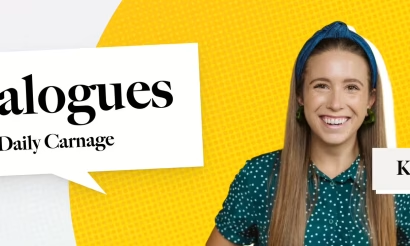
Dialogues: Kimberly Bailey, Head of Marketing at Alpaca
Shannon Sankey
Content2 MIN READ

Know Your Audience: Avian & Saurian Edition
Rich O'Donnell
Content3 MIN READ

Which comes first, the copy or the design?
Rich O'Donnell
Content4 MIN READ

How to Speak Like a Customer—Not Your CEO
Rich O'Donnell
Content4 MIN READ

The New Search Paradigm: How Marketers Can Prepare for SGE
Shannon Sankey
Content2 MIN READ

5 Tips for Marketers Who Hate Writing
Shannon Sankey