
The Daily Carnage
The savvy marketer's hub for industry news, insights, resources, and culture.
Today’s Issue
Issues
View All
13 Ways to Segment Your Email Audience
MARCH 26, 2025Good email segmentation is key to delivering the right message to the right person, at the right time. The gold standard.
Here are 13 creative email segmentation strategies to try:
- Customer engagement: Target active subscribers who engage with your emails regularly, sending them relevant offers while reserving broader campaigns for less engaged subscribers.
- Newcomers: Create welcome emails for new subscribers, sharing brand values and top products to establish trust.
- Past purchase history: Segment based on purchase frequency and offer personalized follow-ups or re-engagement emails to encourage repeat buys.
- Customer reviews: Reward those who leave reviews, offering discounts or incentives for future purchases, or respond to negative reviews to resolve issues.
- Customer Lifetime Value (CLV): Segment customers by their total spend, offering exclusive deals to high-value buyers or personalized perks to frequent shoppers.
- Purchase amounts: Tailor promotions based on past spending, with high spenders receiving VIP rewards and low spenders receiving value-driven offers.
- Acquisition source: Customize welcome emails based on how subscribers joined your list, whether via a website, referral, or in-store.
- Last viewed products: Send follow-up emails based on what users browsed, reminding them of the products they showed interest in.
- Abandoned cart value: Segment abandoned cart emails by cart value, offering discounts for high-value carts to entice purchases.
- Birthdays: We all love these. Send special birthday offers like discounts or gifts with purchase, to build loyalty and encourage sales.
- Loyalty program status: Reward loyalty program members with exclusive perks, early access to sales, or special product launches.
- Location: Tailor offers based on the subscriber’s location, such as sending event invitations or promotions relevant to their region.
- Customer preferences: Leverage quizzes or preference surveys to segment by product interests, ensuring you send relevant content based on what customers want.
Dig deeper over at Klaviyo.
Best Practices for LLM SEO
MARCH 25, 2025There’s a lot of anxiety about LLMs making traditional SEO obsolete. In reality, they represent a shift—an enhanced understanding of user intent and more precise answers.
For marketers, this means adjusting strategies to better align with LLMs’ focus on delivering clear, relevant, and authoritative content.
Keep these things in mind:
1. User intent is king. Unlike traditional search engines, LLMs prioritize understanding the user’s intent, not just matching keywords. Focus on crafting content that answers specific questions or provides value to users, rather than just optimizing for keywords.
2. Indexation and visibility. Ensure your site is easily discoverable by both traditional search crawlers and LLMs. Follow technical SEO best practices to ensure your content is indexed properly, as LLMs pull from a wide array of sources, including social media and industry publications.
3. Links and authority. LLMs evaluate authority differently. While traditional SEO relied on backlinks as votes of authority, LLMs assess content based on real human expertise. Earning coverage in credible publications or participating in relevant forums can help boost visibility.
4. Fresh, relevant content. Content needs to stay current. LLMs prioritize accurate, up-to-date information, so stale content will quickly be deprioritized. Remove duplicates and ensure your content remains fresh to maintain relevance.
5. Content formatting. Tables, bullet points, and clear, concise formatting are more effective for LLMs than long, keyword-heavy paragraphs.
Get the full insight from Eli Schwartz.
The Ultimate Guide to Rebranding
MARCH 24, 2025Biz owners due for a rebrand… tap in.
Your brand isn’t static. As your business evolves, your brand should reflect who you are today—not who you were at launch. If your current brand no longer aligns with your mission or holds you back, it may be time for a rebrand.
Rebranding isn’t just about a new logo or fresh messaging—it’s a full transformation of strategy, voice, and identity. Done right, it can sharpen your positioning, deepen customer loyalty, and drive growth. Done poorly, it risks confusing your audience and diluting your brand equity.
So, how do you get it right? Focus on four essentials:
- Clear strategy. Your rebrand starts with purpose. Define your mission, vision, and long-term goals to guide every decision.
- Distinct brand voice. Your tone and messaging should resonate authentically across all channels, reflecting who you are and why you matter.
- Strong visual identity. Update your logo, colors, typography, and design elements to represent your evolution and appeal to today’s audience.
- Seamless activation. Ensure your rebrand is lived internally and externally. Consistency across your team, website, social media, and customer experience is crucial.
Whether you’re choosing between a brand refresh or a full rebrand, always build on your existing equity and keep your audience at the center.
Take a much deeper dive over at Motto.
Consumers Are Using GenAI to Research Purchases
MARCH 23, 2025Generative AI is quickly becoming a go-to research tool, driving more engaged—but still cautious—buyers.
According to new data from Adobe, traffic to U.S. retail sites from generative AI sources grew by 1,300% during the 2024 holiday season, with a 1,950% spike on Cyber Monday. This surge has continued into 2025, up 1,200% in February vs. July 2024.
Among 5,000 surveyed U.S. consumers:
- 39% used genAI for online shopping in 2024, with 53% planning to in 2025.
- 55% use it for product research.
- 47% seek product recommendations.
- 43% look for deals, 35% for gift ideas, 33% for shopping lists.
And visitors from GenAI tools recorded:
- 8% higher engagement (more time on-site).
- 12% more pages viewed per session.
- 23% lower bounce rate.
However, conversion rates lag—9% less likely to convert than traffic from paid search, email, or social. But, conversion rates are improving steadily since mid-2024, showing growing buyer confidence.
Still, GenAI users are actively researching, which is an opportunity to capture interest, even if conversions don’t happen immediately.
So, focus on well-structured content like guides, recos, and comparisons; use clear CTAs and frictionless paths to purchase, leverage personalization to retarget high-engagers, and watch those conversions improve.
Learn more from MarTech.
3 Proven Ways to Earn Backlinks
MARCH 19, 2025Stop chasing superficial link-building tactics. Instead, invest in creative, data-backed assets and form genuine partnerships.
When you offer something unique, valuable, and link-worthy, backlinks—and brand authority—follow naturally.
Here’s how:
- Publish data-driven industry reports. Become a go-to resource by collecting original, statistically significant data. Offer fresh insights with engaging design, interactive features, and clear narratives. Example: Buffer’s State of Social Report generated 2,800+ backlinks by packaging key findings with strong visual assets and wide collaboration.
- Create emotional, story-driven video content. Develop documentary-style videos that highlight customer stories or industry trends. Let your audience, partners, or customers be the focus. Example: Mailchimp’s Mailchimp Presents series gains media coverage and backlinks with every new release.
- Launch standalone resources and tools. Build microsites, directories, or tools that offer real utility and excitement. Collaborate with well-known brands to expand reach and authority. Example: Mention’s Influencer Marketing Stack gained 847+ backlinks by partnering with top brands and launching strategically.
Dig into the full insight from Grizzle.
Get Started with Video on LinkedIn
MARCH 18, 2025You may have noticed that video content on LinkedIn is rapidly growing, so LinkedIn is sharing some practical tips to get you started:
- Short, engaging videos are key. The ideal length is between 30 seconds and 2 minutes.
- Start strong with a hook. Try asking a question, sharing a personal story, presenting a common problem your audience faces, or using eye-catching visuals.
Some best-in-class examples:
- Harry Lindfors uses an eye-catching illustration, delivers tips in 8 seconds, and ends with a strong visual CTA.
- Valerie Chapman opens with a bold statement, integrates a green screen effect for context, and keeps it under 70 seconds with a clear CTA.
What else is in store for LinkedIn video?
- Full-Screen vertical videos are now viewable on mobile & desktop.
- Videos will appear in search results for increased visibility.
- Nano learning courses from creators like AJ Eckstein and Roshanda Pratt will be dropping monthly.
Head to LinkedIn Guide to Creating for more.
How does Gen Z listen to podcasts?
MARCH 17, 2025 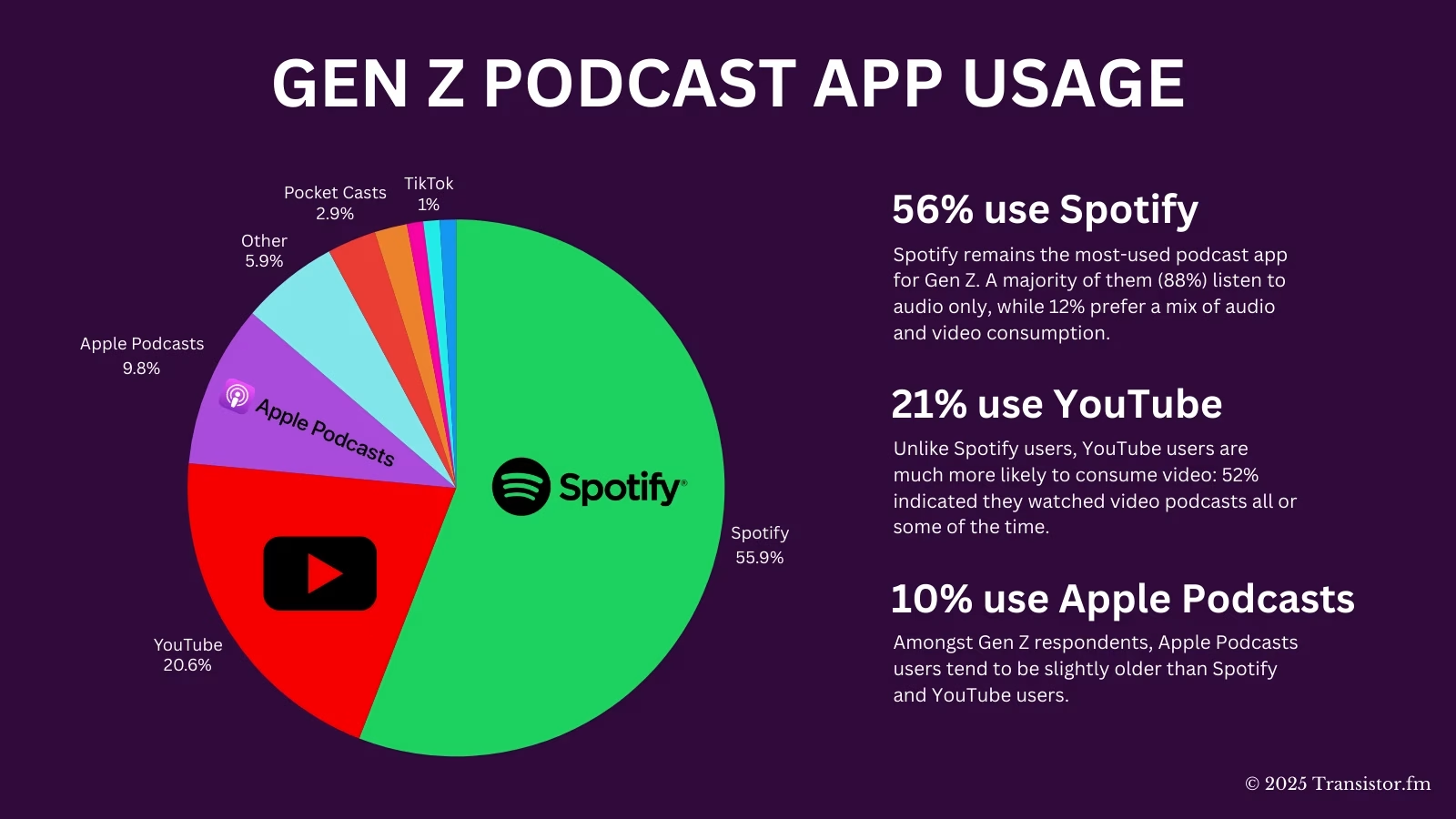
👀 Sponsor this spot to share your content with our community.
While YouTube dominates podcast consumption overall, Transitor’s recent survey of Gen Z reveals some surprising insights about their listening habits.
Takeaways:
- 56% of respondents prefer Spotify, outpacing YouTube (21%) and Apple Podcasts (10%). Spotify’s share has grown since 2021.
- 76% primarily listen to audio podcasts, despite the industry’s growing focus on video content.
- 59% of Gen Z podcast consumption happens at home, mostly on phones or tablets.
- Shows like Welcome to Night Vale and The Magnus Archives rank high among favorites, pointing to a strong appetite for fictional storytelling.
- Joe Rogan is the most frequently mentioned “popular podcaster” by a wide margin.
Check out the full report from Transistor.
Are You Overspending on Paid Advertising?
MARCH 12, 2025If your advertising budget drains too fast, you might be overlooking conversion rate optimization (CRO).
Instead of throwing more money at ads, optimizing your conversion rate can dramatically impact your profitability.
PPC brings traffic, but CRO determines how much of that traffic converts.
Let’s say your business has monthly PPC spend of $50,000:
- You pay $2 per click, bringing in 25,000 visitors.
- Your conversion rate is 2%, so you get 500 sales per month.
- With an average order value of $200, that’s $100,000 in sales.
- After costs, your profit contribution is $20,000.
Now, imagine your conversion rate doubles to 4%:
- You get 1,000 orders instead of 500.
- Sales jump to $200,000.
- Profit contribution skyrockets to $90,000—4.5X more profit!
Or, what if you just wanted to make the same $20,000 profit?
- With a 4% conversion rate, you’d only need to spend $11,111 on ads instead of $50,000—saving 78% on advertising.
Now you can save money OR scale your ads by bidding higher, outpacing competitors, and growing even faster.
See the breakdown over at Conversion Rate Experts.
When to Post: A Q1 2025 Update
MARCH 11, 2025According to new data from Hootsuite, the best overall time to post on social media in 2025 is 8:00 a.m. on Wednesdays.
But as we know, each platform has its own unwritten rules.
- Brands should post early mornings; personal accounts do better in the evening.
- Peak engagement: 3 p.m. – 9 p.m. (Mon), 5 a.m. – 8 a.m. & 3 p.m. – 7 p.m. (Tues), 5 p.m. (Wed).
- Post according to audience time zones.
- Peak engagement: 5 a.m. (Tues), 6 a.m. (Wed-Sat), 8 a.m. (Sun).
- Text posts perform best in the morning; videos in the afternoon.
- Peak engagement: 6 a.m. – 8 AM (Tues), 9 a.m. (Wed), 2 p.m. (Thurs).
X
- Post in the morning for news/trends.
- Peak engagement: 5 a.m. (Mon), 3 a.m. – 5 a.m. (Tues), 4 a.m. – 6 a.m. (Wed).
TikTok
- Posts take time to gain traction; early posting helps.
- Peak engagement: 10 a.m. – 12 p.m. (Mon), 12 p.m. – 4 p.m. (Tues), 4 p.m. – 6 p.m. (Thurs).
- Focus on SEO rather than timing.
- Peak engagement: 12 p.m. (Tues & Fri), 10 a.m. (Wed), 1 p.m. (Sat), 4 p.m. (Sun).
Dig in to the full report from Hootsuite.
Insights
View AllStrategy7 MIN READ

The AI SEO Checklist: How to Stay Visible in the Age of AI Search
Ana Toigo
Marketing5 MIN READ

Top Marketing Tools That Offer Nonprofit Discounts (2026)
Rich O'Donnell
Strategy4 MIN READ

Sharpen Your Core Skills: Listening, Remembering, and Note Taking
Rich O'Donnell
Uncategorized4 MIN READ
Dialogues: Kimberly Bailey, Head of Marketing at Alpaca
Shannon Sankey
Content2 MIN READ
Know Your Audience: Avian & Saurian Edition
Rich O'Donnell
Content3 MIN READ

Which comes first, the copy or the design?
Rich O'Donnell
Content4 MIN READ

How to Speak Like a Customer—Not Your CEO
Rich O'Donnell
Content4 MIN READ

The New Search Paradigm: How Marketers Can Prepare for SGE
Shannon Sankey
Content2 MIN READ

5 Tips for Marketers Who Hate Writing
Shannon Sankey