
The Daily Carnage
The savvy marketer's hub for industry news, insights, resources, and culture.
Today’s Issue
Issues
View All
Audio as Marketing’s Next Frontier
JUNE 27, 2021We’ve touched on sonic branding here and there, but how important is it? It’s everchanging and users are continuing to consume audio in different ways. The Drum and podcasting platform Acast dive into all things audio on a panel discussion called ‘Hear me out: The future of creative is sound.’
Here are the big notes:
Choose Your Fighter: There are a lot of options out there for audio. Sponsoring a podcast or running an advert on a podcast is likely to raise brand awareness, but creating a podcast from scratch is ideal for changing perceptions around a brand given its high audience engagement and long listening times.
Strategize before entering: Sonic and audio branding is undeniably an important part of a modern media plan. But testing and learning are prerequisites. Creators need to have content their audience will value and actually deliver. It’s good to know what works in your other channels before taking on new content mediums.
Digitizing audio: Brands get more from audio, not only because of an uptick in listening habits but because analytics make audio more accountable and monetizable.
New branded format: With audio, advertising can shift instead into branded content spots. Making audio immersive and suggestive can end up being much more effective than an all talk ad. BUT directness has its place, too. It’s all about the content you can creatively bring to the audio table.
For the full scoop, check out The Drum’s panel.
The 10 Marketing KPIs You Should be Tracking
JUNE 23, 2021(If you aren’t already.)
Sales revenue and leads are important data points to track. But where are they coming from? There are several other KPIs you should track to identify which campaigns and tactics have the greatest impact. This is gonna be a bit of a terminology review, but give these KPIs some tracking love:
- Customer acquisition cost (CAC): Customer acquisition cost measures how much money it costs to convert a lead into a customer (including costs like manpower and software).
- Customer lifetime value (LTV): Customer lifetime value indicates the total revenue you can expect from a single customer. If your CAC is higher than your LTV, then you should rethink your spending on getting new customers.
- Marketing ROI: The marketing ROI formula is (sales growth – marketing investment)/marketing investment
- Marketing qualified leads (MQL): An MQL is a potential customer who has shown interest and use for your brand and could become a serious prospect if you nurture the relationship.
- Referral traffic: Referral traffic is a marketing KPI that helps you understand where your website visitors come from. It’s essential to track to understand where to put effort into a given channel.
- Conversion rate: This is the percentage of visitors who complete a desired action, like signing up for your newsletter or making a purchase. Understanding where customers convert or if a conversion rate is low helps you optimize your CTAs and content.
- Return on ad spend (ROAS): ROAS measures the revenue generated by advertising against your investment, usually expressed as a ratio and you can use it to determine the success of your ad campaigns.
These were our top 7 favorite KPIs. Check out MediaTool’s full list of 10 KPIs you should be tracking.
Trends are Your Friends: Video Responses to Social Media Trends
JUNE 22, 2021We’re not saying you gotta hop on every bandwagon. In fact, some trends should be avoided at all costs for some brands. It all depends on what you got and what trend could be relevant to your brand. That being said, if you aren’t paying attention, you could be missing out on amazing opportunities.
Some places you should be tracking trends: Tik Tok Challenges, memes (all social media channels are gonna have these), YouTube, Twitter trending, Quora questions, and Subreddits.
The idea isn’t to directly copy any of these. The idea is that relating to them will in turn be relatable to your audience that is likely consuming the same content and culture. And since visual content is more noticeable, here are some tips if you make video responses based on a trending topic:
- Flash me your brand: Many factors go into creating a successful post and few creators make it past 3 seconds, so at least getting your brand in there is a better chance to them making it to your call to action.
- It’s all about you: The word “you” in the first 5 seconds of a video increases views by 66%. People like knowing it’s all about them!
- Captions should be a given: More and more people watch videos with the sound off for the sake of convenience and privacy. Accessibility is also a huge plus!
- The Remix: Making shorter versions of something can never hurt, especially if you only have so much time to grab someone’s attention.
Trends are useful for insights about what people like. Check out the full Business 2 Community article for more ideas on how to take advantage of them!
5 Q’s Startups Should Ask Before Making Their First Marketing Hire
JUNE 21, 2021Hiring for a startup can be extremely daunting for both the employer and the applicant. You have to know what you need so you can tell your applicants what you need. Otherwise, things are bound to be a mess.
Here are the 5 questions to ask before hiring on your marketing team:
- Which marketing channels have proven successful to date? If you find a promising area, find a candidate that has expertise in it. You want to support what’s working for your brand.
- Where are the target customers? You’re likely going to have to look to competitor data for this one before you know your own. After seeing how/where your customers are, see the channels you would need to hire for most.
- How competitive is the market? Speaking of competition, what edge do you have on the big players in your industry? Hire to cater to that strength (i.e. storytelling).
- Where do the founder’s skills lie? Founders are often the brand builders of startups and have a vision in mind. BUT maybe you need a ground-up branding specialist first. Determine what founders bring to the table and see if their vision needs more support.
- How important is trust-building? Trust-building is often very important to brands in new industries or very revolutionary products. Hiring for this often leans more in the realm of PR experts.
Once you have these five biddies, then you can get into some of the deets like years of experience and a salary to match it. Check out the full TechCrunch article by clicking below.
Hopefully this helps startups and established teams alike. Now, we’ve all seen it: the ridiculously overwhelmed marketing roles for ONE person. There are unicorns out there that can do it all, but those roles are not sustainable. This is when all companies need to consider hiring agencies (wink) or expanding their team.
3 Tips for How Brands Should Address Social Issues
JUNE 20, 2021“Should brands get involved in social issues?” It’s a great question and there is no one size fits all answer. In an AdWeek discussion, brand leaders give some thoughts on it!
The main takeaways from it were:
Lead with listening: If a brand’s beliefs and vision don’t match a particular topic, it may be best to avoid it as opposed to forcing a connection that doesn’t quite feel right. From a leadership standpoint, this is why it’s important to hire with diversity in mind and provide opportunities for multiple perspectives.
Keep up with culture: Everything is changing – the world, marketing, customers, context. It’s not always easy, but keeping up with the shifting culture is essential to your brand authenticity. That means starting with your brand first, and understanding what values it has.
Expect difficult conversations: Messages won’t always come across as planned, initiatives won’t always gain traction as desired. Rolling with the punches and being open to suggestions are key here. There should also be caution to brands jumping in with a “huge bang” on their first attempt at taking on a social issue.
We know to get involved or not depends deeply on the brand. At the end of the day, though, brands are to be authentic and humble when facing real-life issues and values that they and their customers are upholding. To listen to the full AdWeek discussion, smash that button below!
Fighting FOFO (Fear of Finding Out)
JUNE 16, 2021We’ve all had FOMO at some points in our life, or have at least heard of it (fear of missing out). What about the opposite term? FOFO, fear of finding out, is used often in the medical field for those afraid to seek medical treatment and finding out they have a condition. However, FOFO is seen in the marketing realm as well. It typically arises when we don’t want the responsibility or have the right clarity.
Examples of FOFO in marketing:
- FOFO that your marketing model is bloated: Restructuring and streamlining might feel like a struggle at first, but leaders are getting innovative and rebuilding their models.
- FOFO that your money is in the wrong places: Finding leaky pipes and fixing them might mean a huge difference to your bottom line, but it will take the elbow grease to find them.
- FOFO that you’re not planning ahead: No one can predict the true future, but how prepared are you for what’s next? Scary thoughts that keep leaders up at night.
Well alright, we’ve given you an existential crisis. Now what? How to fight FOFO:
- Confront it: Get honest with your financial and auditing minds. Nothing beats transparency and a true understanding of weak spots or hidden strengths.
- Create Confidence: Leaders don’t play the blame game. Let us repeat: NO BLAME GAME. Leaders create confidence and processes for when things go wrong, because they are prepared if things go wrong.
- Think short and long term: “How” and “Why” should be at the forefront of every path.
Check out the full AdWeek article to see how brands have confronted FOFO in their marketing strategies.
Dad Descriptions for Design Blogs
JUNE 15, 2021Creative Boom has a recent list of 50 of the Best Design Blogs. It gives lovely, thoughtful summaries of what these blogs are all about.
Yeah, we’re not gonna do that. In honor of Father’s Day coming up, we’re gonna give blunt, condensed versions of those descriptions (just like any dad would describe anything). Here are some favs from Creative Boom’s list:
- BP&O (brand, packaging, and opinion): print nerds
- Made by Folk: talking to nerds
- Shillington Blog: design school chops
- Creative Review: marketing is ART
- I Love Typography: font nerds
- Design Taxi: put on the news
- Httpster: website eye candy
- Sidebar: website nerds
- Brand New: dad-level puns
- Spotify: …not my playlist?
- Visuelle: just eye candy
Creative Boom, as a design blog themselves, gives a full list of 50 design daddies to check out.
Go get inspired!
Employee branding as a Marketing Strategy
JUNE 14, 2021Good service to customers goes a long way. And who are the peeps delivering your goods? Your employees. They are the people who can make (or break) your brand come alive for your customers. Employee branding is an essential part of your overall reputation strategy.
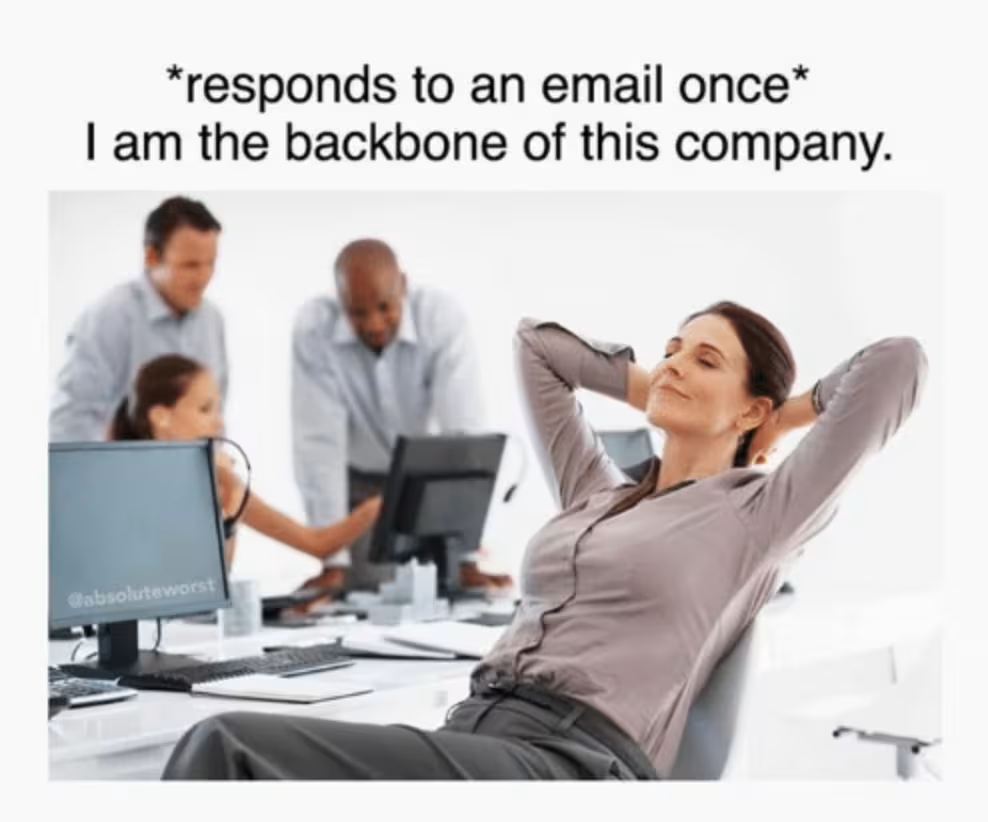
So let’s tap into your people! Much of these tips are for a long-burn strategy that involves strategic talent acquisition, so let’s get into it:
- Building Employee Persona: Collecting data from across employees to create a representative group to know experiences and characteristics to represent the brand’s core values.
- Employee Alignment: When employees believe in the brand, it shows in their work. Engage your employees with the brand, and they’ll want to support it as well.
- Hiring in Tune with Culture: This might seem like an obvious one, but when hiring, you’ll want to ensure that there’s a cultural fit for your brand representation. Your recruiting should reflect your brand as well.
- Create a Brand of Sustainability: Sustainable work-life balance for every employee is now essential to every business or brand worth promoting.
- Role of Technology: The possibilities are limitless for engaging employees and having them engage back thanks to social networking and online portals. We’re in a virtual space more days than not, especially for the workplace.
Remember, every employee touchpoint mirrors consumer marketing touchpoints. There’s always an opportunity to reinforce the brand. Get the full shebang at People Matters’ article.
4 Tips To Help Marketers Battle Against Consumers’ Digital Fatigue
JUNE 13, 2021Between social media detoxes, blue-light eye strain, and constantly being served ads, consumers can get pretty sick of the digital world. We all get digital fatigue nowadays (the world virtual event might even make you groan at this point). But what can we do as marketers to combat this in an audience?
CMS Wire has some tips to shape up your marketing strategy to reach people who are glued to their screens, but don’t want to be.
Make it Personal: The golden rule for most marketing strategies is to personalize it for your user to make it more engaging and customized. There are a lot of ways to do this right, but a great way to start is to break your audience into segments to communicate in specific ways.
Make it Interactive: There are so many new ways to create interactive, interesting content today. AR, VR, 3D worlds, interactive quizzes, are to name a few. It’s easier said than done, but quality over quantity is your best bet here. Creating too many interactive pieces is just going to continue digital fatigue in your users.
Make it Human-Centric: It seems like an obvious one, but brands still forget it. Think of all the ways your users could use more direct engagement in your content and see where you can utilize conversational tactics.
Check out the CMS Wire article for the last tip for staying connected to your users and helping battle their digital fatigue.
Insights
View AllStrategy7 MIN READ

The AI SEO Checklist: How to Stay Visible in the Age of AI Search
Ana Toigo
Marketing5 MIN READ

Top Marketing Tools That Offer Nonprofit Discounts (2026)
Rich O'Donnell
Strategy4 MIN READ

Sharpen Your Core Skills: Listening, Remembering, and Note Taking
Rich O'Donnell
Uncategorized4 MIN READ
Dialogues: Kimberly Bailey, Head of Marketing at Alpaca
Shannon Sankey
Content2 MIN READ
Know Your Audience: Avian & Saurian Edition
Rich O'Donnell
Content3 MIN READ

Which comes first, the copy or the design?
Rich O'Donnell
Content4 MIN READ

How to Speak Like a Customer—Not Your CEO
Rich O'Donnell
Content4 MIN READ

The New Search Paradigm: How Marketers Can Prepare for SGE
Shannon Sankey
Content2 MIN READ

5 Tips for Marketers Who Hate Writing
Shannon Sankey