The Daily Carnage
The savvy marketer's hub for industry news, insights, resources, and culture.
Today’s Issue
Trending
Issues
View All
Psychology-Driven Marketing: 9 Triggers That Work
JULY 28, 2025Marketing is about understanding what makes people say yes.
These 9 psychology concepts can help you do that:
- Halo Effect – One great impression (like a polished website) boosts how prospects perceive your entire brand.
- Loss Aversion – People fear losing more than they desire gaining. Emphasize what they risk by not acting.
- Social Proof – Testimonials, case studies, and client logos reduce buyer hesitation by showing success stories.
- Confirmation Bias – Align your messaging with what prospects already believe, then gently guide them to new insights.
- Scarcity – Limited-time offers or exclusivity drive urgency and prompt action.
- Anchoring Effect – Start with a high reference point to make your actual offer feel like a deal.
- Goal Gradient Effect – Visual cues like progress bars help prospects push through long forms or funnels.
- Mere Exposure Effect – Repeated, consistent visibility makes your brand more familiar and trustworthy.
- Authority Bias – Position yourself as an expert through thought leadership, credentials, and research.
What is Neurobranding?
JULY 28, 2025Neurobranding goes beyond algorithms and surface-level metrics toward a deeper understanding of human memory and emotion.
Neurobranding focuses on how the brain truly remembers brands: through emotional and sensory experiences rather than just messages or logos.
Research shows 95% of buying decisions happen subconsciously, driven by emotions and memory anchors like dopamine and oxytocin.
That means that brands are creating immersive moments that embed themselves in the nervous system, and successful marketers are functioning more like “memory architects.”
Neurobranding insights to consider:
- Memory, not fleeting attention, drives long-term brand success.
- Emotional imprinting is the shortcut to building lasting brand recall.
- Sensory experiences and storytelling create neural coupling with audiences.
- Brands must craft feelings, not just messages or visuals.
Pinterest Men’s Trend Report 2025
JULY 28, 2025In 2025, Pinterest (and Gen Z) is rewriting the narrative around masculinity. We love to see it.
With male users now making up over 1/3 of its global audience, the platform has become kind of a haven for men embracing their creativity.
They’re leaning into wellness and individuality, Pilates, skincare, self-expression through fashion, and even male makeup and nail art.
In response, Pinterest’s new “Pinterest Man” profile caters directly to this audience to help brands connect with male consumers who are open-minded, values-driven, and ready to shop.
Here’s what men are loving on Pinterest:
- 🧘 Wellness: Pilates outfit searches up +300%; hydration tips +50%
- 🪒 Self-Care: Beard styles (+205%), dry skincare routines (+45%)
- 🎨 Expression: Male makeup (+50%), nail art designs (+115%)
- 👖 Style: Older brother core (+95%), jorts outfit (+135%)
- 🤖 Tech: 3D printer designs (+1210%), AI video (+800%)
- 💸 Finance: Investment app (+620%), budget planning (+285%)
- 🕹 Gaming: League of Legends characters (+590%), game design (+160%)
- 🏡 Lifestyle: Chrome aesthetic, smart parenting (+125%), milestone pics (+415%)
Dig in to Pinterest’s full report.
2025 Digital Marketing Statistics (So Far)
JULY 28, 2025Marketers are navigating a storm of economic uncertainty, AI disruption, and changing audience behaviors. But we’re watching, testing, and adapting… fast.
Here are 7 standout stats from H1 2025:
- 📺 $72.4B in digital video ad spend (↑14%)
- 🧠 71% of marketers will invest $10M+ in AI
- 📱 59% plan more influencer partnerships
- 📉 42% of consumers are delaying big purchases
- 🎯 Only 15% of CMOs plan beyond three years
- 🧒 Gen Alpha has $28B in direct spending power
- 🔍 41% of Gen Z uses social as their first search source
Head to Marketing Dive for a closer look at the numbers.
The Marketing Accountability Council (MAC) Stack
JULY 28, 2025The Marketing Accountability Council has published a working version of tthe MAC Stack, a new system designed by and for marketers who are tired of fads, fluff, and frameworks that fall apart in the real world.
Here’s how it breaks down:
🪦 SYMPTOMS: The Graveyard (Steward: Jay Mandel)
Where bad ideas go to die. Think loyalty programs that punish loyalty, bloated martech stacks, and tired tactics that need to be laid to rest.
🎣 CAUSES: The Delusion Series (Steward: Jacob Sanders)
Explores the beliefs behind broken marketing, like “It worked for Nike” or “The algorithm hates us.”
🧠 TESTS: The Heuristics Project (Steward: Moni Oloyede)
Ten tough questions to gut-check your work before launch. Are you solving real problems? Would you trust this message?
⚠️ TREATMENT: The TRUST Framework (in-progress)
A shared ethical operating system:
- Transparency
- Relevance
- Utility
- Storytelling
- Tangible Impact
🧭 The Compass
The conscience of the Stack. It’s the final gut check: Are we being honest with ourselves? Are we dressing up opinions as facts?
The team holds weekly MAC Sessions on Fridays. Head to their Substack to learn more.
How to Find Trending TikTok Sounds
JULY 28, 2025Trending TikTok sounds are like rocket fuel. They catch attention fast, help you ride algorithm waves, and often come with a built-in joke, format, or moment.
The trick, of course, is using them before they’ve hit saturation.
Here are 9 ways to get ’em while they’re hot:
- TikTok Creative Center. Bookmark this trend dashboard to browse top songs by region and category.
- TikTok Search. Search terms like “viral sound” under the Sounds tab to see what’s hot.
- TikTok’s Recommendations. When you upload a video, check out the app’s music suggestions.
- TikTok Playlists. Tap Add Sound > Discover More Sounds to browse curated picks.
- Spotify. Search “TikTok” to find playlists with the latest viral tracks.
- TokChart. A live tracker of the most-used TikTok songs with historical trend data.
- CapCut Templates. Discover viral-ready templates that include trending sounds.
- Instagram Reels. Browse Instagram’s Trending tab. Many sounds tend to overlap with TikTok.
- Buffer’s Updated List. Check Buffer’s curated weekly roundup of trending audio.
Takeaways from Analyzing 4,700 YouTube Ads
JULY 28, 2025Google used AI to analyze 4,700 top-performing YouTube ads, revealing 3 major themes consistent across great video creative:
- Multi-format storytelling works. The most successful campaigns stretch across short-form, long-form, branded content, livestreams, etc. Brands like Volvo and Starbucks created layered, complementary video narratives in various lengths to reach users across viewing preferences.
- Creators drive trust and impact. Creator collabs consistently outperformed traditional spots. Campaigns that let creators lead with their authentic voice built deeper emotional connections. These videos didn’t feel like ads but like content worth watching.
- Culture moves fast, and YouTube keeps up. Brands that tapped into cultural moments (like the Super Bowl or the Met Gala) in real time saw greater engagement. Importantly, the most resonant ads didn’t just reflect trends… they added to them.
Take a closer look at the highlighted campaigns over at Think with Google.
Growth Hack: AI Share Buttons
JULY 28, 2025Growth marketers are using an interesting (and maybe controversial) hack: AI Share Buttons.
Instead of relying solely on Google, AI Share Buttons like “Summarize in ChatGPT” or “Explore in Perplexity” let users input content directly into the memory and citation streams of large language models.
What’s the advantage?
- ✅ Passive citations in AI-generated answers
- ✅ Prompts that guide how your content is summarized
- ✅ Long-tail memory inclusion in user sessions
- ✅ Visibility in zero-click search environments
- ✅ Bypassing traditional SEO competition
You’re feeding the right links into the models your audience is already using. The result is persistent, organic brand awareness inside LLM outputs.
So, where should you put AI share buttons?
- Blog posts & articles
- Newsletters
- Link-in-bio tools
- Product & landing pages
- Documentation & press kits
- X threads & social CTAs
In short: if you trust your content, help AI trust it too.
Why Plain Text Emails Work for SaaS
JULY 28, 2025Plain text emails are making a quiet comeback, especially in SaaS.
Why? Because simple is effective.
Old school emails skip the design bells and whistles in favor of clarity and directness. Plus, they mimic real 1:1 emails, which feels personal, human, and approachable.
SaaS companies are activating this tactic to drive engagement and build trust throughout the user journey.
Here’s why it works:
- ✅ They feel real. Plain text emails prompt higher open and reply rates.
- ✅ They load fast. No images = no lag. This increases the likelihood that your message will actually be read.
- ✅ They boost deliverability. Text-only emails are less likely to get flagged as spam or banished to the promo tab.
- ✅ They’re more accessible. Clean code means screen readers and assistive tech can parse them easily.
- ✅ They save time. No templates to tweak. Just focus on writing a great message.
- ✅ They cut through the noise. When everyone else is shouting with design, a quiet, thoughtful message stands out.
Check out Userlist’s post with 20+ examples.
Insights
View AllStrategy7 MIN READ

The AI SEO Checklist: How to Stay Visible in the Age of AI Search
Ana Toigo
Marketing5 MIN READ

Top Marketing Tools That Offer Nonprofit Discounts (2026)
Rich O'Donnell
Strategy4 MIN READ
Sharpen Your Core Skills: Listening, Remembering, and Note Taking
Rich O'Donnell
Uncategorized4 MIN READ
Dialogues: Kimberly Bailey, Head of Marketing at Alpaca
Shannon Sankey
Content2 MIN READ
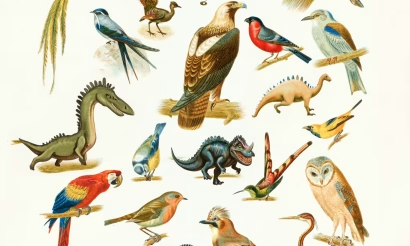
Know Your Audience: Avian & Saurian Edition
Rich O'Donnell
Content3 MIN READ
Which comes first, the copy or the design?
Rich O'Donnell
Content4 MIN READ
How to Speak Like a Customer—Not Your CEO
Rich O'Donnell
Content4 MIN READ

The New Search Paradigm: How Marketers Can Prepare for SGE
Shannon Sankey
Content2 MIN READ
5 Tips for Marketers Who Hate Writing
Shannon Sankey