
The Daily Carnage
The savvy marketer's hub for industry news, insights, resources, and culture.
Today’s Issue
Issues
View All
AI is Changing Email Marketing
JUNE 11, 2025According to the “2025 State of Email” report from Litmus (now part of Validity), 70% of marketers expect AI to handle up to half of their email operations by 2026, while 18% predict AI will manage the majority of their email tasks.
Despite this, marketers still grapple with foundational challenges like mailbox provider updates, privacy regulations, and proving ROI; 22% say they struggle to measure email effectiveness.
Here are the key findings:
- 29% of marketers cite AI-driven content and analytics as the biggest driver of change.
- 30% say content creation is the top skill they’re hiring for.
- Only 6% of teams take over two weeks to produce an email (down from 62% in 2024).
- 97% of marketers use at least one interactive element; CTAs are most effective.
- Top personalization challenges: content creation (17%), data collection (16%), and measuring impact (15%).
- Data privacy remains a growing concern, especially among high-budget teams.
Head to MarTech for a closer look.
How to Write and Edit for Clarity
JUNE 10, 2025Now that AI is cranking out content at lightning speed, clear and compelling writing is a profit-driving power move.
In fact, data from 18 years of conversion tests shows that copy is consistently the biggest lever for increasing performance.
But most AI tools are trained on average writing.
So while everyone has access to content, clarity is what sets you apart. That’s where strong human editing and a deep understanding of how people read become major differentiators.
Here’s how to write and edit so that people understand you:
- ✂️ Cut the fluff. Trim unnecessary words.
- 🧠 Respect the reader’s memory buffer. Keep sentences short and break complex ideas into digestible chunks.
- 🗣️ Speak, then write. Talk through your message, transcribe it, and use that as a base for clear, natural writing.
- 🧪 Run readability tests. Have real people read your copy out loud. Fix any part where they stumble.
- ⚡ Get to the verb quickly. Don’t bury your action. Readers want to know what’s happening fast.
- 🔁 Replace nominalizations. Turn nouns back into strong, active verbs.
- 📏 Follow simple sentence structures. “Someone does something” beats “It is recommended that…” every time.
The bottom line: If you want to win in an AI-saturated content world, you have to make every word count.
Take a closer look at the guide by Conversion Rate Experts.
Re: Trial Reels
JUNE 8, 202580% of Instagram creators who started using Trial Reels saw an increase in reach from non-followers.
Trial Reels, which rolled out six months ago, are shown only to non-followers in order to give you an unbiased assessment of how your content is likely to perform.
You can post up to 20 trial Reels a day, and after 24 hours, you get engagement data like views, likes, comments, and shares. You can also re-post older content as Trial Reels.
That feedback can help you shape future posts or identify which older videos are worth recycling.
📊 Use it to:
- Audience-test new formats or ideas
- Benchmark your content quality
- Build reach with cold audiences, no paid boost needed
- Reach and build a broader audience
Check out this growth hack from Social Media Today.
12 New KPIs for Gen AI Search
JUNE 4, 2025“In this fast-paced digital environment,” “in the new era of generative AI,” yeah, yeah yeah.
But where are the new KPIs?
The old SEO dashboard isn’t cutting it anymore. Click-through rate, average position, and bounce rate were built for a world of ranked listings.
As users shift from clicking blue links to querying smart assistants and chat interfaces, we have to rethink how we define visibility, authority, and performance.
If you’re not measuring these, you’re flying blindfolded:
- Chunk retrieval frequency – How often your content blocks are surfaced in AI prompts.
- Embedding relevance score – How well your content aligns semantically with user queries.
- Attribution rate in AI outputs – How often your brand is cited in AI-generated answers.
- AI citation count – Total mentions across LLMs.
- Vector index presence rate – Percentage of your content indexed into vector databases.
- Retrieval confidence score – AI’s likelihood of selecting your content.
- RRF rank contribution – Your influence in re-ranked LLM results.
- LLM answer coverage – Prompts your content helps resolve.
- AI model crawl success rate – How well AI bots can ingest your site.
- Semantic density score – Depth of meaning per content chunk.
- Zero-click surface presence – Visibility in answer-only platforms.
- Machine-validated authority – AI-derived credibility, not just backlinks.
Head to Search Engine Land to dig deeper.
🔑 The 9 Golden Rules of B2B Ads
JUNE 3, 2025If you’re stuck writing dry, jargon-filled copy, this list is your reset button.
- Features first. Buyers compare specs, not vibes. Make sure your product’s features shine.
- Show use cases, not UI. A screenshot says nothing. Real-world impact says everything.
- Leave room for curiosity. Hint, don’t tell. Draw the viewer in.
- Address the elephant. Tackle objections head-on. Friction makes a great story.
- Visualize numbers. A good chart beats a good paragraph.
- Use analogies. Make the complex simple through something familiar.
- Make it relatable. Talk to the actual pain points. Not your roadmap.
- Keep it real. Be honest about your limits. Credibility > hype.
- Write like a human. No one says “leverage solutions” over lunch. Talk like they talk.
Check out The Creative Marketer for more.
How to Reply to Google Reviews Using an AI Agent
JUNE 2, 2025Managing online reviews is essential, but replying to every Google review is a time drain. Now, AI-powered review agents can handle responses instantly and on-brand, giving your team back hours each week.
Here’s what an AI review reply agent can help you do:
- ✅ Save time: Generate replies in seconds.
- ✅ Maintain a consistent tone: Always sound professional and friendly… or however your brand speaks.
- ✅ Never miss a review: AI instantly detects and responds to new reviews.
- ✅ Boost local SEO: Active, relevant responses improve Google ranking.
- ✅ Strengthen customer relationships: Thoughtful replies build trust and loyalty.
Head to EmbedSocial to learn how to configure your AI agent.
Turn Audience Research Into Content Ideas
JUNE 1, 2025When done right, audience research reveals exactly what your readers want to learn, solve, or understand, making content ideation a whole lot easier and more effective.
Here’s how to use raw audience insights for winning content ideas.
1. Find your content triggers. Look for signals in your research that reveal questions, pain points, or content gaps:
- Questions they’re asking: Customer service chats, social comments, Google’s “People Also Ask”
- Frustrations they express: Reviews, Reddit threads, support tickets
- How they talk: Use their language in your headlines and copy
- What they consume: See what they read, share, and engage with
2. Apply content frameworks. Each insight can turn into multiple pieces using tested formats:
- Problem → Solution: Tackle their biggest headaches
- Misconception → Reality: Bust myths and shift perspective
- How-to: Offer step-by-step guidance
- Comparison: Help them choose between options
- Trends and analysis: Provide clarity on what’s changing (and what to do)
3. Validate before you create. Test content ideas before diving in:
- Social posts for quick feedback
- Keyword tools for demand
- Surveys or community polls for relevance
4. Plan, schedule, repurpose. Once validated, match ideas to the right formats (video, blog, social), build content clusters, and repurpose across channels.
Check out SparkToro for more.
What Jaguar’s Controversial Rebrand Can Teach Us
MAY 28, 2025Jaguar’s 2024 rebrand was radical…ly bad.
We covered the soulless logo and incongruous campaign visuals in the latest episode of The Daily Carnage Show, along with rumors that Jaguar is dumping the agency responsible for it.
The brand’s instincts weren’t entirely wrong. Bold design is essential in the EV era. But in tossing out too much of its DNA, it became a cautionary tale in reinvention.
So, what can other brands learn from this high-profile stumble?
- Evolve, don’t erase. Big changes can alienate loyal customers. Keep one foot in the brand’s legacy… or tread lightly.
- Protect distinctive assets. Logos, symbols, and taglines matter. They serve as memory triggers and carry a lot of equity.
- Keep emotional connections alive. Especially in evolving categories like EVs, consumers still crave identity and emotional resonance.
- Test with your base. Don’t design only for future audiences. Involve current loyalists in the process.
- Clarity is everything. A rebrand should sharpen a brand’s purpose, not blur it.
Head to Creative Boom for more.
Best Practices: Ads in AI Overviews
MAY 27, 2025Google’s AI Overviews surface when a user’s query is complex or exploratory, drawing from a range of web sources to offer quick-hit insights.
Now, ads are part of the equation.
Advertisers can show ads above, below, or within AI Overviews, depending on the relevance of the ad and the commercial intent behind a query.
While we can’t target or opt out of AI Overview placements, Google reports that users find these ads helpful. As this format evolves, new reporting and optimization tools may follow.
Here’s why it matters:
- Ads reach users at the moment they’re synthesizing complex info.
- Ads are matched to both the query and the AI Overview content.
- Ads engage users in high-relevance moments that traditional targeting might miss.
So, how do you get it right?
- Use broad match or keywordless targeting (like Performance Max or Dynamic Search Ads) to align with intent-rich queries.
- Rely on smart bidding to let Google optimize for performance.
- For Shopping ads, keep product feeds fresh—update descriptions, images, pricing, and return info regularly.
Read Google’s guide for more.
Insights
View AllStrategy7 MIN READ

The AI SEO Checklist: How to Stay Visible in the Age of AI Search
Ana Toigo
Marketing5 MIN READ

Top Marketing Tools That Offer Nonprofit Discounts (2026)
Rich O'Donnell
Strategy4 MIN READ

Sharpen Your Core Skills: Listening, Remembering, and Note Taking
Rich O'Donnell
Uncategorized4 MIN READ
Dialogues: Kimberly Bailey, Head of Marketing at Alpaca
Shannon Sankey
Content2 MIN READ
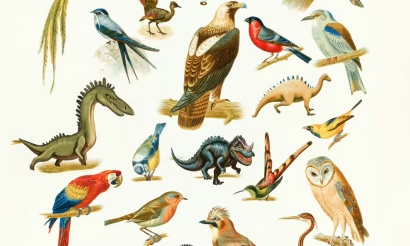
Know Your Audience: Avian & Saurian Edition
Rich O'Donnell
Content3 MIN READ

Which comes first, the copy or the design?
Rich O'Donnell
Content4 MIN READ

How to Speak Like a Customer—Not Your CEO
Rich O'Donnell
Content4 MIN READ

The New Search Paradigm: How Marketers Can Prepare for SGE
Shannon Sankey
Content2 MIN READ

5 Tips for Marketers Who Hate Writing
Shannon Sankey