
The Daily Carnage
The savvy marketer's hub for industry news, insights, resources, and culture.
Today’s Issue
Issues
View All
Level Up on Google Docs
NOVEMBER 21, 2023Old Google Docs, new-to-you tricks. Let’s go:
Look up definitions
Select a word > Tools > Dictionary. That’s Ctrl + Shift + Y on Windows and Cmd + Shift + Y on Mac.
Switch to pageless view
Ditch the printing interface for an infinite canvas with File > Page Setup > Pageless.
Create building blocks
Get started with templates for emails, meeting notes, project roadmaps, and more. Just head to Insert > Building Blocks or click “More” at the top of a new doc.
Compare documents
Track differences between two documents by opening Tools > Compare documents.
Explore your Drive You can drag and drop stuff from the web and your Drive right into your doc from Tools > Explore.
Emoji react
Did you know you can react to comments with emojis? Just hover and select.
Drop in a smart chip
You can add dynamic hover-over information, like a Google Map thumbnail, by selecting Insert > Date, People, File, Calendar Event, or Place. It works for linking between files, too.
Check out the full list by The Verge.
FAQ: Google’s Automatically Created Assets (ACA)
NOVEMBER 20, 2023Back in September, Google rolled out automatically created assets (ACA) as a campaign-level setting that generates custom headlines and descriptions based on the context of your ad, thereby enhancing its relevance and saving you time.
Ginny Marvin, Product Liaison at Google, answered some FAQs about ACA on X. Here’s the scoop, in her words:
How are ACA used?
“RSAs can assemble ad combinations that are predicted to perform best using both the assets you’ve provided and automatically generated assets.”
Where does ACA pull content from?
“Automatically created assets are generated from your own content, including your landing pages, existing ads and keywords. Tip: Be sure your website is up-to-date when using this feature!”
Where can I see automatically-created assets?
“ACA will be labeled as ‘Automatically created’ in the ‘Asset source’ column in ad- and campaign-level asset reporting. You’ll also see when ACAs are included in Combination reports.”
Can I remove ACA?
“Yes, you can review & remove assets you don’t want to serve any more. In addition, any automatically created assets with a ‘low’ performance rating get removed, well, automatically.”
Can I test ACA in Campaign Experiments?
“Yep! Draft and Experiments are compatible with ACA. You will see automatically created assets on both the test and control arm, however the control side will serve 0 ACA impressions.”
Should I just rely on ACA?
“ACA should augment, not replace, your existing assets. Keep the assets you’ve already created and continue to provide as many as you can (up to 15 headlines and 4 descriptions). Note that ACA don’t count toward these asset limits.”
Read the full thread on X.
That One Negative Review
NOVEMBER 19, 2023Just one negative review among many glowing ones has the potential to do some damage. In an analysis of 68,000+ product page visits of a large online retailer, researches found that:
- Consumers are 41.8% less likely to buy a product if the first reviews shown included a negative review, at which point they’re 9.7% more likely to browse for alternatives.
- Each negative review consumers saw made them 26.87% less likely to buy.
- The negative effect became stronger when the product’s average rating was high, the negative review addressed the product’s functionality or the company’s customer service, or when the product was utilitarian in nature.
The takeaway: Make sure a negative review isn’t among the first that consumers see; sort by most relevant, not most recent, for example. Of course, you’ll want to address negative reviews and improve your standard of quality and service, too.
Read the full scope at Ariyh.
5 Shopping Trends for Black Friday/Cyber Monday
NOVEMBER 15, 2023Black Friday / Cyber Monday (BFCM) is almost here. Here’s how to capture shoppers’ attention:
- It’s not too late. Nearly half of consumers start holiday shopping on Black Friday or later.
- Social commerce shoppers love perks. Shoppers ages 18-34 cruise for limited-time offers, and users 35+ look out for free shipping.
- Consumers are more conscious of social responsibility. Promotions that highlight sustainability and other social values have the potential to build customer loyalty.
- Compete in the inbox. Shoppers will be inundated with deals, so your subject and preheaders are more important than ever.
- Customers want in-store and online experiences. A recent survey showed that 45% of shoppers prefer online and 20% prefer in-store, 35% had no preference.
Check out the full scoop at MarTech.
Use the SPEAR Framework to Write Intros
NOVEMBER 14, 2023Intros are tough. You’ve got to get readers to mentally commit to finishing your article, trust your authority, and identify with you and your recommendations. Try this method:
S – Search / User Intent: Include an overview of the features, product categories, product uses, and product tips that various users might be searching for.
P – Pain Points: Positivity doesn’t always sell. Highlight the negative results of not acquiring the product or service you’re writing about—in your intro and your title.
E – Expertise: Take every opportunity to subtly show off your expertise with statistics, experience, and confident value judgments.
A – Audience: Write for each segment of your audience, based on the problem they’re hoping to solve, using the niche language they respond to.
R – Rapport: Before a hard sell, it’s important to build trust with the audience. Once you’ve named their problem and provided personal experience and expertise, they’re more likely to take your recommendations seriously.
Check out the full framework at Increasing.
Top 2024 Marketing Conferences
NOVEMBER 13, 2023Got some room in your 2024 budget for old-fashioned networking and professional development? Here are some large-scale, in-personal marketing conferences to put on the calendar:
- SXSW (Austin, TX; March 8–16)
- ANA Brand Masters (Carlsbad, CA; April 15–17)
- Possible (Miami, FL; April 15–17)
- Programmatic I/O Las Vegas (Las Vegas, NV; May 20–22)
- Cannes Lions (Cannes, FR; June 17–21)
- CultureCon (Madison, WI; August 28–29)
- DMEXCO (Cologne, Germany; September 18–19)
- Programmatic I/O New York (NYC, NY; September 24–25)
- IAB NewFronts (TBD, TBD)
- Advertising Week (NYC, NY; TBD)
See you at the hotel bar!
New Google Requirements for Bulk Email Senders
NOVEMBER 12, 2023Starting in 2024, Google has new requirements for bulk senders (those who send 5k or more emails to Google accounts per day) to improve deliverability, sender reputation, and engagement. Check it out:
- Set up DMARC authentication for your sending domain in your DNS provider.
- Align your “From:” header with your sending domain.
- Include a one-step unsubscribe method in your marketing emails.
- Include an unsubscribe link in the message body.
Get into the weeds at Klayvio.
Increase Signup Confirmations with “Sniper Links”
NOVEMBER 8, 2023According to Litmus and Mailchimp, 27 to 61% of new users won’t confirm their email after sign up, due to:
- Friction in the onboarding process.
- Pesky spam folders.
- Distraction from their inboxes.
So, how can you get users to focus and confirm on the spot? Enter: Sniper Links.
- Add a personalized shortcut to your “confirm email” page based on the email address they’ve just entered (i.e. “Open Gmail”).
- Tweak that shortcut URL to include parameters that simulate a search query, resulting in an inbox that displays only your confirmation email, even if it landed in the spam folder. No distractions.
Check out the interactive case study by Growth.Design to see the magic.
How to Optimize Your PSI Score
NOVEMBER 7, 2023In a recent Reddit thread, Google’s John Mueller offered some tips to optimize your score on Google’s PageSpeed Insights (PSI) tool, for good SEO:
- Temporarily place individual page elements—like images, scripts, or code—on a non-indexed page to isolate and test their effect on page speed. Then, optimize and make changes to your live page.
- If your optimized live page doesn’t show improvement, other factors that you didn’t isolate are limiting your score. In this case, make a copy of the live page, remove the elements you optimized in step 1, and test.
- If page speed is reasonable already, you may not need to do extensive work. Ultimately, changes should be incremental and strategic.
Check out Search Engine Journal’s write-up for more.
Insights
View AllStrategy7 MIN READ

The AI SEO Checklist: How to Stay Visible in the Age of AI Search
Ana Toigo
Marketing5 MIN READ

Top Marketing Tools That Offer Nonprofit Discounts (2026)
Rich O'Donnell
Strategy4 MIN READ

Sharpen Your Core Skills: Listening, Remembering, and Note Taking
Rich O'Donnell
Uncategorized4 MIN READ
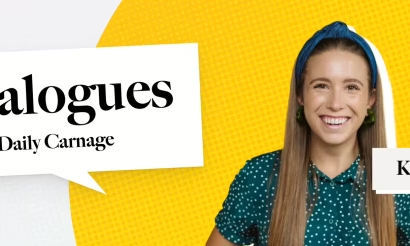
Dialogues: Kimberly Bailey, Head of Marketing at Alpaca
Shannon Sankey
Content2 MIN READ

Know Your Audience: Avian & Saurian Edition
Rich O'Donnell
Content3 MIN READ

Which comes first, the copy or the design?
Rich O'Donnell
Content4 MIN READ

How to Speak Like a Customer—Not Your CEO
Rich O'Donnell
Content4 MIN READ

The New Search Paradigm: How Marketers Can Prepare for SGE
Shannon Sankey
Content2 MIN READ

5 Tips for Marketers Who Hate Writing
Shannon Sankey