
The Daily Carnage
The savvy marketer's hub for industry news, insights, resources, and culture.
Today’s Issue
Issues
View All
6 Elements of a Powerful SEO Product Description
OCTOBER 21, 2020If you’re a fan of the Pyramid Game Show, you know the winners are typically the ones who understand and describe the word or phrase in a way that resonates with their teammate.
Having thorough and detailed descriptions does a lot for your products too. Today, SEMrush brings us 6 elements of a powerful SEO product description.
- Reflect Your Brand Voice. Find a balance describing what the product is while still incorporating a consistent brand voice. Whether it’s to the point, or you throw in some witty humor, utilize your voice in product descriptions.
- Cater to Buyer Personas. Casting too wide a net dilutes your message and makes reaching your target more challenging. Keep your buyer personas in mind when you write your product descriptions. Think about who exactly will benefit from the product. After all, these buyer personas are who the products are for.
- Provide Value to the Customer. Focus on the “why” rather than on the “what.” Your products undoubtedly have some cool features. But features don’t illustrate value. Talk about the benefits of each feature and paint a picture of how others have benefitted from having the products.
- Employ Meaningful, Technically Proficient Writing. Don’t beat around the bush. Steer away from fluff words and phrases like “very”, “really”, and “great value.” Additionally, make sure your descriptions aren’t too promotional. Much of this goes back to illustrating value in the description, so make value your mission.
- Know SEO Basics. Keyword research is an important piece of the SEO puzzle, and it’s no different here. Find keywords with high frequency and low competition regarding your products. Maintain active voice in your writing and try keeping sentences under 20 words.
The last element talks about including a Call To Action, so read away.
11 Email Personalization Tactics for Max Impact
OCTOBER 20, 2020Hey, Mary! Thanks for stopping by. This newsletter is just for you…
Your name is most likely not Mary unless you’re the .2% on our list with that wonderful name. But if you are one of these Marys, then we’re off to an excellent start with our email personalization. For now, we’ll thank all the Marys out there for being loyal subscribers and we’ll discover 11 email personalization tactics for max impact courtesy of Visiture.
First off, personalization is extremely powerful, and the vast majority of marketers and shoppers agree it’s important. Did you know segmented campaigns have resulted in revenue increases of 760%? And personalization drives sales increases to the tune of 20%. It’s a big deal.
- Create Personalized Subject Lines. Hearing your name and even thinking you heard your name grabs your attention. Seeing your name as you skim the subject lines in your inbox does the same. Whether it results in a click or not, it focuses your attention even for a fleeting moment. Putting names in subject lines leads to more opens. It’s that simple.
- Demographic Segmentation. Your audience is all over the place. Geographically, professionally, socially, financially, and more. Segmenting groups based on differences will help you target them more effectively. Your message for a sophomore biology major vs a partner in a law firm will benefit from some nuance – and segmentation can help you deliver.
- Exploit Browsing Histories. Marketers love cookies. When someone spends time reading about a product on one of your pages, you gain valuable information you can use by sending an email about that product to the person browsing. Further incentivize conversions by sending the email with a special offer included.
- Leverage Purchase Histories. When you know exactly what a customer will buy, then you can target them with similar offerings. Don’t ignore purchase history. Upselling and cross-selling are made easier with this information.
Read on for 8 more great tips.
The 10 Most Common SEO Mistakes to Avoid
OCTOBER 20, 2020People can be pretty good at avoiding things they want nothing to do with. Maybe it’s a pile of unfolded laundry (hey – at least it’s clean) or calls from unknown numbers (or known numbers). Heck, we’re even washing our hands more often to avoid getting tested for COVID.
Sure, there are things marketers specifically avoid too. But we’re always learning and improving, so SearchEngineJournal is offering its guidance on avoiding the 10 most common SEO mistakes.
Mistake 1: Not Knowing Your Audience. Who you think your audience is and who your audience actually is doesn’t always match up for marketers.
- Understanding your audience is a continuous process. For instance, creating content will require knowledge of what your audience is currently interested in and what they are searching for. Meet them where they are by diving into real-time and historical data so your content may keep up with them.
Mistake 2: Not Having an SEO Plan & Roadmap. “A goal without a plan is just a wish.” Having an outline of steps will help set your own plan in motion.
- Consider where your site is now and where you want it to be. Determine specific actions and even stakeholders needed at certain parts of your process. The better you plan, the fewer roadblocks you’ll have.
Mistake 3: Creating the Wrong Type of Content. Great content will answer questions your audience has.
- There’s a whole lot out there you can answer, but don’t do it all at once. Take things one at a time and provide valuable and thoughtful pieces tailored to what your audience is asking. The wrong type of content will jam in too many topics or focus just on littering a post with tons and tons of keywords.
Mistake 4 is about publishing non-original content, so learn more and find all 10 common mistakes from SearchEngineJournal.
Voice of the Customer Methodology: All You Need to Know
OCTOBER 18, 2020If you’ve ever traveled to a foreign country or spoke to someone who doesn’t speak your language, you get a pretty humbling lesson on the power of communication.
Every facet of our lives boils down to communication. Whether it’s working with teams, maintaining relationships, or even the functions our brains carry out to the rest of the body. But when it comes to your business, an open line of communication and feedback can greatly improve your offering.
Today, G2 shares all you need to know about Voice of the Customer Methodology. This methodology revolves around three things:
- Collection. Getting feedback is step one. One way or another (or multiple ways) you’ll need direct feedback from customers.
- Evaluation. After you’ve collected feedback, organize it, and look for common themes. Is there a common denominator in the feedback you have?
- Implementation. It’s time you put a plan into place and directly address the feedback you collected.
All this will improve your business for current customers and make your business more attractive to others because of the refined customer experience. Deciding on how you’ll get feedback from customers is the crucial first step. Some common methods are:
- Surveys. Ask the right questions and get the answers you’ll need. Keep questions concise and easy to understand and structure them around simple yes/no responses.
- Customer interviews. If a customer will give you the time of day, then this is an opportunity for face-to-face or over-the-phone dialogue. You can do this with one customer at a time or facilitate a group discussion similar to a focus group.
- Social Listening. Much of this is already done for you since you won’t be providing direct prompts. Collect what users say about your brand and keep tabs on when discussions arise.
We couldn’t hit them all, so check out the full article.
Twitter Best Practices for New and Experienced Social Media Managers
OCTOBER 14, 2020Twitter has its limitations in place regarding character counts (though they have increased to 280). However, the limitations on how you can grow your brand on the platform are few. The platform has evolved from what seemed like a status-update medium in its early days to a hotbed for debate, breaking news, and witty & insightful commentary.
Twitter is invaluable as a marketing tool, and Agorapulse is going over Twitter best practices for new and experienced social media users.
Create Original Content. Twitter’s bite-sized posts are easily digestible. Use it to your advantage with original content in the form of text, images, or video. This can include:
- Product launches
- Company updates
- Blog post links
- Think pieces
Curate Relevant Content. Rather than posting only original content, draw from the other players in your industry and retweet great content they’ve posted. This helps spark discussions especially if you write something on your retweet (quote tweet.) Draw from people your audience connects with, industry influencers, and partners you work with.
Be concise. You don’t have much choice in this considering the inherent character limitations. Even then, using up the full 280 characters isn’t necessary. In fact, 71 – 100 characters is the real sweet spot for tweets. People expect concise content on twitter, so deliver on it.
Develop Twitter Lists. Your feed can be overwhelming. Create a list with only the most crucial accounts you must keep up with. This cuts down clutter and directs you to exactly what you’re looking for.
Automate engagement. Being active on twitter is best in real-time. With how fast everything moves, automated responses help you quickly respond to followers. Prepare responses to certain comments and inquiries and send them when applicable with the click of a button.
Your audience has never been closer, so go out and put these tips to use!
How to Draft a Project Charter (With Example)
OCTOBER 13, 2020“We the marketers, in order to form more perfect content…”
An entire convention of people isn’t necessary for drafting your own project charter. And you certainly don’t need a catchy tune for generations to sing on Schoolhouse Rock (though that would be pretty dang awesome.)
In a nutshell, a project charter helps set a plan in motion by clarifying the project objective, setting a rough timeline, specifying roles and responsibilities within the project team, describing requirements, and serving as a contract.
Today, ClickUp is walking us through how to draft a project charter. Now on to creating one:
- Project background details. This is just a brief section displaying the project name, the date, and perhaps the project owner. This is all more or less to keep organized.
- Details about the project purpose. What is the reason you’re starting this project? Focus on your goals and what is driving you toward those goals. Why is the project important? What will it achieve?
- Project risks, assumptions, constraints, and dependencies. For risks, define what could impact your project for the worse. For assumptions, identify things you expect will remain constant. Constraints will be whatever you might be working against (tight budgets, arduous approval processes, etc.) Dependencies will be things your project hinges on in achieving its own success.
- Deliverables. Determine what you will and will not be delivering with this project. You’ll probably know the former by this point, but just defining what you will deliver isn’t enough; it leaves too much wiggle room. Define things you won’t deliver as they fall outside the project scope. This will be a saving grace from scope creep, which can unfortunately prolong your timeline and stretch your budget thinner.
It’s all about putting pen to paper and then taking action. Visit ClickUp for the rest of their tips.
24 Underrated Google Analytics Features You Should Use More Often
OCTOBER 13, 2020Well, folks, Christmas decorations are beginning to replace the scarecrows and jack-o’-lanterns at department stores, which means Halloween is right around the corner.
Stores push through themed inventory as if they have fortune-tellers whispering when consumers are most ready to buy. You and I know that’s not the case. It’s all in the data of course.
When there’s talk of data, Google Analytics can’t be far behind. After all, GA is our crystal ball revealing insights beyond our wildest marketing dreams. Databox is sharing 24 underrated Google Analytics features you should use more often.
- Event Tracking opens up new doors for insights. Going beyond your typical measures of click-through rates and bounce rates, Events let you go even deeper. You can see just how far down a page a user scrolled, see which buttons were pressed, and know when PDFs are downloaded. Event Tracking is a great gauge of user experience and portrays how users interact with your site.
- The Insights Search Bar is like performing a Google Search right within GA. With the seemingly endless data points you can drill down on, getting lost can be easy – especially if you’re newer to GA. Type in something like “why did website visitors decrease” and Google Analytics will give you its two cents.
- Blocking your company’s IP Address saves your data from getting skewed by you and your team. If you haven’t done this already, it’s very quick and will allow for better reporting. You may have an enormous marketing team with multiple people visiting your site or searching your keywords. Or it might just be you. Either way, don’t let your own activity work against you when poring over your analytics.
You’re probably using a few of these 24 features already, but read on and see which ones can make a big difference in your day-to-day!
How to Create Beautiful Instagram Highlight Covers (40 Free Icons)
OCTOBER 11, 2020When you think about the highlights of your life, what does the cover art look like? For example, a cover describing the adventures starring you and your pup may resemble a muddy paw or floofy ears.
Sharing these souvenir moments on social is fun, but for business, it’s pretty effective for building relationships between a brand and its followers too. Instagram Story Highlights offer a way for followers to rewatch top-notch video content. And like everything else, we have to intrigue folks enough to watch more. Enter IG Highlight Covers!
With Hootsuite’s help, let’s find out how to create beautiful and effective covers (aka the circles sitting underneath a bio on your IG profile.)
Covers typically contain images or icons with very brief descriptions that categorize them. If you’re just getting started on creating covers, check out Hootsuite’s 40 free icons and add your preferred backgrounds in Photoshop or Canva. Then add an image by selecting a highlight, tapping More at the bottom right corner, choosing Edit Highlight, selecting Edit Cover, then you have your image.
Some great tips for your covers and icons are:
- Show off your brand’s aesthetic. Stay within your brand and stick to your usual fonts and colors. Remember you’re working in a small space, so don’t go overboard on text!
- Don’t be afraid to experiment. Whether you’re showcasing products or people, make it fun or go for something more descriptive. Whatever better conveys your message and branding.
- Highlight the Stories that matter most. Not everything in your Stories belongs in Highlights. Think about what your audience really wants to see and keep this content in Highlights.
- Be consistent when organizing Highlights. Some organize it like a website menu (Home, About, Products, etc) while others, go with seasonal collections (New Arrivals, Fall Fashion, etc). Remember, keep audience perspective in mind. It’s not just about what looks nice.
Continue reading for an in-depth look at creating highlights and their covers.
4 Simple Ways to Increase the Value of Your Customers
OCTOBER 7, 2020A bird in the hand is worth two in the bush. Well, unless the bird is ill-behaved… The point is, the same goes for customer acquisition.
Reselling to existing customers statistically costs much less than acquiring new customers. This doesn’t mean you should put up a “NO NEW CUSTOMERS” banner on your store or website. It just means you can strategically tap into the customer network you’ve already built and yield great results.
DigitalMarketer knows all about this and is sharing 4 simple ways to increase the value of your customers.
Bundle, bundle, bundle. People love deals. You probably have a range of products and services and some folks just buy one here and another there. While it’s nice seeing those conversions, there’s an opportunity for even bigger conversions.
- Bundle up some of your offerings with a discount and people will buy a group of items they know they want and they’ll get their hands on things they didn’t even know they needed.
Cart Abandonment Email. You know when you walk into a room looking for something and the second you step in you have no idea what you’re doing there? It’s okay – it happens to all of us.
- What if something could remind you what you were doing there? This is the beauty of the cart abandonment email. People get sidetracked all the time, and a gentle nudge can get them back on track.
Prime with Content. Your customer relationships go two ways. Be sure you give them content other than just sales and promos.
- Give the people free content with real value and with the purpose of solving the problems they face. The more they trust you, the more they’ll buy from you in the future.
Number 4 talks about following up, so don’t miss it, friend!
Insights
View AllStrategy7 MIN READ

The AI SEO Checklist: How to Stay Visible in the Age of AI Search
Ana Toigo
Marketing5 MIN READ

Top Marketing Tools That Offer Nonprofit Discounts (2026)
Rich O'Donnell
Strategy4 MIN READ

Sharpen Your Core Skills: Listening, Remembering, and Note Taking
Rich O'Donnell
Uncategorized4 MIN READ
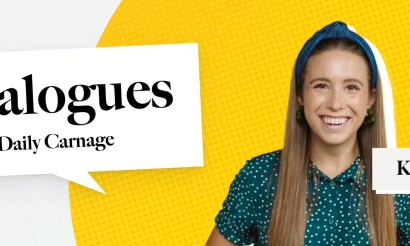
Dialogues: Kimberly Bailey, Head of Marketing at Alpaca
Shannon Sankey
Content2 MIN READ

Know Your Audience: Avian & Saurian Edition
Rich O'Donnell
Content3 MIN READ

Which comes first, the copy or the design?
Rich O'Donnell
Content4 MIN READ

How to Speak Like a Customer—Not Your CEO
Rich O'Donnell
Content4 MIN READ

The New Search Paradigm: How Marketers Can Prepare for SGE
Shannon Sankey
Content2 MIN READ

5 Tips for Marketers Who Hate Writing
Shannon Sankey