
The Daily Carnage
The savvy marketer's hub for industry news, insights, resources, and culture.
Today’s Issue
Issues
View All
How to set up social media automation to save serious time
MAY 5, 2020As much as we love social media, even we have to admit – it’s tedious. Luckily, SproutSocial is guiding us with actionable steps to streamline our social presence.
1. Schedule social posts. You’re probably already doing this. After all, it eliminates pressure, saves time, and helps visualize your content. Many social media platforms already offer the ability to schedule posts in advance. But there are also 3rd-party services like SproutSocial, Later, or Agorapulse.
2. Use chatbots to be available for your customers. Chatbots should be used to add convenience to a user’s experience. Here’s a solid example, not only does SEPHORA’s Facebook bot answer basic Qs, but it’s also capable of routing customers directly to an agent.
Tools: Chatfuel, Mobile Monkey, ChatterOn
3. Save and repurpose replies. Countless customer inquiries come in through social whether it’s pricing concerns, deliverability, complaints, etc. Keeping a record of communication can speed up response time in the long run.
We’re not saying track every single interaction. But when there’s a pattern, record your response that way you have a template built for the future.
4. Automate reports to share with colleagues or clients. Just about all social platforms have analytics to help you make decisions about your content. But tailoring those metrics into useful, easy-to-read data can be a manual job if you don’t have the help of a 3rd-party tool.
Tools: Whatagraph, Google Analytics, or Databox
5. Curate valuable content. Yes, social media is social. While you’re trying to automate the process, don’t forget to maintain human connection. A good rule of thumb is keeping the tone conversational, or laid back. And throw in emojis when it makes sense.
Remember, you’re looking for automation to supplement your branding not replace it. This is the way…
How to Skyrocket Your Search Traffic without Spending a Cent
MAY 4, 2020We have a treat for you today, fam! We’re listening in to Neil Patel and Eric Sui’s Marketing School podcast and learning the most effective tips for boosting search traffic.
Get the timestamp notes below!
[01:25] There’s a surge of online activity for obvious reasons. Now is the time to review your content. Neil suggests specifically looking at winning content within the last seven days. Update that content by adjusting the title tags and making the context more relevant.
[02:15] Eric recommends a strategy call news-jacking. News changes constantly. We aren’t just talking about COVID. But for a marketer – statistics, updates, and tactics change so frequently that it becomes an opportunity to capitalize.
When something new drops in your industry take advantage of it by being the business with the answers. Consider all of the questions that may come from that news piece and create content around it.
[03:10] Similarly, keep an eye on trends. Use Buzzsumo or Google Trends to stay on top of what being talked about most in your industry. Then write about it!
Doing this, you’ll create hyper-relevant content that adds value to the reader because you know you’re answering their questions. Not only will you gain search traffic, but also, traffic coming in from Google Discover.
[03:45] Then there’s this concept from Brian Dean called Power Pages. It’s essentially pulling related content together to make a master content piece. Power Pages help you get more long-tail traffic and consolidates attention to one page.
[04:50] One key insight the Neil offers is not getting overly involved with custom design for your content. It may look cool but updating that content down the line can become very hard.
3 Steps to Brand Development that’s Out of this World
MAY 4, 2020We’re taking notes from Digital Marketing Institute and applying lessons learned from Star Wars to heighten our brand development strategies.
1. The Value (aka the Force) of Stories. Your brand’s story is what resonates with fans. The premise of good v. evil, power struggles, the necessity of love/friendship, and the 12 steps of a Hero’s Journey are just some of Star Wars story themes.
So how does one incorporate the power of the Star Wars story into your brand?
-
- Find your underlying message. Focus on deep-seated messages that spur action like Star Wars’ Episode IV’s message of coming together against adversity. Display that message across blogs, your site’s About pages, video ads, or social media posts.
- Your audience should be the hero of your brand’s story. Take note of the 12 steps of the hero’s journey. Think of yourself as the mentor (or Jedi), leading your hero to the point of transformation.
2. Leverage cultural references to keep your brand refreshing and relatable to your audience. When the original series was released in the 70s, people were facing an economic and societal slump. The Star Wars movies focused on a relatable hero and his journey beside hope. DMI recommends,
-
- Observe your world. What does your audience need at this moment in history?
- Bring that knowledge to your service or product. How can you creatively incorporate this need or desire through your services/products?
3. Customers make decisions based on emotion. What emotions you’re aiming to generate? Emotional consistency creates a unique connection between your business and your audience. Do this by..
-
- Deliver emotion-based storytelling through video, email sequences, or website content.
- Focusing on social to build up an online community and leading customers to action.
Digital Marketing Institute has much more to cover with great examples!
A Simple (But Effective) 31-Point SEO Checklist
APRIL 30, 2020Ahrefs is walking us through these SEO tactics like it’s an easy bake recipe. And there are a TON of ingredients to cover, so we’re not wasting any time. Let’s go!
Best practices to get you started.
- Install an SEO plugin like Yoast to make the daunting technical stuff less daunting.
- Help search engines find the important content on your site by creating a sitemap.
- Add a robots.txt file to your site that instructs search engines where they can and can’t go.
- Set up Google Search Console and link it with Google Analytics. GSC tracks your performance in search and shows your ranking keywords.
The most crucial piece: keyword research
- Take advantage of Google Keyword Planner or Ahrefs’ Keywords Explorer to target one primary keyword for each page or post on your site.
- Find long-tail keyword variations by using Google autocomplete.
- Understand the search intent behind the keyword you’re targeting.
- Take a peek at the “People also ask” box or the “Searches related to” section for a deeper understanding into the Qs people are actually asking.
- Analyze SERPs for indicators of a difficult keyword. Don’t waste your time pursuing an unachievable keyword.
Optimize on-page content
- Keep URLs short while still providing insight so that expectations are always clear.
- Should you include your keyword in the title tag and description? Sure. But, don’t force it. Instead, craft an enticing title and description that will increase CTR.
- Ahrefs recommends using one H1, and include your keyword in it for the benefits of scannability and link framing.
- Link out to high-quality, relevant web pages and make an effort to use internal links.
Well, we only got about halfway. Click through to get a pro-level checklist on content, technical SEO, and link building.
Content Curation on Social Demands More Than a Shared Link
APRIL 29, 2020Social media is the game we’re tackling today, folks. And with help from Content Marketing Institute, we’re learning how to use content curation right to drive better results.
Give context to your curation. It’s all about delivering relevant content that works for your audience and your business. 1) Identify why your audience connects with your brand, and 2) determine why your business uses social media.
Let’s dive into effective examples CMI offers:
- Let’s start with a curated LinkedIn post that presents findings from a survey. The author writes a unique intro, poses questions to their community, concluded with their observations, and used a CTA that encouraged feedback.
- Takeaway: take an excerpt and engage
- This next example post is about giving credit where credit is due. The author is clear about where the info came from and links to the original source in the comments. Doing this builds trust and credibility.
- Takeaway: attribute properly
- If you have a different perspective, share it. This author tastefully tweeted their alternative viewpoints after reading an article that favored Quora. They sourced the article, gave their opinion, and asked for feedback from their followers.
- Takeaway: it’s okay to disagree
Where do you go to find content that’s worth talking about?
- Take a look at Twitter’s trends feature to see what’s popular in real-time.
- Along those lines, SparkToro Trending ranks the most-shared articles on Twitter, shows who is tweeting about it, and points to other content being shared by those accounts.
- Use Feedly to keep up with the content published by the most helpful websites for you.
- CMI recommends Zest to keep up with the latest marketing industry changes.
- Try out the BuzzSumo Chrome extension to judge content based on its number of shares. Hint: Of the most-shared stories, consider which ones will work for your curation.
Smash the button!
How to Write Customer Success Stories That Sell
APRIL 27, 2020Wouldn’t it be nice if customers knew the greatness of our respective companies and bought without much question?
Thank goodness that’s not the case. A world without marketing is a boring one. We’re leaning on CoSchedule today to supercharge our conversion and sales efforts with customer success stories (CSS).
CSS is a stand-alone content piece that clearly shows the benefits of working with a company from the perspective of its customers.
How to find the right customers to feature in CSS? Start by evaluating your current CRM data to find traits of happy customers:
-
- Long-time buyer
- Spend more money than most
- Buy frequently
- Refer others to you
How should you reach out to happy customers? When you start outreach, focus on making your message specific and relevant to the customer. CoScedule actually has an email template already drafted for you to use!
What to ask your customers after they say yes to an interview? Your customers could have the most amazing success story but you have to draw it out of them. CoSchedule has a list of 20 questions you can use. Here’s what you’ll want to cover within your questions:
- Customer background
- Customer challenge
- Their process for finding a solution
- Their chosen solution
- Implementation
- Outcomes/benefits they achieved
- Future plans
How to turn the interview into evergreen content? These are the building blocks to create a powerful piece of content that lives on your website:
- A strong, click-enticing headline
- Company information: industry, company size, revenue, and other facts pertinent to your product
- Brief overview: an introductory paragraph that calls out the most impressive outcomes and metrics
- The story itself: a narrative that includes your customer’s challenge, the solution they’ve implemented, and the outcome they’ve experienced.
There are more fantastic tips we couldn’t cover. Smash the button!
How to Communicate with Your Customers During the COVID-19 Crisis
APRIL 26, 2020As COVID cases begin to peak and leaders talk about reopening the economy, the question has to be asked, “How do we handle marketing as businesses reopen?” We’re looking to Convince and Convert today for the best ways to communicate with customers and win their trust. Let’s get started.
- Be open with your communication in the most direct way possible. Use your website, your blog, and social platforms to keep communication direct and consistent. In a survey by the American Association of Advertising Agencies,
- 56% of consumers are happy to hear how brands are helping out communities in response to COVID.
- 43% of consumers find it reassuring to hear from brands they know and trust during these uncertain times.
- 40% want to hear how brands are responding to the COVID-19 outbreak, such as with cleaning procedures.
- Don’t pretend everything is normal. Things aren’t normal and pretending otherwise seems out of touch. Be clear in addressing the issue or any changes to your business head-on.
- Don’t market the same as before. Focus your message on the goodness of people. Look within your community, your city, and fellow aligned businesses to show your support. Take the new Budweiser commercial that supports of the heroes at the front line of the health crisis.
- Be cautious when using humor. It’s necessary to keep in mind that many have love ones that are sick or at risk while others have worries of providing for their families. Spread lighthearted, hopeful messages.
Convince and Convert said it best, “People will always remember how you make them feel and giving hope in times of crisis is a great way to create positive energy.”
69 Highly Effective Lead Magnet Ideas to Grow Your Email List (Updated)
APRIL 22, 2020OptinMonster has a killer blog all about the best strategies in lead generation. We’re going to jump into a few lead magnet ideas, but keep in mind, they cover the what and why basics if you’re interested!
- Useful Lead Magnets: save your user time, energy, and money with one specific, actionable solution to a problem.
-
- Turn your most popular blog post into an easily-consumed checklist.
- If you’re in a creative industry, consider making an attractive printable.
- Educational Lead Magnets: become a thought leader in your industry by teaching users about a specific topic that is highly relevant to your offerings.
-
- Educate potential prospects with a lengthier guide that shows why they should buy from you.
- Play into FOMO with a limited-time, live webinar.
- Entertaining Lead Magnets: this one is pretty straight forward, be entertaining.
-
- Make an awesome quiz with a tool called Qzzr and generate leads by getting users to enter their emails to find out the results.
- Host an effective giveaway that qualifies leads by offering a relevant prize (what does your ideal customer want?) and incentivize participants to share by offering additional entries for each social share.
- Community-Building Lead Magnets: it’s a place where users can interact with each other and your brand.
- Here’s 3 reasons to do a challenge –> Get highly qualified leads, sense of urgency with start and end date, foster a sense of community.
- Provide a place for your like-minded fans to hang out using Slack or a Facebook group. (shameless plug😜–> Daily Carnage FB Group & MissFits FB Group)
- Bottom of Funnel Lead Magnets: prepare for prospects that haven’t given you their email yet, but are already thinking about buying your product.
-
- Give the people what they want; coupons.
- Offer a sneak peek of your product or service with a free trial or sample.
Customer Engagement: An Easy-to-Understand Guide for Business Owners
APRIL 21, 2020We’re diving straight in today with our friends from the Motley Fool. First, let’s consider the following elements when evaluating customer engagement.
- How much do you really know about your target audience?
- Have you tested different marketing methods to see how your audience reacts?
- Is your offer highly relevant and worthwhile to your audience?
- Does your content type resonate with your audience?
Notice how all four points involve your audience? If you’re after customer engagement, then giving your customer a positive experience needs to be priority number one. Not revenue.
Bring on the marketing strategies to boost customer engagement:
- Recommendations. This is all about making things easy and relevant to the customer. Motley Fool reported, “Online sales at Amazon increased by 29% when the site began integrating recommendations into almost every part of its customers’ purchasing process.”
Tip: Recommendations need to be data-driven. Base it on previous purchases, products the customer has already looked into, products they’ve shared, etc.
- Gamification. Add gaming qualities for an exciting customer experience. An example could be offering site discounts and freebies as prizes to your games like Stylesbysoma did with a roulette wheel on its website. Plus, you can make it a lead magnet by asking visitors for their email address before playing.
Tip: Your game should focus on ease of play, plus offer thoughtful prizes that would be useful to the customer.
- Interactive videos. It’s a way to entice fans with real conversation. By publishing unique content you can help your brand stand out from competitors and leave a lasting impression with your fans.
Tip: Encourage replays to better absorb your content and be super sure your videos works across multiple devices.
We only uncovered the tip of the iceberg, so click through for more advice and strategies.
Insights
View AllStrategy7 MIN READ

The AI SEO Checklist: How to Stay Visible in the Age of AI Search
Ana Toigo
Marketing5 MIN READ

Top Marketing Tools That Offer Nonprofit Discounts (2026)
Rich O'Donnell
Strategy4 MIN READ

Sharpen Your Core Skills: Listening, Remembering, and Note Taking
Rich O'Donnell
Uncategorized4 MIN READ
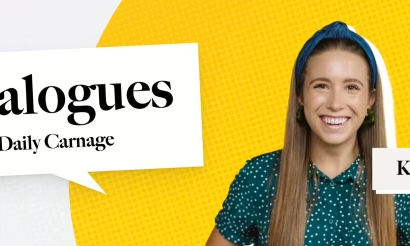
Dialogues: Kimberly Bailey, Head of Marketing at Alpaca
Shannon Sankey
Content2 MIN READ

Know Your Audience: Avian & Saurian Edition
Rich O'Donnell
Content3 MIN READ

Which comes first, the copy or the design?
Rich O'Donnell
Content4 MIN READ

How to Speak Like a Customer—Not Your CEO
Rich O'Donnell
Content4 MIN READ

The New Search Paradigm: How Marketers Can Prepare for SGE
Shannon Sankey
Content2 MIN READ

5 Tips for Marketers Who Hate Writing
Shannon Sankey