
The Daily Carnage
The savvy marketer's hub for industry news, insights, resources, and culture.
Today’s Issue
Trending
Issues
View All
Dealing with Trolls
SEPTEMBER 16, 2019We’re just gonna come out and say it. “Internet trolls suck.”
Hiding behind the computer screen and being nasty for the sake of being nasty is no way to operate.
But, here’s the thing: trolls aren’t going anywhere.
It’s important to know how to deal with these trolls and fight back in a productive, civil manner.
Here are a few suggestions:
- Make a ‘No Trolls’ policy: This is an easy one. Create some guidelines stating that you will not tolerate trolls. It needs to be as clear as possible. Check out how Content Marketing Institue handles its policy here.
- Get some moderators: Once you have your policy in place, you need to enforce it. Enlist the help of group members to moderate or use moderation tools within the platform you’re operating on.
- Ignore the trolls: Trolls want you to engage with their trolling. When you decide to engage, you’re giving them what they want. Don’t be afraid to delete them or their comment and move on.
- Kill ’em with kindness: When ignoring isn’t an option, either call them out on their BS or kill them with kindness.
- Make it a joke: Rather than getting angry, how about making a joke out of it? You’ll have more fun and avoid the racing heart rate.
Whatever you end up doing, always take the higher road.
What’s the Best Word Count for Google?
SEPTEMBER 15, 2019How many words are too many for a blog post or landing page?
Well, according to Google’s John Muller, “word count is not a ranking factor.”
Perfect, right? Not so fast.
While Google may not take a stance on word count, data shows that longer copy can position better.
Here are some studies from popular blogs:
- “A 2017 study by Ahrefs found the average #1 ranking page will also position for about 1,000 related keywords
- “HubSpot, in their 2017 post, found their blog post sweet spot was 2,500 words.”
- “A joint study by BuzzSumo and Brian Dean found that long-form content (2,000-10,000 words) gets more links than short blog posts.”
- Viola Eva from Search Engine Journal said the following; “longer content leads to more links and more links lead to better rankings.”
To piggyback off these stats, over 91% of content gets ZERO traffic from Google. Yikes.
So, should you always write long-form copy?
The answer is no.
Short-form copy also ranks, but here’s the real secret:
Focus on your reader.
In addition to focusing on your reader, you need to look at what your competition is doing.
What does their content look like? Videos, images, listicles, etc. Does their page link on authority sites?
Once you’ve spent some time researching your competition, think about the following things (courtesy of SeoCopywriting).
- Have I said everything I could?
- Have I overcome all objections?
- Have I showcased the product or service?
- Is the keyphrase usage seamless?
- Does the copy encourage the next conversion step?
- Have I connected with my reader?
And there you have it.
Five Tips for Becoming a Successful Remote Worker
SEPTEMBER 11, 2019The workplace is changing. Many of us have the luxury of skipping the commute and working out of our kitchens or favorite coffee shops. A survey by Global Workplace Analytics and FlexJobs shows that remote work has grown 91% over the last 10 years.
As great as working remotely can be, it also comes with its challenges. Truth be told, it’s not for everyone. Some folks thrive and enjoy the structure of a 9-to-5 desk role.
Whether you work remotely or are considering it, here are a few tips to make the most out of it.
- Acknowledge that you’ll be working fixed hours: Don’t confuse working remotely with freelancing. If you’re on a remote team, you’ll more than likely be working similar hours. And by similar, we mean an “actual schedule.”
- Get familiar with apps and technology: There’s a good chance you’ll be using Zoom, Slack, Skpe, WhatsApp, etc. for daily communication. Get a jump start by familiarizing yourself with these and similar programs.
- Work on your communication skills: A survey of over 400 remote workers from TalentLMS found that communication is the most essential skill to master. It takes time to get a sense as to what method of communication works best. On the phone? Chat apps? It’s all about figuring out which channels your team engages with most. Regardless of the channel, make sure your messages are clear and concise.
- Learn how to focus: Working from home can be extremely distracting. Laundry, Amazon Prime packages, and your binge-worthy Netflix show are all within reach. It’s crucial to figure out what environment you’re most productive in.Here’s how remote workers from TalentLMS’s focused on the task at hand; 25% of respondents say they work by the sound of some background noise (from sources like a TV or radio), 21% concentrate in silence, and another 21% focus by listening to meditative music.
- Develop your time management and organizational skills: Self-discipline and remote work go hand-in-hand. Try creating a task list every night. It’ll help you get a jump start on your day. Also, take a look at How to Work From Home: 20 Tips From People Who Do It Successfully for more tips and tricks.
7 Tips for Writing a Great Survey or Poll
SEPTEMBER 10, 2019Want a quick and easy solution to create content and products that resonate with your audience?
Surveys.
Surveys are a sure-fire way to gain a deeper understanding of the needs and motivations of your audience.
Here are 7 tips for putting together a killer survey or poll:
- Ask closed-ended questions: The last thing you want to do is create friction with your survey. Open-ended questions (or free-response) require more effort and time, so try to avoid them. If you need to include some open-ended questions, try to keep it to no more than 2 and put them at the end of the survey.
- Keep your questions neutral: It’s easy to approach your survey with bias. If you’re looking for accurate responses, make sure to keep your opinions out of the survey. Bad: “We think our customer service representatives are really awesome. How awesome do you think they are?” Good: “How helpful or unhelpful do you find our customer service representatives to be?”
- Keep a balanced set of answer choices: Just like your questions, your answer choices need to remain neutral. Give your audience a chance to tell you how they really feel.
- Don’t ask for two things at once: Keep your questions simple. Bad: “How would you rate our customer service and product reliability?” Good: “How would you rate our customer service?”
- Keep your questions different: If you want your audience to put some real thought into your survey, keep your survey questions different. Mix up your question prompts and answer choices.
- Let most of your questions be optional to answer: By forcing your audience to answer questions, you’re setting yourself up for failure. They may not know the answer and/or feel comfortable answering every single question. Give them an option to get the most out of your survey.
- Do a test drive: Before you share your survey with your audience, have your colleagues give it the once-over by actually taking the survey.
Best SEO Plugins for WordPress (Tried & Tested)
SEPTEMBER 9, 2019It’s SEO Monday.
If you’ve spent any time searching for WordPress SEO plugins, you were likely overwhelmed with the amount of choices.
(*If you’re completely new to WordPress SEO, we recommend starting here.*)
Today, we’re giving you some insider tips on the best SEO plugins for WordPress. You’ll want to bookmark this email!
Here are the best ones:
- Yoast SEO: Installing Yoast SEO is a good starting point for most WordPress site owners. Yoast allows you to create XML sitemaps, exclude certain types of content from search, create title and meta descriptions and more.
- Rank Math: Rank Math is one of the most powerful plugins on the market. It’s user friendly and jam-packed with features. Rank Math allows you to integrate Google Search Console, redirect, markup rich snippets and preview cards for Facebook Twitter. It also has a 404 error monitor built-in.
- Easy Table of Contents: This plugin adds a table of contents to your posts and pages to make them easier to navigate. Tip: Google likes that!
- Broken Link Checker: Broken Link Checker allows you to fix links in a couple of clicks, and in bulk. It also suggests replacement links and lets you swap out dead links for working links.
- Shortpixel: Want your site to go faster? Compress your images. Shortpixel will automatically optimize and serve any images you upload in the future.
- WP Super Cache: Want your site to go even faster? Super Cache creates static HTML versions of all the dynamic content on your website. It then serves those pages to visitors instead of the slower-loading dynamic versions.
- Anti-spam: Spam ain’t cool. Install this plugin to filter your spam comments without requiring a captcha.
For 8 more plugins and more information on the above, smash that button below. 👇
Creating a Customer Avatar
SEPTEMBER 4, 2019There’s a good chance you know WHAT your business is offering (we hope).
But, how well do you know WHO you’re offering it to?
Before you can sell anything effectively, you need to understand…
- WHO your ideal customer is
- WHERE they’re hanging out online
- WHAT their challenges are
When you’re laser-focused on WHO you’re selling to, the sales funnel becomes a lot more efficient.
So, how do you get laser-focused on the WHO?
Create customer avatars.
Here are the 5 major components of creating a customer avatar:
- Goals and values: Pretty self-explanatory here. List out what a potential client might want to achieve with his/her business. For example: Agency Eric wants to scale his business and increase the capabilities of his team. Agency Eric values professional development and using white hat marketing principles.
- Sources of information: This component will help you determine the best places to advertise to your customer. Think about the following questions: Where to they hang out (online and in-person)? What materials do they read? What gurus do they follow?
- Demographic information: Age, gender, marital status, children, job title, income, education level, etc. will fill this section.
- Challenges and pain points: Your goal here is to get inside the head of your customer. What keeps them up at night? Agency Eric has a hard time finding, training and retaining top talent. Because of that, he fears losing business to his competitors.
- Objections and role in the process purchase: Why would a potential customer choose not to buy your product or service? List out 3-5 reasons why they would object and make sure you indicate their role in the process (ie: are they the decision-maker?)
Once you have your first customer avatar nailed down, move onto creating more based on the different segments of your market. Digital Marketer put together a customer avatar worksheet to simplify the process. Rinse and repeat.
Reddit Marketing Strategies
SEPTEMBER 4, 2019Reddit is kind of a big deal. It’s one of the largest communities on the internet, with over 300m active users.
We’ve mentioned using Reddit in your marketing strategy before, but truth be told, it’s not the place for native promotion, so many marketers disregard it altogether.
Case in point (directly from Reddit’s community guidelines): It’s perfectly fine to be a Redditor with a website, it’s not okay to be a website with a Reddit account.
You might not have time to go all-in on Reddit marketing, but there are plenty of ways you can use the platform to enhance your marketing strategy.
Here are a few:
- Use Reddit as a customer research tool to find the latest trends: This step requires no engagement, just a little bit of time. Start by manually searching for subreddits that are relevant to your brand or use a third-party tool like Redditlist to find the most popular subreddits.
- Use Reddit to get ideas on how to write catchy headlines: In order for content to gain steam on Reddit (other than the content itself), it’s gotta have a catchy and enticing title. Marketers can learn a lot from this. Check out some of the top posts in your subreddits and take note of what’s resonating.
- Connect with people on Reddit who want to engage with your brand: Redditors often talk about products on the platform and they very well could be talking about yours. Do a manual search to see if you show up in search results. If you do respond, remember to keep it as authentic as possible.
Check out 5 more tips below. 👇
It’s All About the Journey
SEPTEMBER 3, 2019How many GPS users in the house?
Whether you’re using Google Maps, Apple Maps or Waze, (sorry MapQuest) one thing is certain, the app is guiding you to your destination.
When it comes to marketing, we need to channel our inner GPS with our customers.
Enter the customer journey map.
Your customer journey map is crucial when it comes to identifying your most valuable touchpoints. Having a strong handle on your customer journey will allow you to see where conversions are happening.
Here’s how to create your own customer journey map.
- Talk to multiple departments: It’s time to make some new friends and move beyond the walls of your marketing department. Talk to sales, customer service, HR, and more. The goal is to get a 360-degree view of your customer.
- Identify key touchpoints: Your goal here is to do a deep-dive into your data and current marketing efforts. Ask questions like: Are we losing customers because of our hard-to-navigate website? Did a customer decide to go with a competitor after seeing a Facebook ad? Why would a customer be persuaded to work with/or purchase from a competitor? You get the point.
- Use data to tell a story: In order to fully understand your customer, you must dive into the emotional journey. Intuit does a great job of mapping out emotional plot points of their customers’ journey. Check it out here.
- Keep it simple: Don’t get overwhelmed with every single detail. While there’s a lot to unpack, focus on pairing down your information to zero in on what matters most.
Pro tip: Use a spreadsheet or flowchart to lay out your customer journey map.
How to Craft the Perfect Words for Social Media Captions
AUGUST 28, 2019“Copywriting is one of the most essential skills for a marketer to have.”
When it comes to writing copy, there are a lot of moving parts. We’re here to help.
Below are some social-specific copywriting tips to keep you on track.
- Begin your planning with copy (not visuals): Visuals are important (obviously), but what if you started with copywriting first? Copywriter, Karola Karlson follows this four-step process when it comes to featuring copy before visuals.
- Plan what you want to say
- Plan the exact wording
- Develop the post’s design
- Upload and publish your message.
- Pay attention to trending content: We talk a lot about content relevance. The same logic applies to your social copy. Staying on top of social trends will help guide the direction of your copy.
- Use power words: Power words are all about triggering a psychological or emotional response. Here are 5 of the most persuasive words: YOU, FREE, BECAUSE, INSTANTLY, & NEW. We want more, we want more. Ok, here are 189 more power words. Have fun.
- Try some proven copywriting formulas: Buffer did a knock out job on this one, so just head over to this link and get out your notepads.
Insights
View AllStrategy7 MIN READ

The AI SEO Checklist: How to Stay Visible in the Age of AI Search
Ana Toigo
Marketing5 MIN READ

Top Marketing Tools That Offer Nonprofit Discounts (2026)
Rich O'Donnell
Strategy4 MIN READ

Sharpen Your Core Skills: Listening, Remembering, and Note Taking
Rich O'Donnell
Uncategorized4 MIN READ
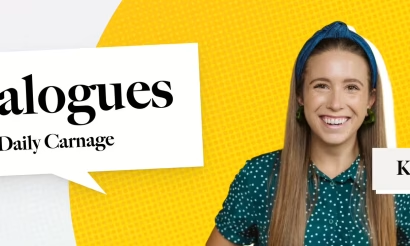
Dialogues: Kimberly Bailey, Head of Marketing at Alpaca
Shannon Sankey
Content2 MIN READ

Know Your Audience: Avian & Saurian Edition
Rich O'Donnell
Content3 MIN READ

Which comes first, the copy or the design?
Rich O'Donnell
Content4 MIN READ

How to Speak Like a Customer—Not Your CEO
Rich O'Donnell
Content4 MIN READ

The New Search Paradigm: How Marketers Can Prepare for SGE
Shannon Sankey
Content2 MIN READ

5 Tips for Marketers Who Hate Writing
Shannon Sankey