
The Daily Carnage
The savvy marketer's hub for industry news, insights, resources, and culture.
Today’s Issue
Trending
Daily IssueAugust 10, 2026
Google is changing the Smart Bidding game
StrategyAugust 10, 2026
The AI SEO Checklist: How to Stay Visible in the Age of AI Search
The Daily Carnage ShowJuly 29, 2026
Ep #2.14: Google Image Search is… Pinterest?
The Daily Carnage ShowJuly 26, 2026
Sony & The Death of Physical Media
Issues
View All
How to Use Mailchimp’s Audience Dashboard
MAY 13, 2019When he’s not working on the vision behind a new brand or project, our very own Creative Director, Rich enjoys writing an article or two.
In today’s tactic section, Rich breaks down how to use the Mailchimp audience dashboard.
Mailchimp is a robust platform for us marketers, but sometimes it can be a bit overwhelming.
Here are two features in Mailchimp we’re most excited about, why we love them, and how they can inspire your strategy:
-Email Marketing Engagement:
What is it?
Your subscribers’ level of engagement (frequency of opens and clicks) are broken down into three categories: Often, Sometimes, Rarely.
Why we love it?
Open and click rates tell you how individual campaigns are performing. On the other hand “Email Marketing Engagement” tells you how your audience is responding. In other words, this feature puts the focus on the people you’re communicating with not just the messages you are sending.
How can you use it? Go here.
-Likelihood to Purchase Again:
What is it?
This feature is for eligible paid accounts. Here you get a predictive model specific to your customers’ behavior. Subscribers are broken down into three categories based on their predicted likelihood to purchase again: High, Moderate, Low.
Why we love it?
Because we love machine learning, of course! (Well, we might change our minds when they become our robot overlords, but in the meantime…) The more likely a customer is to make multiple purchases, the greater their predicted lifetime value.
And, once again, these categories are instantly actionable right there on the dashboard.
How can you use it? Go here.
How to Approach Content for SEO
MAY 12, 2019Today’s SEO Monday is a little different…
We’re chopping up a podcast with Viola Eva, Founder of SEO Strategy at Flow SEO. Viola was recently featured on the Search Engine Nerds podcast and dropped some serious knowledge.
How Viola approaches content creation for SEO:
Data-driven SEO and mindful marketing. Viola says that good content is content that is well-researched, provides value, solves a problem or satisfies a need.
Takeaway 1: Don’t forget to do your SEO homework.
Areas of content creation that Viola focuses on:
Viola takes a three-step approach when it comes to building sustainable content.
- What you want to communicate
- What people are searching for
- What Google favors
Takeaway 2: It’s important to know your brand in and out. Having a brand voice, style guide and understanding who you’re creating content for is of the utmost importance.
How much should you be writing?
The game has changed with long-tail keywords. Viola recommends one page per keyword cluster.
Takeaway 3: Don’t compete with your own content.
On keyword research:
For young sites, Viola recommends ‘super long tail, super low difficulty’ keywords. Focus on search traffic and then keyword difficulty.
Takeaway 4: Study the heck out of page 1 on Google. You need to understand keyword difficulty and find the sweet spot with your content.
How Many Emails Are Too Many?
MAY 7, 2019Here’s a short and sweet one for all you to B2B folks.
We’re assuming you’re no stranger to cold emails. It’s part of the job.
The first touch point typically results in crickets (aka no response). The real magic is in the follow-up. But, how many emails are too many?
The folks at Nutshell pieced together some interesting data on the importance of email communication and the magical follow-up.
Here it is:
- Email marketing generates an ROI of $44 for every dollar spent.
- Eight in 10 prospects prefer talking to sales reps over email.
- However, at any given time, only 3% of your market is actively buying; 56% are not ready, while 40% are poised to begin.
The Follow-Up:
- 44% of salespeople give up after only one follow up.
- Additionally, 92% of salespeople give up after four “no”s, but 80% of prospects say “no” four times before they say “yes”.
- In high-growth organizations, sales teams make an average of 16 touches per prospect, within a 2-4 week span.
So, what’s the magic number for follow-up emails?
5 Emails! That’s certainly not set in stone and will vary based on your product or service, but 5 emails seem to be the standard. Unless you hear “NO,” we’re big fans of not giving up.
Create a Killer Landing Page
MAY 6, 2019If it ain’t broke, don’t fix it.
You’ve probably heard that one before. Well, the same logic applies to creating a killer landing page (kind of).
Before we get into creating landing pages, it’s important to assess your current landing pages to see what’s working. Today’s tool will help with that. 👇🏽
You need to look at your landing page as a product and a process. If you go into it with a ‘set it and forget it’ mentality, you’re setting yourself up for failure.
Now to the optimization…
- Make Your Offer Clear: You have less than 2 seconds to capture a visitors attention. Don’t confuse them with a bunch of jargon. Take a look at these examples of well-done landing pages.
- Above the Fold: Above the fold refers to the point at which a user must scroll to see more information. You want your most important info above the fold on your landing page. Don’t confuse this with jamming a ton of information above the fold. Keep it simple with a headline, a brief sentence and a strong CTA (call-to-action).
- Scarcity Sells: If you want your user to act fast, you’ll need to compel them with scarcity. Do this by using a limited-time discount, a limited quantity, and/or a countdown timer.
Check out more optimization strategies here.
Sell Tickets and Get Your Event Seen
MAY 5, 2019Today’s SEO hot tip comes in the form of SEO for events.
If you’re in charge of events or the marketing of events on your team, it’s important to recognize the role SEO plays in audience awareness and visibility in search.
Before we dive into the tactics, let’s discuss where your event can actually show up in search.
- The Event Pack: This is a search engine results page that is triggered by events based searches. For example; concerts, festivals, tickets, shows, etc. The Event Pack gives you the unique ability to rank in position one, which equivalates to a killer click-through rate.
- The Google Event Carousel: This search engine result sits above the organic search results just like the ‘Event Pack.’ The main difference is the event carousel will send you to a new search results page. The ‘Event Pack’ sends you directly to the event page.
Ok, now the juicy part.
- Use Event Schema: This will be the most important thing you do (talk about pressure). Event schema refers to markup code (semantic vocabulary) that you put on your website to help the search engines return more informative results for users. Here’s what you’ll need to have marked up for your event:
-Location
-Location Address
-Name of Event
-Start & End Date of Event
-Description
-Image
-Venue Name
-See more here - Use Keywords in Your Event Names: It’s important to research terms that trigger the ‘Event Pack.’ Let’s say you’re running a marketing conference in Pittsburgh on October 4th (ya, we are). You’ll need to know the behavior of the search engine. To do this, head over to Google and plug in a few different terms. To show up on the event pack, be sure to include the city of the event and the context. ie: Pittsburgh Marketing Conference. Easy, right?
- Ticketing Marketplaces & Sites: Use a ticketing platform that is certified by Google. It’ll help you appeal to a wider audience and show up in broad event-related searches.
How to Get More Users to Share
MAY 1, 2019When it comes to breaking through the ‘noise’ on social media, user-generated (UGC) content takes the cake.
Why?
It’s the most authentic form of content creation out there. Think about it…
No one is forcing your customer’s hand. They’re sharing your product because they want to. That’s a powerful thing.
From an engagement standpoint, UGC is huge. The more people who share, the better your posts will perform in the feed.
Enough about the why. Let’s talk about how to encourage your users to generate content.
- Hold a competition: People love prizes. An easy way to fire up some UGC is to host a competition in which you offer a prize for the best photo featuring your product or service. Make sure to include some ground rules, such as; ‘To qualify, you must tag 3 friends.’
- Hashtag: The hashtag game has changed a bit, but the premise remains the same; hashtags facilitate searches. Do some research on existing hashtags. Pick one that no one else is using and ask your audience to use it.
- Backed by a cause: Doing good is good. What’s really good is when your brand can align with a social cause (aka cause marketing). Brand ethos matters to people, so whether you’re a big or small brand, think about ways to get your user base involved with a cause.
- 15-seconds of fame: If your customers know they can land on your website or other social channels, they might be more enticed to generate content. Make sure you’re re-sharing UGC on other channels outside of Instagram.
Master the Follow-Up
APRIL 30, 2019Dear {Person},
Just following up on my last email. Would love to connect. Let me know a good time.
Thanks,
{Your Name}
Ah, the dreaded follow-up email. Let’s face it. We’ve all been there. A couple of days or even a week go by and crickets.
So, how do you nail the follow-up email?
- Go back in time: Did your first email include a legitimate close? We’re not talking about a vauge one-liner stating “I’d love to connect,” or something along those lines. We’re talking about a close like this…”Are you free to talk on Friday at 1pm?” Takeaway: Always include a specific close.
- Keep it fresh: As tempting as the copy and paste buttons are, stay away from them. Look at each email as a chance to try something new. From your subject line to your CTAs, treat each email differently.
- Be chill: When you follow up too soon, you risk coming off as desperate. Don’t do that. Wait at least 1 week between your first email and your follow-up.
- Say no to clickbait: We all want our emails to be opened and read, but clickbait for biz dev just ain’t cool. Don’t use subject lines like Re: Our call last week if you never had a call last week.
- Don’t give up: If you sent 4 emails and haven’t heard anything, it could be time for a breather. By breather, we mean wait a few months and send a follow-up. Potential clients have different needs at different times. Be patient.
To Automate or Not…
APRIL 24, 2019Love it or hate it, automation is here to stay.
For us marketers, it’s not a bad thing (until all of our jobs are taken by bots). 🤖 Let’s face it though, our jobs are safe for quite a while.🤞🏼
When we talk about the ‘Pros’ of automation, a few come to mind.
- Time-savings
- A/B testing abilities
- A feedback loop between your sales and marketing team
Considering we’re ‘glass half-full’ kind of folks here at Carney, we’re gonna lean into the positives and discuss some ways to use automation.
- Post Scheduling: We all know social media is a grind. It requires constant attention, strategic planning, and meticulous scheduling. Luckily, there are a ton of tools to use for scheduling purposes. Pro tip: plan out your social media posts at least 2 weeks in advance, so you aren’t making decisions on the fly.
- Mention Tracking: There’s no need to waste time digging through search results looking for mentions of your brand. Why? Because Google Alerts is free and effortless to set up. Pro tip: Start using Google Alerts.
- Ad Retargeting: We already know you’re using a Facebook pixel on your website 😉, so why not give folks an extra nudge to convert? Pro tip: Set up some retargeting ads to folks who are engaging with your site.
Dive in deeper to some automation tactics right here.
How to Increase Sales on Your Website
APRIL 23, 2019If we took a poll on how to increase sales on your website, responses would likely vary.
Do you really wanna know what it’s all about though?
Conversion Rate Optimization aka CRO.
What the heck is CRO?
CRO is the process of increasing the number of websites visitors who take a desired action. It could be a sale, an email submission, etc. It really depends on how you define a conversion.
Alright, now you know what CRO is, let’s talk about calculating your conversion rate.
Divide the number of conversions on your webpage by the number of people who visited that page.
Example: If a user visited your site 3 times and converted once, your conversion rate would be 33.3%.
So, how do you optimize for conversion rates?
It’s all about the who, what and where.
The analytical approach will have you tracking your conversions (we like Google Analytics). You’ll be looking at data such as, where people are entering your site from, what devices they’re using, demographics, funnel abandonment and more.
The flip side would be a qualitative approach (aka the human method). You can do data-backed research all day, but sometimes you just gotta talk with your actual audience. Do this through surveys, user-testing, and cold outreach. Ask the tough questions about your product or service and prepare for some constructive criticism.
Whatever you do, don’t play the guessing game with CRO.
Insights
View AllStrategy7 MIN READ

The AI SEO Checklist: How to Stay Visible in the Age of AI Search
Ana Toigo
Marketing5 MIN READ

Top Marketing Tools That Offer Nonprofit Discounts (2026)
Rich O'Donnell
Strategy4 MIN READ

Sharpen Your Core Skills: Listening, Remembering, and Note Taking
Rich O'Donnell
Uncategorized4 MIN READ
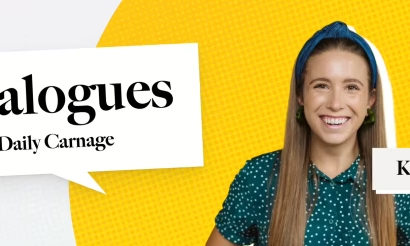
Dialogues: Kimberly Bailey, Head of Marketing at Alpaca
Shannon Sankey
Content2 MIN READ

Know Your Audience: Avian & Saurian Edition
Rich O'Donnell
Content3 MIN READ

Which comes first, the copy or the design?
Rich O'Donnell
Content4 MIN READ

How to Speak Like a Customer—Not Your CEO
Rich O'Donnell
Content4 MIN READ

The New Search Paradigm: How Marketers Can Prepare for SGE
Shannon Sankey
Content2 MIN READ

5 Tips for Marketers Who Hate Writing
Shannon Sankey