The Daily Carnage
The savvy marketer's hub for industry news, insights, resources, and culture.
Today’s Issue
Issues
View All
Free Trial vs. Demo?
SEPTEMBER 9, 2024The B2B software customer journey is often lengthy and complex, particularly for anything beyond basic, low-cost products. B2B SaaS buyers typically want to see the product before investing, so free trials, freemium models, and demos can be effective.
Many small and mid-market vendors are shifting toward product-led growth (PLG) and product-led marketing (PLM) due to high sales team costs and a growing buyer preference for self-service.
Obility conducted an experiment analyzing over 11,000 paid search ads from January 2023 to August 2024, with a total ad spend of over $20 million. The ads offered either a demo or a free trial.
The findings revealed that while demo calls to action (CTAs) had a higher conversion rate, free trial CTAs generated a higher click-through rate (CTR). Free trials consistently outperformed demos in terms of conversions per impression, especially in non-branded campaigns.
Take a look at the findings:
- A demo CTA generally drew a higher conversion rate, but the free trial call to action drove a higher click-through rate (CTR).
- For non-branded campaigns, a free trial CTA showed nearly twice the CTR of a demo call to action.
- Calculating conversions by 1,000 impressions shows free trials nearly double demos.
- For non-branded campaigns, demos drove fewer conversions than trials per 1,000 impressions.
- For branded campaigns, free trials drove 167% more conversions per impression.
Dig deeper with MarTech.
16 ChatGPT Prompts for PPC
SEPTEMBER 8, 2024One thing we’ve learned: No matter how smart you’re ChatGPTing, someone is always ChatGPTing smarter.
Pocket these prompts for your PPC efforts:
- “Create two Google Ads in an RSA format (using multiple headlines and descriptions) for an A/B test for ‘Ms. Hvac’s HVACs.’ Explain why the ads would make a good test.”
- “I need to create some responsive display ads for a Google Ads campaign. Please suggest images, headlines and descriptions for a meatless shepherd’s pie with spokesperson Paul McCartney. Lyric puns are acceptable.”
- “What can a person do from this page and why would they want to do it? [LP URL]”
- “Rewrite a headline for [LP URL] that explains [unique value proposition] and includes the phrase [keyword phrase].”
- “You are a [description of your ideal customer]. Give me 10 statements that describe what you want from a [product category]. Use normal, everyday language. Your output should start with the words “I want”, then give me a bullet list of the 10 statements.”
- “Please write a SWOT analysis for EGO power products.”
- “If I were going to run ads for Impossible Foods on the Google Display Network, what types of sites and channels should I target?”
- “Create a list of competitors for [my company] and their estimated monthly paid search spend.”
- “Please create a list of competitors to clickup.com. List the name of the company, the location of their headquarters, the size of the company (small, medium or large) and whether they are a direct or indirect competitor. Please compile the results in a table format.”
- “My conversions from paid traffic are down 20% month over month. What metrics and dimensions should I look at to find the cause?”
- “You are documenting a channel experiment where you tested the hypothesis that by [testing X] will achieve [desired outcome]. These were the results [Insert test results]. Write me an Experiment Summary answering the question, “What are the big takeaways from this experiment?”
- “Analyze the data with 3 key bullet points to share with executives in a succinct email format. Use numbers.”
- “I’m going to tell my client that paid search performance is down month over month because of seasonality. How might they respond that would challenge my conclusion?”
- “How might this fail?”
- “Write a brief email to a client asking for a $15,000 additional budget because there’s opportunity to increase lead volume below the target CPA.”
- “Using the DiSC profile, write one email for the Dominant personality and write another version for the Steady personality.”
Get even more from Search Engine Land.
10 Tips for Writing Better Copy from Eugene Schwartz
SEPTEMBER 4, 2024If you haven’t read Breakthrough Advertising by famous copywriter Eugene Schwartz, you totally should. He famously had a winning-ad rate of 85 percent. But for now, here is some of his wisdom distilled:
- Set a timer: Write with intense focus for 33.33 minutes, then take a short break. Repeat until your task is complete.
- Create problems: Instead of focusing solely on the product, highlight and amplify your audience’s problems to make your solution more appealing.
- Assemble, don’t create: Your job is to organize existing claims, features, and benefits into a persuasive narrative, not create them from scratch.
- Take a note from action movies: Keep your readers engaged by modeling your copy’s flow after action films, with regular bursts of excitement.
- Tap your subconcious: Take breaks to focus on unrelated tasks; your subconscious will feed you breakthrough ideas.
- Gauge awareness: Tailor your copy to your audience’s level of awareness—from unaware to most aware.
- Use fascination bullets: Add curiosity-laden bullets to your copy to keep readers hooked, making them eager to learn more.
- Preparation over everything: Success comes from intense preparation, like studying great ads and thoroughly researching your audience.
- Be a clear window: Your writing should be transparent, allowing readers to focus on the benefits of the product rather than the writing itself.
- Listen: To write effective copy, immerse yourself in your audience’s world by listening more and speaking less.
Check out Jeremy Mac’s blog for more on Schwartz.
GA4 Introduces Benchmarking Data
SEPTEMBER 3, 2024Thanks to an update, you can now compare your GA4 performance across key metrics with industry peers.
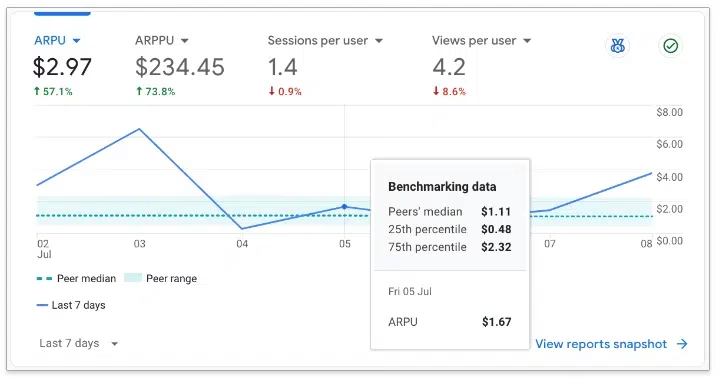
If your property has the “Modeling contributions & business insights” setting enabled in Admin > Account Settings, you can:
- View benchmarks, including your trendline, the median in your peer group, and the range in your peer group (25th to 75th percentile). Benchmarks are refreshed every 24 hours.
- Customize a hyper-relevant peer group by selecting from various categories.
- Compare a wide range of metrics, including acquisition, engagement, retention, and monetization.
Find out more at MarTech.
Attention Spans Are Getting Longer?
SEPTEMBER 2, 2024Tubular Labs’ “The State of Social H2 2024” report highlights several key trends in social video content:
- Attention spans are increasing: Are we… healing? There’s a notable shift towards longer videos on TikTok and YouTube. Videos between 1–2 minutes on TikTok and 30 seconds to 1 minute on YouTube saw 39% year-over-year growth in uploads. These longer videos are garnering more engagement, suggesting that audiences are beginning to favor more substantial content over ultra-short clips.
- Content categories on the rise: On TikTok, the fastest-growing categories are beauty (up 22%), music (up 30%), and business & finance (up 73%).
- Gameplay is growing: Gameplay videos reached a record 6 billion views on YouTube in June, marking a significant milestone.
- The Olympic games were golden: During the Paris Olympics, gymnastics emerged as the most-viewed sport on YouTube with 1.1 billion views, far outpacing other sports like track & field, which had 543 million views.
Check out the full playbook by Tubular Labs.
New Google Features for Retailers Ahead of The Holidays
AUGUST 28, 2024This year, Black Friday falls five days later than last year, meaning the window between Thanksgiving and New Year’s is the shortest it’s been in recent history. Google is helping retailers navigate the compressed 2024 holiday shopping season in 4 key ways:
- Shopping Trends: Google’s Merchant Center now offers insights into popular shopping queries. This allows retailers to capitalize on viral trends, make informed inventory decisions, and optimize product descriptions to match what consumers are searching for.
- AI Insights: The updated Merchant Center includes generative AI-powered summaries and custom reports. Retailers can quickly access performance insights, like product trends, and generate tailored reports without manual effort.
- Automated In-Store Availability Sync: A new feature automates the synchronization of in-store product availability with shopping ads. This streamlines local inventory management, ensuring customers see accurate product availability in real time.
- Goals in Google Ads: Google Ads has introduced new tools to help retailers attract customers faster. This includes setting new customer acquisition goals and optimizing ads for profit with cart-level conversions, enabling more precise targeting during the holiday rush.
Learn more on the Google blog.
2 Tips to Improve IG Performance
AUGUST 27, 2024We have some Instagram quick hits for you. In a Q&A session, Instagram chief Adam Mosseri shared some these tips to optimize your reach:
Insight #1: Repost your Reel to Stories.
“Posting a Reel to your Stories will help a bit with reach. Usually, for most people, your feed posts get a lot more reach than your Stories, and this is because there’s a ton of Stories inventory, so there’s a lot more competition relative to feed. But it will just generally be additive, so it’s a good practice, as long as it’s not something that annoys your followers.”
Insight #2: The largest account should request the collaboration.
“In general, the ranking system [for Collab posts] biases more towards the original collaborator than the person who accepts. It really shouldn’t matter, but right now it matters a bit, so if the original collaborator is the larger account, that will help on the margins.”
Check out the video on Threads.
How to save your online writing from disappearing forever
AUGUST 26, 2024Maybe the Internet is forever, but publishers migrate systems or un-publish content or flat-out fold all the time, resulting in dead links throughout your portfolio of online writing.
To protect your work, you can save PDFs, republish work on your personal website, use paid bookmarking services like Pocket Premium to save copies of webpages, or rely on archiving tools designed for creatives to exhibit your work.
The Wayback Machine
The Wayback Machine has been archiving webpages since 1996. You can request a page be saved using a browser extension, though archived pages can be removed by site owners.
Cost: It’s free to use, with optional donations.
Authory
Authory automatically backs up your content from specified sites, preserving both links and text. It also serves as a portfolio where you can showcase your work, even if the original source disappears.
Cost: A free plan allows for 10 items, with no auto-import. The Standard plan ($15/month or $144/year) includes unlimited items and automated import, and the Professional plan ($24/month or $216/year) adds features like custom domain support.
Journo Portfolio
Journo Portfolio builds personalized portfolio sites for creatives. It offers themes, customizable content blocks, and e-commerce features. Higher plans include automatic article backups and archiving.
Cost: A free plan includes one page with 10 portfolio items. The Plus plan ($8/month or $60/year) offers a 5-page site with 50 items. The Pro plan ($12/month or $96/year) supports 1,000 items, backups, and two collaborators. An Unlimited plan ($18/month or $168/year) provides unlimited pages, items, and collaborators.
Conifer
Conifer, managed by Rhizome, saves pages as interactive sessions with working links and organizes them into collections. It’s less user-friendly and lacks automation but offers extensive free storage.
Cost: A free Plan offers 5GB of storage. For $20/month, you get 40GB, with additional storage available. Annual plans are available for $200/year with extra storage for $50/year.
If you’re a digital writer, it’s time to safeguard and showcase your work so it’s accessible no matter what happens to the original platform.
Anatomy of a Winning LinkedIn Post
AUGUST 25, 2024All the best LinkedIn content shares these elements:
- Hook. Effective hooks are often indicative of the intended audience, as well as provocative and contrarian. Don’t be afraid to be vague for the sake of intrigue.
- Visuals. Leverage carousels, screenshots, photos, GIFs, and memes to boost engagement. Natural, less branded content works best.
- Personality. Find an authentic voice, perhaps a shade bolder or more casual than the tone you would use on your website.
- Consistency. Start slow with a regular publishing and interaction schedule, and increase your cadence over time.
- Intrigue. If you want to make the algorithm happy, stop the scroll. The longer users dwell on your content, the higher your reach.
- Discussion. Respond quickly to comments to increase engagement and reach. But genuine, quality interactions are more valuable than quantity. Establish connections through thoughtful follow-ups.
Get the full scoop from a LinkedInfluencer at Beam Content.
Insights
View AllStrategy7 MIN READ

The AI SEO Checklist: How to Stay Visible in the Age of AI Search
Ana Toigo
Marketing5 MIN READ

Top Marketing Tools That Offer Nonprofit Discounts (2026)
Rich O'Donnell
Strategy4 MIN READ

Sharpen Your Core Skills: Listening, Remembering, and Note Taking
Rich O'Donnell
Uncategorized4 MIN READ
Dialogues: Kimberly Bailey, Head of Marketing at Alpaca
Shannon Sankey
Content2 MIN READ
Know Your Audience: Avian & Saurian Edition
Rich O'Donnell
Content3 MIN READ

Which comes first, the copy or the design?
Rich O'Donnell
Content4 MIN READ
How to Speak Like a Customer—Not Your CEO
Rich O'Donnell
Content4 MIN READ

The New Search Paradigm: How Marketers Can Prepare for SGE
Shannon Sankey
Content2 MIN READ
5 Tips for Marketers Who Hate Writing
Shannon Sankey