The Daily Carnage
The savvy marketer's hub for industry news, insights, resources, and culture.
Today’s Issue
Issues
View All
The 6 Habits of Highly Curious Marketers
AUGUST 21, 2024Curious if you check all of these boxes?
- Start with questions, not answers. Determine what you need to know before looking at the existing data. Don’t be satisfied with only the available information.
- Ask generative and divergent questions. In addition to who, what, where, and when, ask stakeholders, end users, and current and prospective audiences open-ended questions like what if and why not?
- Be nonjudgmental and seek context. Don’t think in terms of right or wrong behaviors. Instead, consider circumstances, actions, and opinions from the POV of other personas.
- Maximize feedback. Ask for feedback from those who don’t typically share your opinions. Weigh the comment, keep your ego out of it, and don’t react immediately. Follow-up with open-ended questions.
- Look for patterns and connections. Use scatter charts and other data visualizations to reveal relationships between variables.
- Take risks. Venture outside your comfort zone, which should keep expanding over time.
Check out the full whitepaper from AdWeek and Survey Monkey—it’s a cool read.
TikTok Live: Tips and Best Practices
AUGUST 20, 2024Whether you’re answering questions, hosting live shopping experiences, going behind-the-scenes, fulfilling audience requests, or collaborating with a creator, TikTok Live is a powerful way to reach new users.
Here’s how to do it right:
- Timeslot: Use TikTok analytics to find when your followers are most active and schedule your live streams during those peak times.
- Length: Keep your streams around 30 minutes, even though you can go live for up to 60 minutes, for better viewer retention.
- Consistency: Regularly post videos and inform your audience when you’ll go live, using TikTok’s scheduling features to increase visibility.
- That Good Lighting: Stream in well-lit environments or use a ring light to keep viewers focused on you.
- Connection: Ensure a stable internet connection to avoid interruptions during your live stream.
- Agenda: Have clear guidelines or a loose plan to stay focused, while still being flexible and spontaneous.
- Engagement: Actively interact with your viewers by responding to comments and questions in real time.
- Moderation: Use TikTok’s tools to filter comments and block disruptive viewers for a smoother experience.
Check out the Buffer blog for a full primer.
2024 Facebook Ad Objectives & When To Use Them
AUGUST 19, 2024Last year, Facebook consolidated its 11 original ad objectives. If you’re not a daily user, here’s a quick guide to the 6 Facebook ad objectives and when to use them:
- Awareness (previously Brand Awareness, Video Views, and Store Traffic): Choose this to introduce a new brand, break into a new market, promote a big event or festival, or launch a new product.
- Traffic: Choose this to drive traffic to a specific location, like a blog, an ecommerce site, or an app landing page.
- Engagement (previously Messages, Conversions, and Video Views): Choose this to increase organic reach and visibility, build a community around your video content, or increase attendance at an event.
- Leads: Choose this to get newsletter sign-ups, encourage webinar registrations, increase ebook downloads, or generate inquiries.
- Sales (previously Conversions and Catalog Sales): Choose this to drive product purchases, announce new collections, or promote offers and deals.
- App Promotion: Choose this to generate app installs quickly, encourage existing app users to engage with the app, and acquire new, long-term users.
Head to Wordstream for more on the new structure.
When Native Ads Backfire
AUGUST 18, 2024Ads that appear as regular content get more clicks initially, but have much higher bounce rates.
Native ads—from social posts to search ads to news articles—can combat banner blindness by camouflaging as non-sponsored content.
But research shows that, while users were more likely to click on a native ad across a variety of categories, they were less likely to stay on the page once they realized they’d clicked on an ad.
For this reason, native ads are more expensive—by 16% according to one study—than traditional banner ads when counting the number of actual website visits.
What gives? Well, users reported feeling 19.6% more annoyed by native ads. Feeling bamboozled doesn’t always inspire purchases—more often, it makes people bounce.
Still, native ads can be effective when they incorporate a soft sell into meaningful content that offers real value. If your bounce rate remains high, test campaigns on a cost-per-aquisition model rather than a than cost-per-click model.
Check out the research at Ariyh.
Leads Not Converting From Paid Ads?
AUGUST 14, 2024If your ads are generating leads who opt in for something you’re offering for free, but then never convert to buying your product or service, it’s usually due to these mistakes:
- No follow up. They give you their contact information, you provide the free report, ebook, whitepaper, template, calculator, what have you. Then you ghost, or you start sending irrelevant promotional emails. Instead, build trust by delivering even more value related to the free content over a series of 3 emails. Once you have rapport, it’s time for the CTA.
- No clear CTA. Your objective in generating leads shouldn’t be to just build a big list. Define your immediate goal, the why behind the effort. Include a CTA on your thank-you page (after delivering your freebie) and on each of your trust-building pages that deliver additional content. When it’s time to convert, be very direct about the action you want a lead to take.
Check out Keap for the full insight.
How to Appear in Google News
AUGUST 13, 2024Inclusion in Google News isn’t limited to traditional news outlets. As of 2019, application and manual domain approval are no longer required to appear in Google News and its various sub-platforms.
If you’re an expert in your field and share timely, relevant information with your audience, you’re essentially a news publisher. You don’t need to completely overhaul your content strategy to break into Google News. Often, simply refining your existing content approach or incorporating a reactive marketing strategy can help your content rank more prominently and quickly, increasing site traffic by up to 40% in some cases.
Here’s how to get started:
- Submit your publication feed and details to Google, even though it’s not required anymore. Use the Publisher Center to submit your publication’s details, such as affiliations, preferred naming, and location. It’s a formality now, but it provides additional settings that could be useful if Google updates the platform.
- Follow Google’s guidelines strictly, ensuring that content adheres to best practices and does not violate core policies, especially in sensitive areas like hateful content, deceptive practices, or sexually explicit material.
- Clearly identify ads and sponsored content; these should not be presented as independent editorial content. Ensure that content in Google News is original, free from commercial influence, and meant to inform rather than sell. Include clear and noticeable disclosures for advertorials or sponsored posts.
- Avoid misleading content by ensuring that articles accurately reflect the details promised in their titles. Produce genuine and sincere content that delivers on its promise and avoids clickbait tactics. Prioritize transparency, as it’s more critical in news than in regular search results.
- Include the following on every post:
- Clear dates and bylines.
- Information about the authors, publication, and publisher.
- Information about the company or network behind the content.
- Contact information.
Head to Rise at Seven for the full guide.
How Wimbledon Gained 1M New Followers in 14 Days
AUGUST 12, 2024This July, Wimbledon posted 376 videos on TikTok and 667 posts on Instagram—or the equivalent of 2 years worth of content for most brands—and earned 1 million followers for their effort.
Here’s how to apply this tactic:
Assemble a live social team and a digital assembly line. In addition to your photographers, videographers, and interviewers, employ separate teams for efficient editing and publishing. No matter your event size, it’s important that your content creators aren’t also tasked with polishing and publishing content if you want a rapid and responsive workflow.
Break down your event into segments and pillars. Before the match, Wimbledon socials featured warm-ups, walk-outs, behind-the-scenes, and interviews. During the match, they featured audience reactions, “Overhead at Wimbledon” snippets, match highlights, fails, and funny moments. And after the match, they featured reactions, fan interactions, and post-match reflections.
Check out Marketing Examined’s breakdown of this tactic for more.
Blog Post CTAs to Try
AUGUST 11, 2024Odds are that you should just be using more CTAs on your blog pages. Here are some ways to implement them:
- Add a CTA to the sidebar. It’s non-invasive, follows the reader as they move through your content, and can even be dynamic depending on the funnel stage your blog falls into.
- Drop CTAs throughout the post. In-text CTAs can be very effective, especially for middle of the funnel. Drop your own personalized ad blocks right into your relevant content.
- Experiment with pop-ups. A pop-up that overlays the bottom of the screen and follows users as they scroll looks clean and professional.
- Try exit pop-ups. These trigger when a user is about to leave or moves their cursor to the top of the browser window. Always make sure it’s easy to click away, but give them a try.
- Drop a CTA at the bottom. A good ol’ attractive CTA button at the bottom of your article is effective.
- Work your CTAs in naturally. Weave your products and services naturally into the discussion, and amp up the sales pitch at the bottom of the funnel.
Dig into the full post at Positional.
3 Examples of Weather-Wise Marketing
AUGUST 7, 2024Is strategic use of weather data on your marketing radar? These brands are doing it right:
CeraVe
- More than half of millennials, Gen Z, and multicultural audiences change their skincare routine with the weather (The Weather Company Personal Care & Beauty Survey, August 2022). CeraVe aimed to increase awareness and boost sales among these groups by addressing their real, timely needs.
- Recognizing the impact of seasonal weather changes on skincare routines, CeraVe launched a campaign during specific weather conditions like clear skies and high UV. The campaign aligned messaging on The Weather Channel app with evolving weather conditions, enhancing engagement and brand recall.
- As a result, CeraVe saw improved sales, with a ROAS 2.3X the industry benchmark and most incremental sales driven by new buyers.
TruFuel
- 83% of people say summer weather impacts their lawn and garden work (The Weather Company Summer 2022 Behavior Survey, February 2022). Homeowners need the right equipment and fuel for yard work, and TruFuel wanted their premixed fuel to be top of mind.
- TruFuel timed its messaging to align with local forecasts for warm, sunny weather, optimal for outdoor projects, and also targeted severe weather areas to emphasize the importance of keeping equipment ready.
- TruFuel’s strategy led to a 5% lift in aided awareness, 8% in familiarity, 7% in favorability, and 7% in purchase intent.
Flu Season
- 61% of people use weather information to assess their flu risk (The Weather Company Consumer Behavior Survey, November 2023). A major healthcare company aimed to raise awareness and motivate adults, especially older ones, to book flu vaccinations.
- Using a custom AI model combining insurance claims and weather data, the brand targeted high-risk populations with timely messaging 14 days before a predicted flu risk surge.
- The campaign resulted in a 17% increase in brand lift, a 14% rise in familiarity and favorability, and a 3X increase in online searches for flu vaccines.
Check out The Weather Company’s full report at AdWeek.
Insights
View AllStrategy7 MIN READ

The AI SEO Checklist: How to Stay Visible in the Age of AI Search
Ana Toigo
Marketing5 MIN READ

Top Marketing Tools That Offer Nonprofit Discounts (2026)
Rich O'Donnell
Strategy4 MIN READ

Sharpen Your Core Skills: Listening, Remembering, and Note Taking
Rich O'Donnell
Uncategorized4 MIN READ
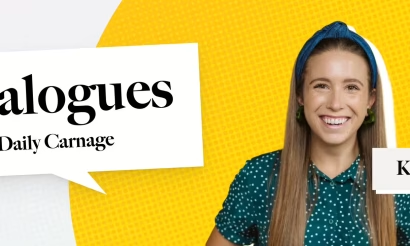
Dialogues: Kimberly Bailey, Head of Marketing at Alpaca
Shannon Sankey
Content2 MIN READ
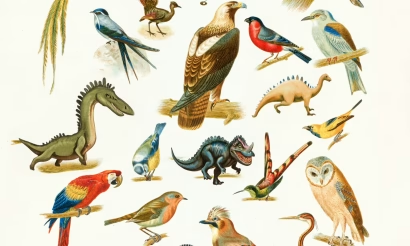
Know Your Audience: Avian & Saurian Edition
Rich O'Donnell
Content3 MIN READ

Which comes first, the copy or the design?
Rich O'Donnell
Content4 MIN READ

How to Speak Like a Customer—Not Your CEO
Rich O'Donnell
Content4 MIN READ

The New Search Paradigm: How Marketers Can Prepare for SGE
Shannon Sankey
Content2 MIN READ

5 Tips for Marketers Who Hate Writing
Shannon Sankey