The Daily Carnage
The savvy marketer's hub for industry news, insights, resources, and culture.
Today’s Issue
Issues
View All
Apple’s 8 Secrets to Landing Page Copy
JANUARY 16, 2024When you think of the perfect product landing page, Apple makes the list every time. Here’s how to replicate the brand’s recipe:
- You guessed it. Understand your target audience.
- Mine their lingo from forums and Facebook groups.
- Use this language in your landing page titles and hook sentences. Apple uses pop culture and puns to speak to the moment of a product era.
- Build social proof and customer reviews, and use those in your header section.
- Leverage your value proposition to cut through the noise.
- Get technical if that’s your audience’s thing. Apple knows professionals get excited by CPU performance and Neural Engines, so they don’t talk down.
- Make it easy for customers to imagine the product in their hands with 3D renders and VR. Allow people to explore the product and its components.
- Tie in your product with your entire eco-system with soft-sells throughout.
Check out Brief-er for more.
SEO Checklist for 2024
JANUARY 15, 2024Here are the SEO considerations that should be top of mind for a new year:
- Outline the potential strategic moves, new products, markets, audiences and pivots your brand or business may take this year.
- Keep an eye on industry and economic trends and predictions for the year.
- Consider how the way customers search or buy your product or service may have changed.
- Map out your key competitors to include new players.
- Do an old fashioned SEO SWOT.
- Review your best and worst performing content across formats and channels.
- Consider your preferred tools and reports — what can you optimize>
- Find opportunities where you can embrace AI.
- Ask for feedback from the recipients of your SEO reports to refine.
- Review your team of partners, freelancers, and colleagues. Is everyone set up for success?
- Ensure that your keywords are still relevant and align with user intent.
- Build out your content roadmap for each quarter.
- Review your website health and technical SEO.
- Ask yourself why your target publications will want to talk about your business in 2024.
- Communicate with other teams and departments to align on goals.
Dive deeper into each task at Search Engine Land.
Social Proof Warms Up Cold Calls
JANUARY 14, 2024Guillaume Moubeche, CEO of lempire (a B2B software business), has a podcast called Bootstrapped Stories. He interviews big-name thought leaders and asks them to share sound-byte links on their socials, which most folks are eager to do.
Then, he keeps tabs on the users that interact with those posts (or gets a list from his guests) and emails the leads directly to recap the podcast and offer a 15-minute sales call.
The relevance and familiarity of a mutual connection provides the kind of social proof that builds trust and captures attention. Plus, the CTA is reasonable.
Check out CXL to see the emails Guillaume has gotten in response to this tactic.
Your Conversion Tracking is About to Break
JANUARY 9, 2024Google has begun the process of phasing out third-party cookies, which will conclude in the back half of 2024.
Your conversion tracking is going to break soon. Your results will suffer, the algorithm won’t be able to learn and predict accurately, and your budget will be spent inefficiently.
Here’s what you should do:
- Implement Advanced Consent Mode V2, especially if you’re subject to EEA regulations. Google will use Conversion Modeling to recover lost conversions by users who don’t consent to ads cookies, so you can keep building your audience. Do this before March if you’re in Europe.
- Implement Enhanced Conversions. Use enhanced conversions for web and for leads to recover conversions you would have missed for uplifts between 5 and 25 percent.
- Implement Server-Side Tracking. This will prevent data loss due to ad blockers, cookie restrictions, and browser limitations. Plus, it will improve tracking accuracy, page load times, and UX.
Check out The PPC Edge for the full scoop.
How to Beat The Instagram Algo in 2024
JANUARY 8, 2024New year, new gram. These are Flick’s tips for beating the Instagram algorithm this year:
- Create Video Content & Carousels. Static images are easier to scroll past.
- Think Beyond Likes. Saves and shares on a post are better metrics to measure value.
- Get into Reels. Aligning your priorities with the platform’s priorities is always a good idea.
- Hashtags. Using just one hashtag on your post boosts your interactions by 29%.
- Encourage Interactions & Conversations. UGC is a cost-effective way to build community.
- Promote Your Content Through Multiple Channels. Repost your most recent Reel on your Stories, for example, and take advantage of joint posts.
- Be Consistent. Set a schedule you can stick to.
- Measure Your Successes (And Failures). Set clear targets and measure your KPIs so you know when to stay or change course.
- Work on Your Visuals. Keep to a broad theme with visually cohesive filters and color stories.
- Improve Your Captions. Captions with few words and lots of emojis seem to perform best.
- Don’t Delete and Repost. Instead, adapt the concept into a new format.
- Geotag (When Relevant).
- Engage with Other Accounts. It’s still a social media platform.
Check out the Flick blog for more.
A Cost-Effective Model to Measure Digital Ad ROI
JANUARY 7, 2024How do you measure return on investment from digital advertising on Google and Facebook?
“Advertisers fundamentally want to know what happens to somebody who sees the ad compared to somebody who doesn’t—that’s the causal effect of the ad, which directly translates to return on investment for the money put in. But the problem is that because of algorithmic targeting, the people who see the ads are super different from those who don’t.” — Florian Zettelmeyer, a professor of marketing at the Kellogg School of Management
The solution: A small, cost-effective number of randomized controlled trials (RCTs), in which a randomly selected group of consumers is shown an ad and is compared with a randomly selected control group that doesn’t see the ad. This data is then combined with data on industry-standard measures like last-click conversion counts. This model allows advertisers to predict how well a campaign will do in terms of true causal effect.
Take a closer look at the research at Kellogg Insight.
Neil Patel’s Top 5 Digital Marketing Trends for 2024
JANUARY 3, 2024Cofounder of NP Digital and one of Forbes’ Top 10 Marketers Neil Patel has some educated guesses for our industry this year. Let’s go:
- Companies will create podcasts over blogs. Take advantage of a less saturated channel and grow your podcast with the help of email blasts and ad swaps.
- Companies will spend time on the less popular social networks. Facebook, Instagram, and YouTube don’t provide the best return on ad spend despite their dominance.
- Marketing moats will become non-existent, other than brands. Brand-building sets you apart from copycat competition. Follow the rule of 7 touchpoints and leverage an ecosystem of channels to get attention.
- You’ll change the way you write content. Content written by humans is outperforming AI content over 94% of the time. If you’re leveraging AI, make sure humans are doing the revising.
Check out Patel’s full blog post for more.
Micro-Influencer Tactics for 2024
JANUARY 2, 2024As it becomes harder to sell through influencers on social, brands are moving away from expensive professional content creators in favor of more cost-effective UGC. Here’s how:
- Work with existing customers. Tap your existing network of loyal fans whose honest reviews of free product will resonate more in an oversaturated influencer landscape.
- Hone your gifting strategy. Test incentives like affiliate commission, free products and gifts, access to special events and exclusives, and promotional discounts.
- Build lasting relationships. Keep fans engaged by sending birthday cards, spotlighting users, co-creating products with them, and inviting early feedback.
- Know when to go traditional. Larger influencers can still support bigger brand moments and product launches, in tandem with your micro-influencer strategy.
Dig deeper at Inc.
5 AI in Marketing Certifications for 2024
JANUARY 1, 2024Happy January! If you have some mandatory professional development to do, or if you’re leveling up for the love of it all, consider an AI-related marketing cert to stay ahead of the curve, like these:
Certifications for Beginners:
- Certification in AI for Business by Growth Tribe (Beginner, 21 Hours)
- AI in Digital Marketing by Great Learning (Beginner, 1.5 Hours)
Certifications for Advanced Learners:
- Futureproof Your Marketing by Pathmonk Academy (Advanced, 5 Hours)
- AI for Marketing a Certification by Guy Yalif from CXL (Advanced, 1.5 Hours)
Something for Everyone:
- AI for Marketing Mastery Program by MAII (Suitable for All, 8 Hours)
Read more about each at Pathmonk.
Insights
View AllStrategy7 MIN READ
The AI SEO Checklist: How to Stay Visible in the Age of AI Search
Ana Toigo
Marketing5 MIN READ

Top Marketing Tools That Offer Nonprofit Discounts (2026)
Rich O'Donnell
Strategy4 MIN READ

Sharpen Your Core Skills: Listening, Remembering, and Note Taking
Rich O'Donnell
Uncategorized4 MIN READ
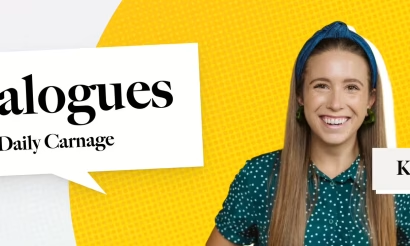
Dialogues: Kimberly Bailey, Head of Marketing at Alpaca
Shannon Sankey
Content2 MIN READ
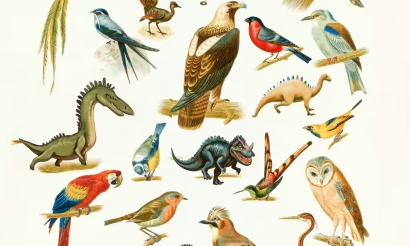
Know Your Audience: Avian & Saurian Edition
Rich O'Donnell
Content3 MIN READ

Which comes first, the copy or the design?
Rich O'Donnell
Content4 MIN READ

How to Speak Like a Customer—Not Your CEO
Rich O'Donnell
Content4 MIN READ

The New Search Paradigm: How Marketers Can Prepare for SGE
Shannon Sankey
Content2 MIN READ

5 Tips for Marketers Who Hate Writing
Shannon Sankey