
The Daily Carnage
The savvy marketer's hub for industry news, insights, resources, and culture.
Today’s Issue
Issues
View All
Tips for Holiday Affiliate Marketing
OCTOBER 3, 2023Your affiliate marketing strategy should be finalized this month before holiday calendars start filling up. Consider these tips to maximize your impact:
- Less is more. While budgets have shifted towards cost-per-click (CPC) placements, brands must be strategic and considerate in their approach, avoiding overwhelming customers and publishers with excessive product promotions during the holiday season.
- Time is money. By evaluating commission rates and optimizing spending, brands can allocate resources more efficiently. Building relationships with aligned publishers, particularly by offering exclusivity, can help you stand out in a competitive Q4 environment characterized by ad oversaturation and increased publisher rates.
- Consider the economy. In anticipation of reduced holiday spending, lower-cost brands may thrive in affiliate campaigns by offering additional discounts. Position products as necessities rather than luxuries, given consumers’ cautious approach to discretionary spending.
Read more at Marketing Brew.
What is Customer Intelligence?
OCTOBER 2, 2023Customer intelligence (CI) is the collection and analysis of patterns within customer data in order to:
- Predict behavior.
- Identify trends and opportunities.
- Improve customer experiences.
- Increase loyalty and satisfaction.
Customer intelligence platforms can collate CRM and ERP data, social and web analytics, email marketing data, and data from other sources. This infrastructure allows marketers to segment customers, identify patterns, analyze predictive analytics, and understand customer behavior and preferences.
Benefits of strategically collecting, analyzing, and executing against CI include:
- More precise segmentation
- Higher engagement
- Competitive advantage
- Insights into product development
- Lower churn
- Personalized customer experience
- Measurable ROI
Check out the Meltwater blog for examples of CI in action.
Guest Blogging for SEO
OCTOBER 1, 2023Most experts believe that guest blogging remains an important part of SEO when implemented correctly. Here are the keys to an effective guest blogging strategy:
- Find Valuable Prospects: Identify high-quality sites with relevant industry focus, good domain authority (DA), and a history of accepting guest blogs to ensure quality backlinks and improved search rankings. You can do DIY research, hire a team or a freelancer, or utilize directories for this.
- Personalize Your Pitch: Craft persuasive and personalized outreach emails or social media messages to potential target pages. Explain the value of your proposed blog post and why you are the best fit for the task.
- Create Impactful Content: Invest time and resources in creating high-quality, memorable content. Conduct interviews and client/follower research or share real-life cases to engage readers emotionally. Optimize content and choose keywords wisely.
- Manage Your Personal Brand: Website owners may assess your online presence, so ensure your social media profiles and online image reflect your expertise. A strong personal brand can also attract opportunities and collaborations.
- Avoid Overdoing It: Maintain a balanced approach to guest blogging to avoid appearing spammy or violating Google policies. Quality and relevance should be prioritized over quantity.
Check out Search Engine Land for more.
Schwartz’s 5 Stages of Awareness
SEPTEMBER 27, 2023Famed copywriter Eugene Schwartz believed there were 5 stages of consumer awareness, as follows:
- Unaware: Individuals in this category are oblivious to the existence of a problem, rendering marketing efforts less effective.
- Problem Aware/Pain Aware: These individuals acknowledge the presence of a problem but are unaware of potential solutions to address it.
- Solution Aware: This group recognizes the availability of solutions but has not made a decision and remains uninformed about your product.
- Product Aware: Individuals in this category are familiar with your product but remain uncertain about its ability to resolve their issue.
- Most Aware: Those in this group possess extensive knowledge about your product and stand at the brink of making a purchase, requiring specific details to seal the deal.
To find out how to communicate effectively to consumers at all stages of awareness, check out Active Campaign.
Take Up More Space
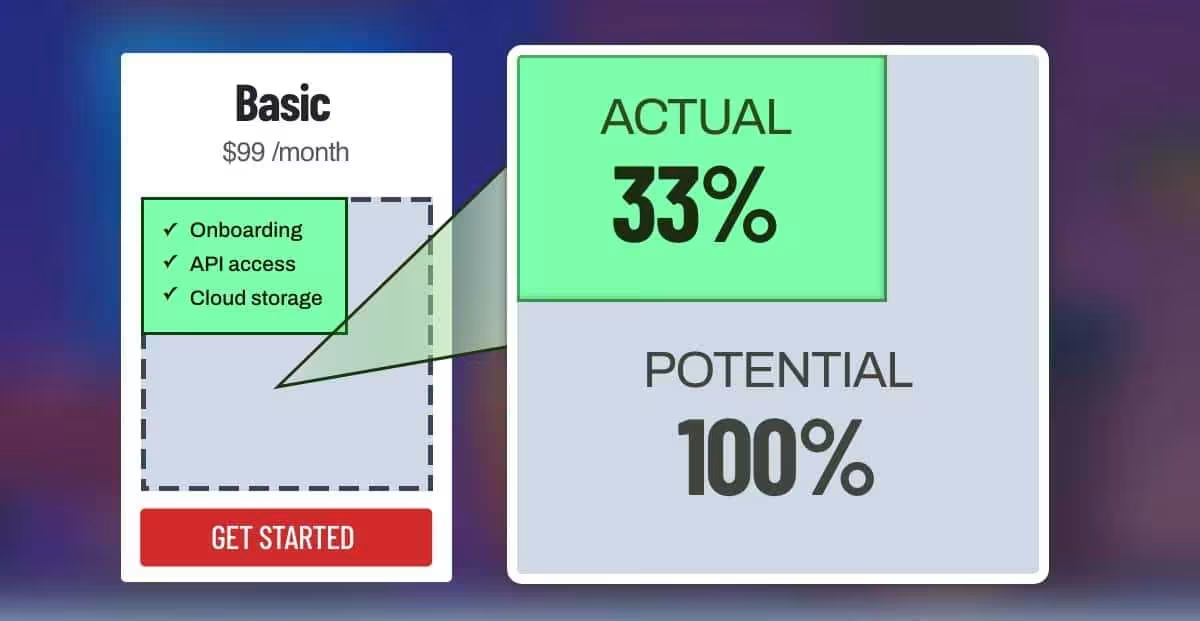
SEPTEMBER 26, 2023Did you know that blank space in visual layouts can reduce persuasion?
Studies show that marketing messages were less persuasive when surrounded by empty space, particularly when space appeared below an argument or appeal (Kwan, Dai, & Wyer, 2017).
But isn’t minimalism king? Not necessarily. According to the research, “a communicator who intends to convey a strong opinion is likely to use all of the space available to elaborate his or her position, whereas a communicator who is less confident… may leave space unused.”
Plus, an argument like “100% satisfaction” may feel smaller and hold less weight in the context of a large canvas of negative space.
Check out Nick Kolenda’s blog for more on this insight.
5 Outdated KPIs to Replace
SEPTEMBER 25, 2023With engagement costs increasing across ad channels, it’s time to reconsider conventional KPIs and aim for a more nuanced understanding of your campaigns. Here are 5 KPIs to replace:
- Replace Spend with Profit. In most cases, spend shouldn’t be your driving consideration. Aim for efficiency goals without specifying spend per channel—or risk spending too much on one channel and not enough on another.
- Replace Platform-provided CPA with CRM-based CPA. If you rely on CPAs from platforms like Google Ads, Facebook, and LinkedIn without taking quality into account, you’re likely to overspend on the wrong leads.
- Replace Click-based CPA with Incrementality-based CPA. True CPA implements the halo effect, brand lift testing, geo lift testing, and more to help you understand the real impact of any advertising interaction.
- Replace Average CPA/Average ROAS with Marginal CPA/Marginal ROAS. Marginal CPA helps you figure out what you paid to acquire marginal returns, so you don’t overspend to reach expensive customers without additional value.
- Replace Impression share lost to bidding with Impression share lost to budget. Keep budgets up and control spend using bids and efficiency targets.
Dig into the details at Search Engine Land.
The Art of The Re-engagement Email
SEPTEMBER 24, 2023If a re-engagement campaign isn’t part of your email strategy, it might be time to implement one. It’s more expensive to acquire new customers than to retain current ones. Here’s how to do it:
Who’s not clicking? Keep an eye on your ESP metrics over 10-, 15-, and 30-day increments. Build a segment of your subscribers who have recently begun to click less frequently.
Email 1: Start the conversation by sharing your latest blog posts, product updates, and other relevant information.
Email 2: A message like “We noticed you might not be interested anymore…” can get the attention of lapsing subscribers.
Final Email: Provide an incentive to convince subscribers to engage, like a discount or a free demo/preview. The tone should be consistent with your standard communications, whether transactional or more relationship-based.
What’s next? Determine an appropriate interval for pruning subscribers that never re-engage to keep your list active and healthy. You can consider moving lapsed subscribers to a cheaper email broadcast platform, too.
Check out more from this podcast episode of Better Done Than Perfect.
Connect GA4 to Google Sheets
SEPTEMBER 20, 2023Did you know GA4 has an official (and free) add-on that allows you to transfer data from GA4 to Google Sheets? The GA4 Reports Builder extension lets you customize, collaborate, and visualize your data in a whole new way. Here’s how to get started:
- Install the add-on. Open your Google Sheets document, select Extensions > Add-Ons > Get add-ons, then search for and install “GA4 Reports Builder for Google Analytics.” Make sure to authorize access to Google Analytics.
- Configure the report. From the Google Sheets menu, select Extensions > “GA4 Reports Builder for Google Analytics” > Create New Report. Here, you’ll name the report; choose your GA4 account and property; and define the date range, metrics, and dimensions you want.
- Run the report. Finally, select Extensions > “GA4 Reports Builder for Google Analytics” > Run Report. Your imported data will populate into a new tab. Now, you can experiment with visualization options, like charts, graphs, and pivot tables.
Check out Loves Data for more info on this handy trick.
22 Headline Formulas to Try
SEPTEMBER 19, 2023We’re not saying you don’t know how to pen a world-class headline. But if you’re stumped and out of time, these headline formulas work for a reason:
- Who Else Wants [blank]?
- The Secret of [blank]
- Here Is a Method That Is Helping [blank] to [blank]
- Little-Known Ways to [blank]
- Get Rid of [problem] Once and For All
- Here’s a Quick Way to [solve a problem]
- Now You Can Have [something desirable] [great circumstance]
- [Do something] like [world-class example]
- Have a [or] Build a [blank] You Can Be Proud Of
- What Everybody Ought to Know About [blank]
- Give Me [short time period] and I’ll Give You [blank]
- If You Don’t [blank] Now, You’ll Hate Yourself Later
- The Lazy [blank’s] Way to [blank]
- Do You Recognize the [number] Early Warning Signs of [blank]?
- See How Easily You Can [desirable result]
- You Don’t Have to Be [something challenging] to be [desired result]
- Do You Make These Mistakes?
- Warning: [blank]
- How [blank] Made Me [blank].
- Are You [blank]?
- [Blank] Ways to [blank].
- If You’re [blank], You Can [blank].
Check out CopyBlogger for more on why these headline formulas get results.
Insights
View AllStrategy7 MIN READ

The AI SEO Checklist: How to Stay Visible in the Age of AI Search
Ana Toigo
Marketing5 MIN READ

Top Marketing Tools That Offer Nonprofit Discounts (2026)
Rich O'Donnell
Strategy4 MIN READ

Sharpen Your Core Skills: Listening, Remembering, and Note Taking
Rich O'Donnell
Uncategorized4 MIN READ

Dialogues: Kimberly Bailey, Head of Marketing at Alpaca
Shannon Sankey
Content2 MIN READ

Know Your Audience: Avian & Saurian Edition
Rich O'Donnell
Content3 MIN READ

Which comes first, the copy or the design?
Rich O'Donnell
Content4 MIN READ

How to Speak Like a Customer—Not Your CEO
Rich O'Donnell
Content4 MIN READ

The New Search Paradigm: How Marketers Can Prepare for SGE
Shannon Sankey
Content2 MIN READ

5 Tips for Marketers Who Hate Writing
Shannon Sankey