The Daily Carnage
The savvy marketer's hub for industry news, insights, resources, and culture.
Today’s Issue
Issues
View All
4 Key Components to a Winning Audio Ad
APRIL 2, 2023Boost recall on your radio and podcast ads with these 4 essential components.
- Sonic branding. Super sticky auditory stimuli—from short but catchy sound logos to entire brand anthems and iconic taglines—is the most effective way to improve brand recognition.
- Music. Ads with on-brand songs, melodies, and jingles are more memorable than those without, driving purchase intent, recall, and enthusiasm.
- Voice. Ask not “who?” but “how many?” Interestingly, ads that utilize multiple voices and two-way banter perform better than those with just one voice actor.
- Messaging. The key? Get your brand name in the script 4 or more times. Plus, think of this disclaimer boilerplate as an extra creative space. Bonus: aim for :30 in length, unless you’re in the retail industry, which does better at :15.
Check out the full study at Audacity.
What are UTM Codes?
MARCH 29, 2023If you don’t know, now you know! UTM codes are custom URLs that can marketers use to accurately track the performance of a campaign. UTMs track these 5 parameters:
- Source: The website, publication, or advertiser that is sending traffic to your site. For example, you could add a UTM code to your Twitter bio to track the traffic it refers.
- Medium: The type of channel driving the traffic, such as PPC, organic search, paid social, organic social, and email.
- Campaign: The specific campaign, promotion, or sale that your link represents.
- Term: The target keyword driving traffic to your site.
- Content: The specific content, such as multiple CTAs, that a user can click on within the same campaign.
These parameters can help you track your referrals, optimize your bidding strategy, and measure the success of your campaigns. Get a closer look at UTM codes over at Semrush.
How to Address Keyword Cannibalization
MARCH 28, 2023Keyword cannibalization happens when you have multiple pieces of content on your website that rank for the same search query in SERPs. The topics covered are too similar, or the content is optimized for the same keyphrase. Google can’t discern which page should rank higher, resulting in lower rank for your content overall.
Here’s how to resolve keyword cannibalization:
- First, audit and analyze the performance of your content. Google: site:domain.com “keyword” to determine if several pieces of similar content are ranking lower than you’d like.
- If two blog posts cover virtually the same content, for example, merge them into one long-form piece to improve ranking.
- Remember to redirect removed content to the new link.
- Improve your internal linking structure to help Google understand which piece of content should be ranked highest. Achieve this by linking to more important articles from less important articles.
Learn more about keyword cannibalization from Yoast SEO.
4 New LinkedIn Features for Business Pages
MARCH 26, 2023Level up your B2B marketing efforts by utilizing these 4 new LinkedIn features for business pages.
- Native post scheduling. Plan posts for your business page up to 3 months in advance directly from the platform. This feature is currently only available on desktop.
- Audio events. Participate in audio-only discussions live instead of relying on external broadcasting applications.
- Automatic job posting. Businesses with fewer than 1,000 employees can now automatically share one open position each day as a pre-scheduled post.
- Follow as your page. LinkedIn Pages can now follow other Pages to help you build more community in your industry.
Check out the full post at Search Engine Journal.
3 Ways to Improve Your Content Writing Skills
MARCH 22, 2023It can be hard to avoid writer’s block and content fatigue as a modern marketer. Here’s 3 healthy habits of successful writers:
- Upgrade your information diet by curating media streams for yourself—including social media, magazines, videos, books, and other formats. Set up “read-it-later” apps to stay organized and consider keeping a “commonplace book,” or a collection of content that inspires you.
- Maybe you’re not a pen-and-paper person, and that’s fine. Capture your ideas wherever they happen—collect them from your Notes app, Twitter, the group chat, a never-ending Google doc… the idea is to build a searchable note-taking system that works and can be referenced later.
- The writing process doesn’t have to be so lonesome. Generate and develop ideas by engaging in conversations with friends, readers, and editors. These opportunities help you hone concepts, get helpful feedback, and test ideas at-scale.
Spend some time with David Perell’s Ultimate Guide to Writing Online to take a deeper dive.
9 Reddit Ads to Try
MARCH 20, 2023Reddit’s 57 million users represent highly engaged, niche online communities—and a huge opportunity for brands that know their target audience. Here are 9 Reddit ads to consider:
Promoted Post
- Image Ads: Test a scroll-stopping image ad that appears in the Reddit feed.
- Carousel Ads: Similar to other platforms; maximize your ad space with multiple images.
- Video Ads: Engage your audience with an in-feed video.
- Conversation Placements: Drive incremental reach with ads that appear within conversation threads.
- Text Ads: Quickly promote your message with simple in-feed text ads.
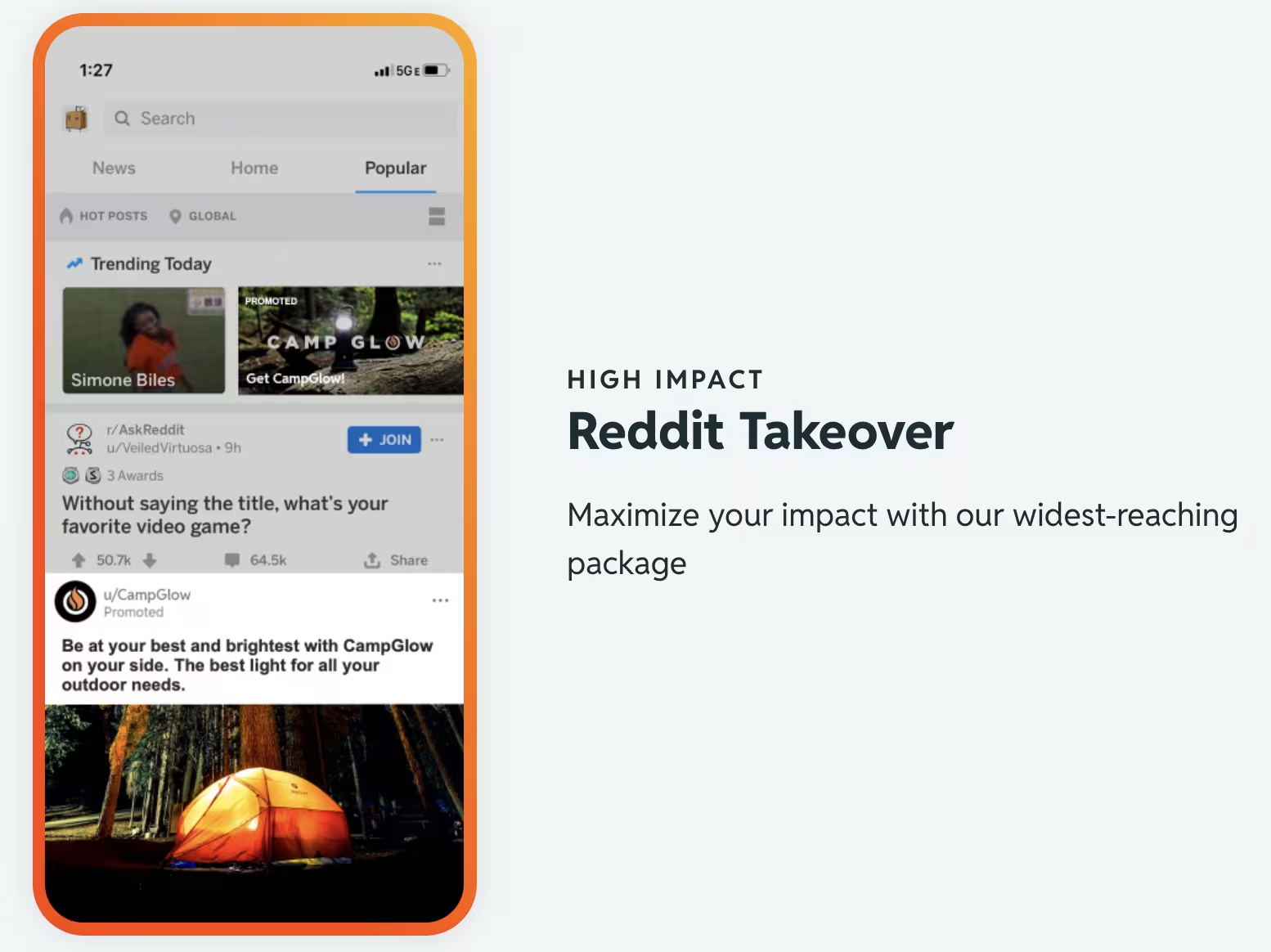
High Impact
- Reddit Takeover: Get your content trending in the Popular feed with Reddit’s widest-reaching package.
- Front Page Takeover: Own the homepage with a 24-hour ad.
- First View: Own the first unique ad impression on the Home and Popular page.
- Category Takeover: Own top communities in your category for 24 hours or more.
Checkout Reddit for Business to get started.
5 PPC Keyword Challenges
MARCH 15, 2023Optimizing keywords for paid search campaigns can be difficult to get right. Here’s how to approach 5 common challenges.
Challenge #1: How many keywords should you have in your account?
The answer is simple: as many as necessary. By using keyword planning and competitor keyword tools, you can build a large list of potential keywords to narrow down and ultimately integrate into your account structure.
Challenge #2: Variants, variability & redundant keywords
Keyword phrases can be quite similar, with only slight variance in the order of words. Google has recently moved to flagging keywords for redundancy, but the fact is that even similar keywords can perform very differently. Consider testing both, so long as they have estimated search volume.
Challenge #3: Head terms vs long tail variants
Start by adding long tail keywords (4+ words), which are more specific and less costly than broader head terms (3 words or fewer).
Challenge #4: Match type myopia
These days, broad match can be too broad, targeting search terms that are not relevant to your business. Instead, try phrase and exact match terms first. After sustained success over time, you can expand into broad match.
Challenge #5: Keyword list maintenance
It’s not a crockpot—you can’t set up your account and forget it. Your keyword list needs regular maintenance to optimize performance. Make sure your keywords are still relevant, identify new versions to test, and analyze your best and worst performers to improve.
Check out WordStream’s guide for a deep dive into PPC.
Prowly
MARCH 14, 2023Boost your earned media efforts with an easy, drag-and-drop press release builder. Prowly helps you build visually engaging and interactive press releases, generates target audiences, connects you to an expansive media contact database, and distributes your content directly.
8 Elements of a Solid Press Release
MARCH 14, 2023Whether or not you’re the PR point person for a brand, you may find yourself with the task of writing a press release. If you’re new to the genre, don’t worry.
The press release follows a simple formula:
- Add your contact information to the header.
- If your announcement can be published upon receipt, add “For Immediate Release” to the top. If it should be held until a date and time, specify that with an embargo.
- Summarize your news with a concise title and an italicized subheading that adds more context.
- Open with a precise lede (who, what, where, when, and why).
- Provide two to three paragraphs of context, and include quotes from stakeholders.
- Share relevant facts and/or figures in bullets.
- Include your company boilerplate description and logo at the bottom.
- End your press release with three pound symbols (###). It’s tradition!
Check out HubSpots guide and templates to draft your press release.
Insights
View AllStrategy7 MIN READ

The AI SEO Checklist: How to Stay Visible in the Age of AI Search
Ana Toigo
Marketing5 MIN READ

Top Marketing Tools That Offer Nonprofit Discounts (2026)
Rich O'Donnell
Strategy4 MIN READ

Sharpen Your Core Skills: Listening, Remembering, and Note Taking
Rich O'Donnell
Uncategorized4 MIN READ
Dialogues: Kimberly Bailey, Head of Marketing at Alpaca
Shannon Sankey
Content2 MIN READ
Know Your Audience: Avian & Saurian Edition
Rich O'Donnell
Content3 MIN READ

Which comes first, the copy or the design?
Rich O'Donnell
Content4 MIN READ

How to Speak Like a Customer—Not Your CEO
Rich O'Donnell
Content4 MIN READ

The New Search Paradigm: How Marketers Can Prepare for SGE
Shannon Sankey
Content2 MIN READ

5 Tips for Marketers Who Hate Writing
Shannon Sankey