The Daily Carnage
The savvy marketer's hub for industry news, insights, resources, and culture.
Today’s Issue
Issues
View All
What About Your About Page?
JANUARY 3, 2023
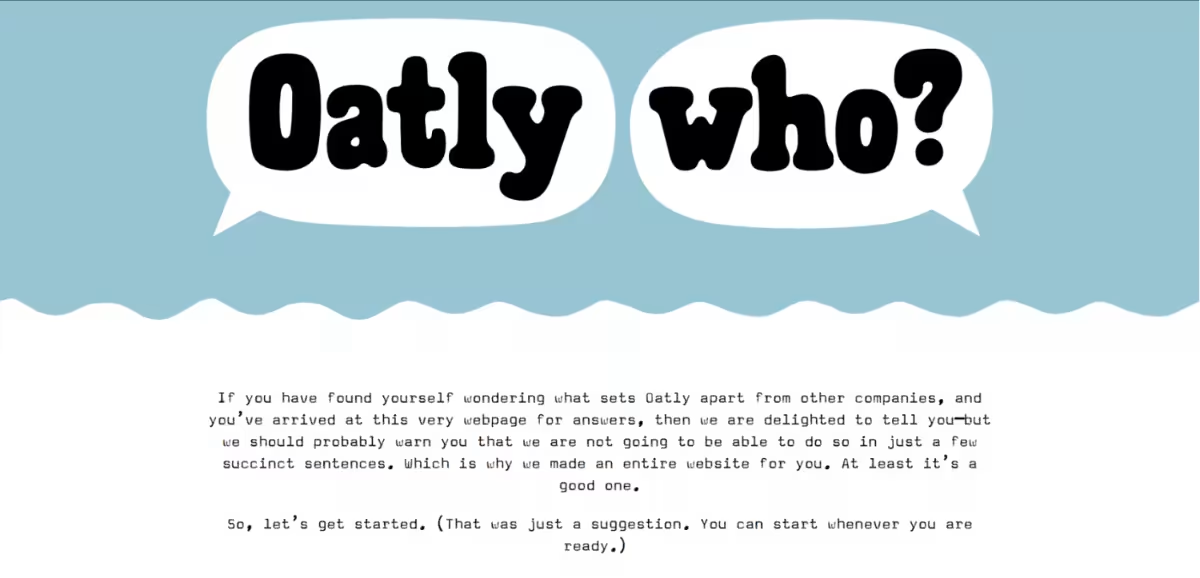 Your About Us page isn’t just a parking spot for your boilerplate copy. In fact, users rank it as the second-most important element on a site behind contact information. The most engaging About Us pages stay true to the brand’s tone and share these key elements in common:
The why. This is your opportunity to share your mission with consumers who are hungry to support brands that align with their values. What problem—macro or micro—is your brand committed to solving? Why does your brand exist?
The how. Your About page is not the place for corporate speak, so “execute” somewhere else. Users are here to learn exactly how you’re going to make their life better. Use clear, customer-focused language to pitch what you’re selling.
The when and where. Storytelling facilitates connection. Share your brand’s humble beginnings, origin story, inspiring impetus. When did all begin? And where are you headed?
The who. When it’s appropriate, sharing headshots and bios of the key players on your team can build trust with consumers who increasingly value brand transparency.
The what now? Don’t forget the obvious. Your About page should include a call-to-action to drive users to back to your services and products, blog content, newsletter, etc.
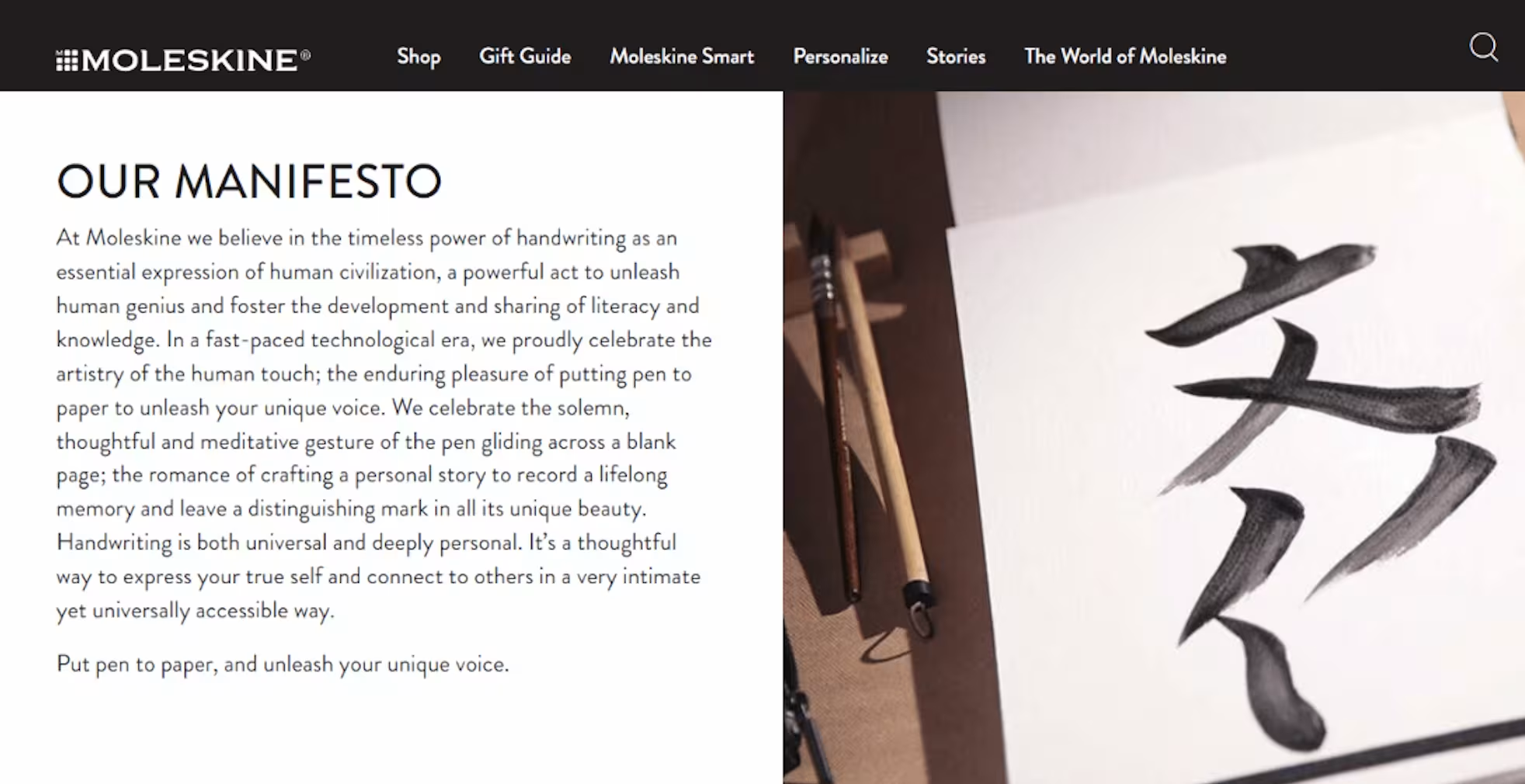
Check out Search Engine Land for a full list of gold-star About Us examples.
Know Your Social Stats
JANUARY 2, 2023What were the top challenges faced by social media managers last year? Keeping up with the algorithm, navigating new features, and fighting that shrinking organic reach. It can be hard to prove ROI to clients and managers, despite what we know to be true. So, here are a few powerful, platform-specific stats to have on hand:
- Instagram users spend an average of 30 minutes on the app a day, and 81% of them are researching products and services with all that time.
- TikTok‘s 1 billion monthly users spend a whopping 95 minutes daily on the app, where they’re engaging at a rate of 17.96%.
- Twitter is still hot with millennials (this 😂 emoji is the most used). Despite ongoing chaos, new user sign-ups were at an all-time high in November ’22—and 30% of users are hoping to see more brands on their feeds.
- LinkedIn posts sees 15x more content impressions than job postings, and 6 people are hired from this platform every minute.
Check out HeyOrca to dive into the full scope of stats from 2022.
Google Ads in ’23
JANUARY 1, 2023Based on last year’s trends and new features—as well as some upcoming data regulations—here’s what to expect from Google Ads in 2023:
- Broad match or bust. Google strongly suggests that you upgrade existing keywords to broad match to yield quality impression share and higher conversions. More data = better optimization. Still, you should closely monitor broad match, as it could produce overspend from irrelevant queries.
- More dependence on creative. In 2023, emphasize creative. Use high-quality images and videos for Display Network ad types (Responsive, Discovery, Performance Max) and set yourself apart by adding images to search ads.
- Privacy-focused management. Google—and the digital marketing industry at large—is moving to first-party data. On May 1, 2023, Google advertisers will no longer be able create similar audiences, even with first-party data.
- Less transparency to advertisers. Google’s automation and machine learning algorithms continue to be a mystery to advertisers. The challenge will be finding opportunities within these limitations.
Check out the full story over at Practical eCommerce.
How can marketers use ChatGPT?
DECEMBER 28, 2022You’ve probably heard the hype about ChatGPT, the AI chatbot trained by OpenAI that amassed over a million users in five days. ChatGPT is capable of generating natural and coherent language responses to general questions. Its ability to build strategies and automate tasks has caused some experts to speculate that AI has the potential to replace human marketers in the not-so-distant future. For now, it’s still a developing tool with the power to enhance your workflow. Here’s how:
- Keyword suggestions. ChatGPT can’t replace a solid SEO strategy, but it can help quickly identify a list of synonyms from a root keyword.
- Content. Major digital publications have already started trusting ChatGPT with basic articles. The copy is relevant and readable, if a little rudimentary. However, with a simple request like “What to see and do in Athens,” ChatGPT provides a helpful overview and outline for a real content writer to work from.
- Ad copy. Coming up with snappy headlines and taglines can suck up a lot of time. ChatGPT seems to excel at yielding totally viable options for a request like “give me headlines related to ‘buy budget beds online.’” If AI doesn’t strike gold for you, it’s at least getting the brainstorm started.
- Names. Need to come up with the second-best name for a newsletter? ChatGPT can do that, too.
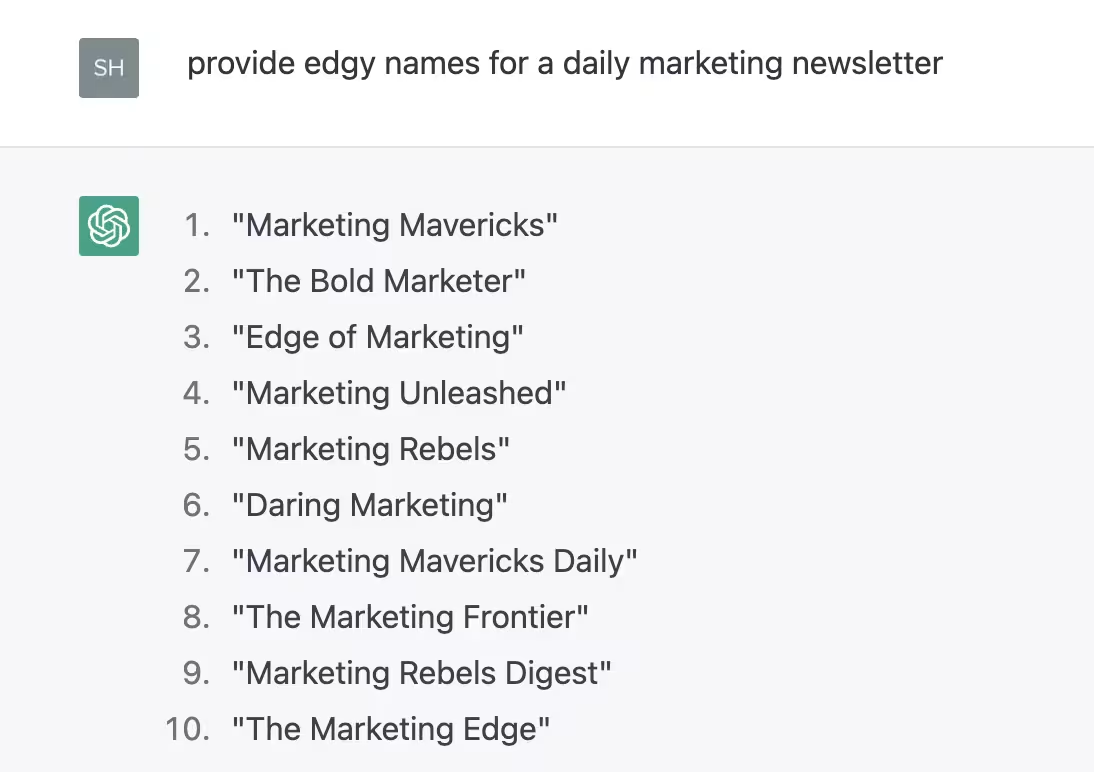
Ok, nothing groundbreaking here. - Code. If you need a little help with basic coding and your favorite dev is busy, you tell ChatGPT to “create HTML for a link to open in new window,” for example.
Check out Browser Media’s article to find out more about ChatGPT’s capabilities and limitations.
Demystifying the TikTok Algo
DECEMBER 27, 2022It’s the fastest growing social media platform of our time with the highest engagement rates per post. In Q3 of 2022, TikTok surpassed 1 billion monthly active users. The “For You Page” (FYP)—a curated feed of videos hyper-tailored to user interests and behaviors—is no small part of that success (and controversy). So how do you make the TikTok algorithm work for you and your brand?
- Try a CTA. When a user interacts positively with your content (posting a comment, liking a video, following your account, or simply watching the content through), the algorithm is sure to show them more of the same—and bring them back to you. Encouraging users to interact positively can pay off.
- TikTok SEO. TikTok video information includes sounds, captions, hashtags, overlays, and video descriptions. It’s no secret that brands can hop on a viral sound to reach a wider audience, but the small stuff counts too. Experts recommend conducting keyword research on the platform to optimize your description. Plus, captions are a non-negotiable if you want to max visibility.
Check out Search Engine Land’s tips for going viral on TikTok, plus some debunked myths about what does and doesn’t work on the app.
5 Ways to Optimize Your Ad Campaigns in 2023
DECEMBER 26, 2022We know a lot of work goes into building and optimizing display ad campaigns, but you can’t let the same campaigns repeat without optimization. As you plan your 2023 campaigns, check out these 5 ways to finetune and boost your ads.
- Try different approaches to targeting. There is a theory that the more you narrow down targeting, the more relevant your ads become. Since there is no one-size-fits-all audience, experimentation is essential. Just be careful with too much hyper-targeting as it often comes with higher costs per click.
- Refine campaign budget allocation. Google Ads cost per lead has increased for 91% of industries… yikes. Make clear 2023 goals before allocating budgets. When making adjustments, only shift a maximum of 10% at a time and always set aside a sum for A/B testing, as it can help you greatly improve your campaign’s performance.
- Run A/B tests through thick and thin. A/B testing is amazing for understanding underperforming campaigns so you can pinpoint what elements work best. Run A/B tests even when you’re satisfied with your current results because there’s always room for improvement.
- Review performance data periodically. Data is everything. Leverage analytics if you want to squeeze as much ROI as possible from your campaign. Choose the best KPIs to track beforehand so you know what you’re looking for in a sea of metrics. Check campaign reports periodically and see what adjustments you could make to boost performance.
Whatever you do, be sure to set your goals before any launches. Check out other budgeting advice, pre-planning, and ongoing optimization tips from Search Engine Land’s post.
A Study on the Phenomenon of Zero Clicks in Search
DECEMBER 21, 2022What good is ranking high on SERPs if people just aren’t clicking through? Search behavior has a huge impact on how marketers operate and optimize their sites. Part of Semrush’s State of Search explains the trends in “zero click” search.
3 Types of Zero Clicks
- “Google” clicks: Actions that change the URL, but keep the user in Google, such as switching from the main SERP to Images, News, or Shopping.
- Google keyword change: A new Google search with a different keyword or using a keyword suggestion.
- Other zero clicks: All other cases of zero clicks during the two-minute mark of a search.
The Stats of the Study:
- Zero Clicks are Higher on Desktop. People are more involved in and engaged with the experience on mobile than they are on desktop, which points to the rise in zero clicks and the demand for such ease of access.
- Decision Times are Still Fast. The majority of users make a decision on where to click next within 5 seconds of a search.
- Images are a Top Search Source. After a main search, Images are the next destination for users. That means your images better be optimized to rank.
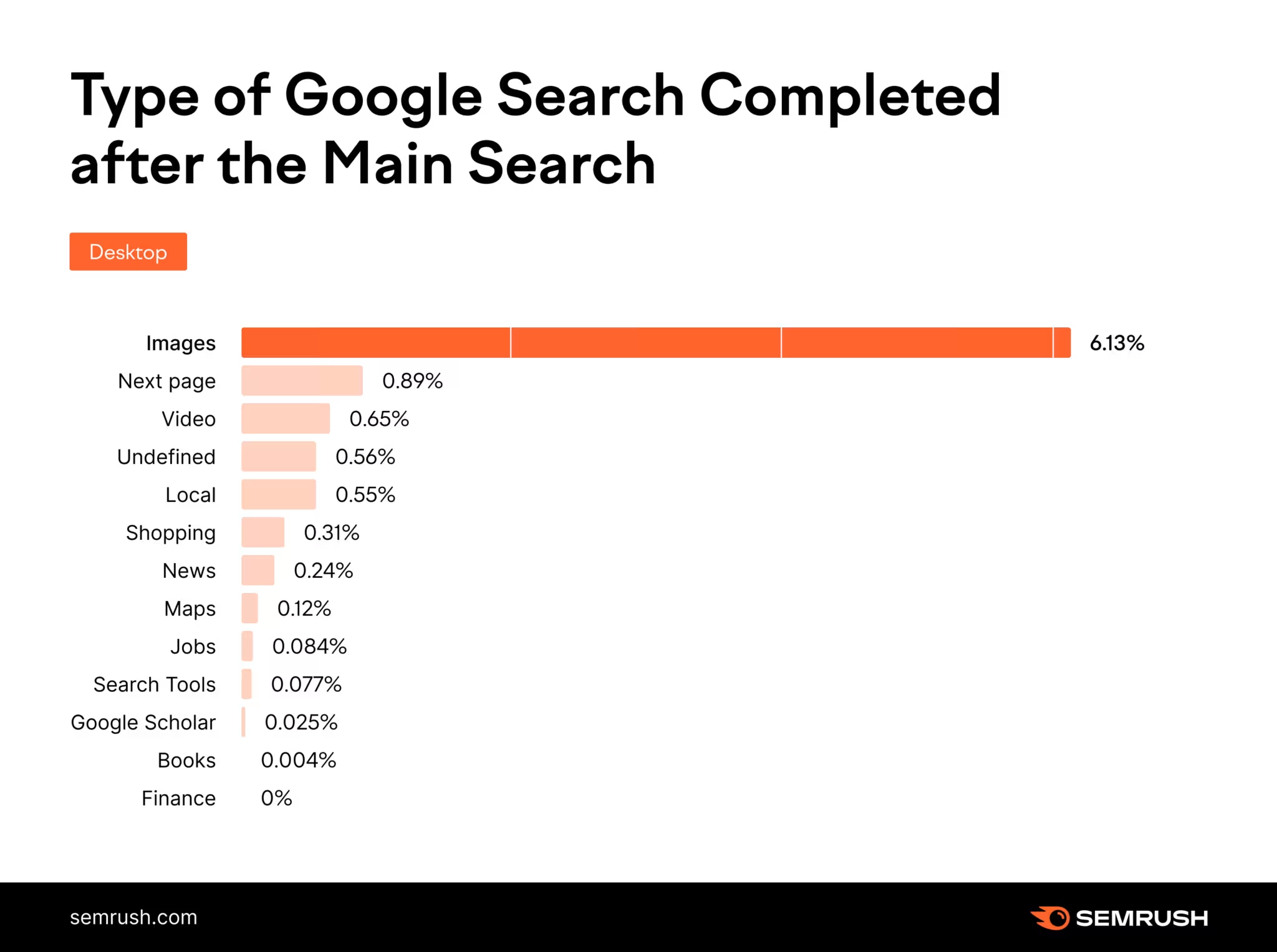
Two Big Takeaways for User Journeys and Behaviors in Search:
- It’s Gotta Be Fast: Google provides URL-less content with direct answers on the SERP to support ease of access for users. So while zero clicks bum out marketers yearning for traffic, users are simply after immediate, effective results from snippets or Direct Answers.
- Complex User Journeys: The journey a user takes toward their ultimate destination may be more complex than some think. Because Google offers so many access points and formats in SERPs, user journeys are multiplied with options. Search is constantly adapting to user needs and behaviors.
What do you think of these findings? What’s your stance on zero clicks and how it’s affecting your SEO strategy?
Spotify Wrapped by the Numbers
DECEMBER 20, 2022It’s the most wonderful time of the year: when Spotify Wrapped goes more viral than Influenza A. Since 2016, Spotify has packaged up your behavioral data and gifted you a snackable, shareable musical reflection of your year. You benefit from some social clout, and Spotify builds serious brand equity. Win-win.
The viral campaign has improved each year, dramatically increasing user engagement and tweet volume. 2022 is record-breaking in impressions, engagements, unique authors, and tweet volume. Within the first three days of its launch, 425,000,000 tweets mentioned Spotify Wrapped.
So, what can we learn from the success of Spotify Wrapped?
- Optimize your content for social sharing. It has to be good enough to share on the grid, and you have to make it easy for users to do so.
- Annual campaigns—which capitalize on a sense of ritual or tradition—have the potential to build major excitement.
- Be a good sport and create brand-specific spoof content, like Guinness (“You spent 119.5 seconds waiting for your pint to settle”).
Check out the full Spotify Wrapped download over at Sprout Social.
Time to Revisit Your Professional Bio 🥱
DECEMBER 19, 2022Here’s the thing about professional bios: no one likes writing them and no one likes reading them. Your bio is meant to introduce and represent you to your colleagues and clients, but it often reduces you to a sleepy list of jobs and skills and organizations. Inject some humanity into your professional bio with some personal trivia—and if you can’t think of a fun fact on the fly, here’s thirteen prompts to get you started:
- Your childhood.
- Your dream occupation.
- Your first car.
- Your hidden talents.
- Your proudest accomplishments.
- What you learned from your biggest mistake.
- The most unusual item in your office.
- Your favorite sports team.
- Your pet.
- Your guilty pleasure.
- Your high school yearbook superlative.
- Your best friend.
- What’s on your bucket list.
Check out the full post on Entrepreneur for more inspiration on the professional bio.
Insights
View AllStrategy7 MIN READ

The AI SEO Checklist: How to Stay Visible in the Age of AI Search
Ana Toigo
Marketing5 MIN READ

Top Marketing Tools That Offer Nonprofit Discounts (2026)
Rich O'Donnell
Strategy4 MIN READ

Sharpen Your Core Skills: Listening, Remembering, and Note Taking
Rich O'Donnell
Uncategorized4 MIN READ
Dialogues: Kimberly Bailey, Head of Marketing at Alpaca
Shannon Sankey
Content2 MIN READ
Know Your Audience: Avian & Saurian Edition
Rich O'Donnell
Content3 MIN READ
Which comes first, the copy or the design?
Rich O'Donnell
Content4 MIN READ
How to Speak Like a Customer—Not Your CEO
Rich O'Donnell
Content4 MIN READ

The New Search Paradigm: How Marketers Can Prepare for SGE
Shannon Sankey
Content2 MIN READ
5 Tips for Marketers Who Hate Writing
Shannon Sankey