Be in The Know
🛒 Amazon ditches Rufus chatbot, launches Alexa shopping agent.
🤖 TikTok opens its ad platform to third-party AI agents.
🇺🇸 Plus, TikTok expands its TikTok Go program in the US.
📅 You can now book consulting business directly from your LinkedIn profile.
Inbox Placement in 2026
Inbox placement is increasingly determined by trust and engagement, not traditional spam-check tactics.
Google, Yahoo, and Microsoft now rely heavily on AI-driven filtering systems that evaluate sender reputation, user behavior, and content relevance.
As a result, we have to demonstrate long-term credibility rather than focus on short-term deliverability hacks.
Here’s what you should know:
- Inbox placement depends heavily on user engagement signals.
- Opens, replies, clicks, saves, and deletions all influence reputation.
- Low engagement can reduce inbox visibility over time.
- Authentication is now a baseline requirement.
- SPF, DKIM, and DMARC are essential for sender trust.
- Improper authentication increases spam-folder risk.
- AI is reshaping inbox filtering.
- Providers analyze behavior patterns and content quality at scale.
- Attempts to manipulate filters are increasingly ineffective.
- List quality matters more than list size.
- Inactive subscribers damage sender reputation.
- Consistent list cleaning improves long-term performance.
- Reputation is built gradually
- Sudden spikes in email volume can trigger filtering concerns.
- Warm-up strategies remain important for new domains and IPs.
- Subscriber experience is becoming the core metric.
- Relevant, expected, and timely content performs best.
- Brands must align messaging with subscriber intent and preferences.
Head to Litmus for the full scoop.

Q for You
Are you planning any America 250 campaigns?
Twilio’s Conversation Layer
Twilio announced a new “Conversation Layer” at SIGNAL 2026, designed to preserve customer context across chat, voice, SMS, and email.
Instead of forcing customers to repeat information every time they switch channels or agents, an identity-based conversation history will follow the interaction across touchpoints.
The system also enables real-time orchestration between AI and human agents, allowing businesses to automate portions of conversations while escalating more complex moments.
Now Streaming 🎙️
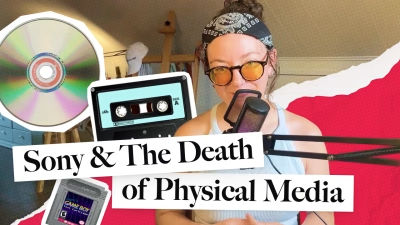
Don’t miss the latest episode of The Daily Carnage Show, “Sony & The Death of Physical Media” to learn more about Sony’s controversial decision to end disc production, the subsequent backlash, and the ongoing debate about consumer ownership.
🎙️ Plus, catch up on Season 2:
- Brand vs. Planet: The Marketer’s AI Footprint (12:14)
- Silent Spring: Is Rainbox Capitalism Dead? (11:41)
- The Future of Google Search (9:56)
- GLP-1s are Disrupting Every Sector (9:56)
- Spirit Airlines 2.0: Will it Fly? (11:08)
- Transgressive OOH (18:45)
- Your Brain on AI (12:33)
- Ethics in the AI Era (18:33)
🎙️ Now streaming on Youtube, Spotify, Amazon Music, and Apple Music.
Sponsor The Daily Carnage
“The Daily Carnage was the newsletter that brought us the most meaningful demo clicks and new trials.” — Digital Summit
“Open rate was nearly 50% and CTR was relatively high, especially considering this newsletter’s audience was likely being exposed to our event for the first time.” — Adweek
Hop on our 2026 sponsorship calendar to get your content in front of 25,000 marketers.
Book a $99 Classified ad instantly, or ask us about our custom sponsorship packages tailored to your campaign objectives.

Hot Dog!
Kraft Heinz’s is celebrating the upcoming 250th anniversary of the U.S. with “The United Tastes of America,” a love letter to the summer cookout.
The campaign brings together the whole portfolio (Heinz, Kraft, Oscar Mayer, and Velveeta) to position backyard grilling as a universal emotional thread through generations and regions.
And while we’re at it, here’s an overview of all the brands on the America 250 bandwagon so far.
r/TheDailyCarnage
Weigh in on The Daily Carnage Subreddit:
- The Daily Carnage Show Ep 2.9 Discussion: “If AI agents become the primary interface to knowledge, what happens to the humans and businesses that knowledge originally came from? What does it mean for the internet to quietly transition from an open ecosystem of destinations into a closed ecosystem of gate-kept answers? Are we speeding toward a future where people stop visiting the web directly? If that behavior ends, we ever be able to rebuild it?”
Ads from The Past

Subaru, 1969