The Daily Carnage
The savvy marketer's hub for industry news, insights, resources, and culture.
Today’s Issue
Issues
View All
Multinational vs Multilingual SEO
AUGUST 6, 2024Multinational SEO and multilingual SEO are often used interchangeably in discussions about global website optimization, but they have distinct differences.
Multinational websites are optimized for multiple countries.
Example: A site targeting English-speaking audiences in the U.S., UK, Australia, and Ireland could be a single English-language site or multiple localized sites with market-specific content.
- Key Considerations
- Geo-targeting
- Domains: ccTLDs vs. gTLDs, separate domains, subdomains/directories
- Schema markup for local details
- Hreflang attributes for language and region
- Localized content: Translation/localization, local info, local interests
- IP detection: Ensuring language doesn’t override users’ locations
- Challenges
- Ensuring correct site indexing
- Avoiding duplicate content issues among sites in the same language
Multilingual websites are optimized for a single country with multiple languages.
Example: A Canadian site in English and French, or a U.S. site in English and Spanish.
- Key Considerations
- Accurate translation
- Cultural relevance
- Alignment with local search intent
- Localization elements
- Schema markup: Must be localized
- Hreflang attributes: Especially with language and market targeting
- Content: Translation/localization, spelling, local info, local interests
- Concepts, entities, and keyword phrase inclusion
- IP detection: Ensuring location doesn’t override users’ language preferences
- Challenges
- Maintaining linguistic accuracy
- Optimizing for local keywords and entities
- Strong geo-targeting signals to avoid confusion
Check out the SEO action items at Search Engine Land.
What You Can Learn From The TikTok Masters
AUGUST 5, 2024Did you know that TikTok users are 1.2x more likely to watch more of a brand’s content, and 1.2x more likely to direct message the brand?
CreatorIQ analyzed the top 100 brands on TikTok, by earned media value between 2023 to 2024, to illuminate the metrics to watch and the strategies that work on the platform. Here’s what you need to succeed:
- Authenticity. 41% of TikTok users associate creators on the platform with authenticity, and this transfers to brand partners. 55% of users say they’re more likely to trust brands when they hear about them from TikTok creators, compared to other ads on the FYP.
- Retention. The majority of TikTok’s top brands have a creator retention rate over 25% YOY, which establishes credibility with audiences over time, increasing conversions.
- Alignment. 55% of users say that TikTok creators help them feel connected to brands. Plus, ads by a creator with a natural affinity to a brand’s vertical are 1.5x more likely to hook a user than those less aligned.
- Engagement. Top brands focus on more than just followers. They select creator partners with a proven track record of engaging the right audiences.
Check out the full report for more tested TikTok insights.
Sharpen Your Note-Taking Skills
AUGUST 4, 2024You can’t analyze and synthesize what you can’t remember. But in an era of multi-tasking, Zoom calls, and notifications, how can you sharpen core skills like note taking?
💬 Paraphrase:
No, not parrot-phrase. 🚫🦜 A parrot can repeat words without understanding them. Paraphrasing requires comprehension.
For exact quotes, rely on recordings and AI transcripts. For understanding, put notes in your own words.
💡 Ideate:
Don’t transcribe. React. Record more than what you hear, jot down ideas sparked by what you hear. Use a different color, placement on the page, or a simple symbol (like an exclamation point) to distinguish those sparks of inspiration or ideas you want follow up on.
✍️ Ditch the keyboard:
For increased focus, comprehension, and retention, create your notes by hand rather than typing them. Allow enough white space for indents, shapes, arrows, and sketches that capture the relationships between ideas. Invest in writing tools that feel great and work well. (i.e. Pick a pen and notebook you can wax poetic over.)
Alternatively take electronic notes with a stylus. Paper-like note taking devices like the reMarkable are a great way to combine the benefits of handwritten note taking with the power of digital tools.
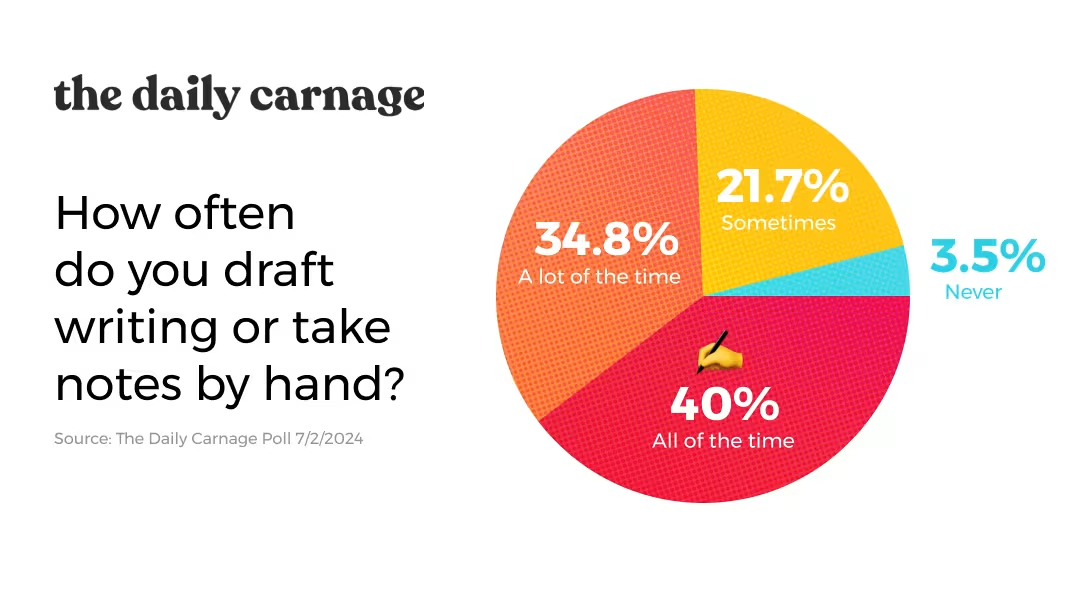
We surveyed some of the sharpest marketers around and almost 75% use hand-written notes all of the time or most of time:
🔁 Review:
Retention is increased by reviewing your notes shortly after they are taken. With the ideas fresh in mind, expand on phrases you jotted down to preserve context that future-you will thank you for. Mark-up and highlight key takeaways.
Or type a summary of your hand-written notes for documentation and to share with your team as needed. (This is also the moment when you have the best chance of deciphering your own handwriting.😉)
Head to the Carney blog to sharpen your listening and remembering skills, too.
Emphasize Progress to Motivate Customers
JULY 31, 2024Open this email.- Try this tactic.
Research shows that people are more likely to take your desired action if you emphasize an already completed step. It’s the law of motion, the power of momentum, the motivation of progress:
- Customers visited a coffee shop more frequently when they were given a loyalty card that started with existing progress.
- Customers bought more wine if their selection became the first product in a bundle.
- Survey respondents provide more detailed answers when each section ends with a completion screen.
How can you put this tactic into motion?
- Let users start with 1 referral instead of zero.
- Tell users their profile is 5% complete, not zero.
- Check off “opening this email” as a first step in your desired action.
In general, acknowledge when your users complete trivial tasks, and give them a little head start on progress.
How often does Google mix ads into organic results?
JULY 30, 2024Google is testing various ad placements, such as under featured snippets and within organic results, which could potentially capture more attention than traditional placements.
Data shows Google generally places 2 ads mixed with organic results on desktop, and one ad mixed with organic results on mobile.
Google favors the spot right after featured snippets for ad placement on desktop, but not on mobile.
Here’s the breakdown:
- 0.31% of desktop SERPs have ads mixed into organic results.
- 0.01% of mobile SERPs have ads mixed into organic results.
- 2% of all SERPs have “normal” ad placement at the top.
- 18% of SERPs with mixed ads place them immediately after a featured snippet.
- Less than 2% of mobile SERPs with mixed ads follow this pattern.
Check out the data at Search Engine Land.
10 Things Freelancers Get Wrong
JULY 29, 2024Matthew Fenton, founder of Winning Solo, shares his 10 major fails as a freelancer of 25 years:
- Lack of initial planning: Make a clear plan and income goals before you begin.
- Pipeline neglect: Continually seek new clients and advance your business every week to avoid income gaps.
- Sales aversion: Approach sales as a conversation, not as a pitch. Listen to understand. Sell them what they need.
- Poor positioning: What does “marketing consultant” even mean? Be specific. It’s okay to lose the sale because they don’t need what you do, but not because they don’t understand what you do.
- Neglected network: Don’t allow professional relationships to go cold.
- Verbal agreements: Relying on handshake deals will come back to bite you. If there’s money involved, get it in writing.
- Reading deficit: Set a yearly reading target. The ROI of a good book can’t be measured.
- Delayed journaling: Start routinely reflecting on your work wins and personal gratitude now.
- Unwritten projects: Make time to write the book you’ve been meaning to write.
- Late support network: Join a community, workshop, or accountability team of freelancers early on.
Read the Winning Solo blog to find out what he did right.
Dialogues: Kimberly Bailey, Head of Marketing at Alpaca
JULY 28, 2024The Dialogues series spotlights marketing mavericks, adland disruptors, and cool creatives in The Daily Carnage community who have new tactics to share. Is that you? Tell us your story.
Meet Kimberly Bailey, Head of Marketing at Alpaca and OG subscriber (’16) of The Daily Carnage.
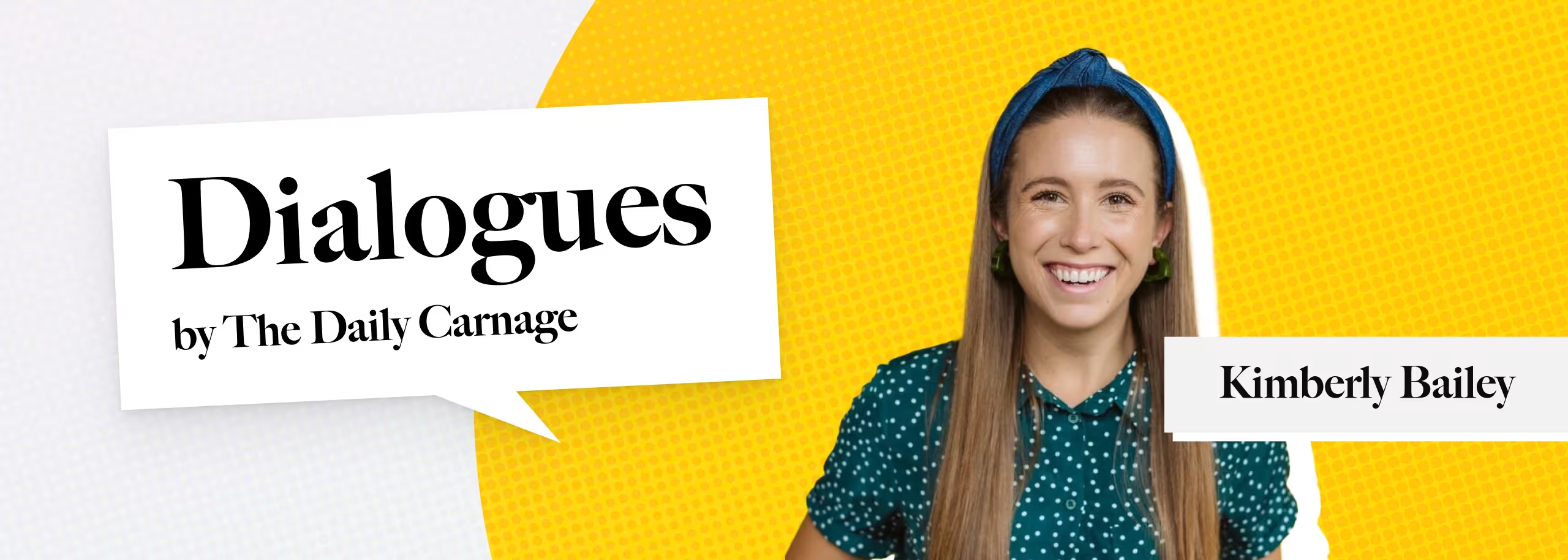
Kimberly started her career at Flywheel, a high-growth startup later acquired by WP Engine, where she advanced from marketing intern to in-house photographer and producer.
Today, she leads marketing efforts at Alpaca, an Omaha-based edtech startup on a mission to make school the happiest place to work.
Alpaca’s employee engagement platform provides pulse surveys to help school leaders understand school culture and teacher wellbeing on a monthly basis, provides actionable insights for school leaders and districts, and prompts thoughtful celebrations for teachers.
We caught up with Kimberly to hear more about the content strategy that grew her professional community to over 2,100 connections on LinkedIn. Here’s what we learned:
- Celebrate your little wins on LinkedIn. Relatability creates engagement and connection.
- Curate your personal LinkedIn feed to learn more about what excites your brand’s target audience—what they celebrate, what they find newsworthy, what troubles them.
- Find creative opportunities for your CEO to repurpose and generate insights for thought leadership content.
Head to the Carney blog to read our conversation with Kimberly.
Hootsuite’s Social Benchmarks by Industry
JULY 24, 2024Let’s get into Hootsuite’s 2024 Social Benchmarks:
Education
- Facebook Page impressions: 817,000
- Facebook audience growth rate: -0.93%
- Average Facebook post engagement rate: 1.45%
- Facebook posting frequency: 0.45 posts/day
- Instagram profile impressions: 1.0 million
- Instagram audience growth rate: 7.42%
- Average Instagram post engagement rate: 2.21%
- Instagram posting frequency: 0.88 posts/day
Entertainment and Media
- Facebook Page impressions: 5.4 million
- Facebook audience growth rate: -3.83%
- Average Facebook post engagement rate: 0.99%
- Facebook posting frequency: 1.78 posts/day
- Instagram profile impressions: 3.2 million
- Instagram audience growth rate: 3.09%
- Average Instagram post engagement rate: 1.94%
- Instagram posting frequency: 1.25 posts/day
Financial Services
- Facebook Page impressions: 858,000
- Facebook audience growth rate: -0.84%
- Average Facebook post engagement rate: 0.91%
- Facebook posting frequency: 0.25 posts/day
- Instagram profile impressions: 724,000
- Instagram audience growth rate: -5.91%
- Average Instagram post engagement rate: 2.00%
- Instagram posting frequency: 0.35 posts/day
Food and Beverage
- Facebook Page impressions: 1.5 million
- Facebook audience growth rate: -12.39%
- Average Facebook post engagement rate: 0.66%
- Facebook posting frequency: 0.3 posts/day
- Instagram profile impressions: 949,000
- Instagram audience growth rate: -3.53%
- Average Instagram post engagement rate: 1.54%
- Instagram posting frequency: 0.81 posts/day
Retail
- Facebook Page impressions: 2.2 million
- Facebook audience growth rate: -5.14%
- Average Facebook post engagement rate: 0.72%
- Facebook posting frequency: 0.33 posts/day
- Instagram profile impressions: 2.2 million
- Instagram audience growth rate: -2.72%
- Average Instagram post engagement rate: 1.62%
- Instagram posting frequency: 0.95 posts/day
Check out the full report for more industry benchmarks.
State of Social Media Saturation
JULY 23, 2024With over 5 billion global users engaging across social platforms, the volume of content is staggering.
Algorithms now prioritize interests over connections, and the constant flow of AI-generated content has maxed out users’ ability to process information. To say the least.
The competition for customer attention is tight. Last year, brands averaged 10 posts per day. With a fragmented social landscape and new platforms emerging all the time, how do we adapt our strategies to combat saturation?
- Invest in a mix of original content and trends for algorithm sustainability.
- Calibrate your content with audience preferences. This means understanding what users expect from each platform and keeping an eye on what formats are performing well.
- Focus on content that offers educational entertainment. Users prefer this content even to memes, according to data, which helps you build deeper connection.
- You’re probably feeling burnt out. Make time for open-ended, creative thinking, external inspiration, and collaborative exercises that promote different perspectives.
- Shift your success metrics from broad reach to more meaningful engagement. A user sharing your content with a friend is a lot more valuable than a few hundred extra eyeballs (and the algorithms tend to agree).
Check out SproutSocial’s guide for more.
Insights
View AllStrategy7 MIN READ

The AI SEO Checklist: How to Stay Visible in the Age of AI Search
Ana Toigo
Marketing5 MIN READ

Top Marketing Tools That Offer Nonprofit Discounts (2026)
Rich O'Donnell
Strategy4 MIN READ

Sharpen Your Core Skills: Listening, Remembering, and Note Taking
Rich O'Donnell
Uncategorized4 MIN READ
Dialogues: Kimberly Bailey, Head of Marketing at Alpaca
Shannon Sankey
Content2 MIN READ
Know Your Audience: Avian & Saurian Edition
Rich O'Donnell
Content3 MIN READ

Which comes first, the copy or the design?
Rich O'Donnell
Content4 MIN READ
How to Speak Like a Customer—Not Your CEO
Rich O'Donnell
Content4 MIN READ

The New Search Paradigm: How Marketers Can Prepare for SGE
Shannon Sankey
Content2 MIN READ

5 Tips for Marketers Who Hate Writing
Shannon Sankey