The Daily Carnage
The savvy marketer's hub for industry news, insights, resources, and culture.
Today’s Issue
Issues
View All
Handwrite Your Next Project
JULY 2, 2024Chew on this: Research suggests that handwriting has significant cognitive and creative benefits. Here’s why you might want to switch back to the pen (or stylus) during your meetings and brainstorms
- Handwriting involves complex coordination between motor and visual systems, engaging the brain more deeply than typing.
- Studies show that handwriting synchronizes brain areas related to motor and visual information processing with memory formation, unlike typing.
- Engaging in handwriting helps create associations between body movements and cognitive processes, crucial for learning and thinking.
- Writing by hand forces you to slow down and process information, leading to better retention and understanding.
Read more from NPR.
Five or 5?
JULY 1, 2024Where are our APA nerds at? You know the rule.
Use numerals for numbers 10 and above. Use words for numbers zero through nine.
But it turns out, you should probably be using numbers alone in your copywriting. According to new data, representing values in digits converts better.
That said, if expertise is what you’re selling, your customers expect visual complexity. In which case, “thirty-minute consult” might be preferable to “30-minute consult.
Start A/B testing to see which style converts better with your unique audience.
Read more about the full study on Nick Kolenda’s blog.
Ignore This Tactic
JUNE 26, 2024You give your audience and customers CTAs all day long. But what happens when you tell them what NOT to do?
Due to FOMO, curiosity, playfulness, and disruption, people are likely to exert their agency by doing just that.
Here’s how to play chicken with your audience:
- “Don’t Click” Ads: Simply tell your audience not to do something, without giving a reason. It works best when the instruction is straightforward and easy to follow. For example, “Don’t click” is effective, but something like “Don’t integrate your 3rd party data sources with our API” is too complex and won’t work.
- Dissonance Games (only use if it suits your brand’s voice and tone):
- “This free download is definitely NOT worth your time.”
- “If you’re happy with boring marketing, look away.”
- “Warning: This blog post might actually make you smarter. Proceed with caution.”
- “The ultimate guide to… nah, just kidding. It’s pretty basic. But helpful.”
- “Thinking of skipping this post? We wouldn’t blame you. But you might miss a hilarious typo.”
- Challenge Marketing: Encourage your audience to prove you wrong, leading to positive outcomes. For instance, if you’re in the fitness industry, challenge them NOT to get in shape using your program.
- Exclusive Clubs / Memberships: By creating a sense of exclusivity and telling people they can’t join, you increase their desire to be part of it. Make your events invite-only, and people will go to great lengths to gain access.
You know what? Forget it. This probably won’t work anyway.
26 Seconds is The New Sweet Spot
JUNE 25, 2024Social media marketing firm Emplifi analyzed data from 325,000+ brand profiles across Instagram, Facebook, TikTok, and X. Here are the key insights:
- Medium-to-long videos ranging from 13 seconds to over 26 seconds performed well on Instagram and TikTok in 2023, suggesting that brands should not entirely dismiss longer video formats.
- Instagram has consistently led TikTok in median video views over the past two years, but TikTok has made small gains in closing that gap across 2023.
- The engagement divide is growing between visually engaging content (on Instagram and TikTok) and its static counterparts (on Facebook and X).
Check out more from the report at Net Influencer.
Optimize Your Ad Frequency to Prevent Fatigue
JUNE 24, 2024You want to make an impression. But for users, too much exposure to any one ad results in ad fatigue and negative brand perception.
Here’s how to optimize ad frequency to prevent fatigue and achieve your objective:
- Conduct consumer research. Start by conducting comprehensive consumer research. Collect consumer preferences, behavior, and media consumption habits through surveys, focus groups, and data analytics tools.
- Implement A/B testing. Experiment with different frequencies on a sample audience to determine which what delivers the best engagement and conversion rates. Do this regularly to continually optimize ad frequency.
- Monitor and adjust. After establishing the ideal ad frequency, monitor click-through rates, conversion rates, and consumer feedback. Use this data to make necessary adjustments. Stay flexible and responsive to maintain the campaign’s success.
For more, check out “Psychological Effects of Ad Frequency on Brand Perception” by Leo Celis.
Optimize Semantic SEO to Rank Higher
JUNE 23, 2024To rank highly, your content must be thorough and cover topics extensively. Here’s how to master semantic SEO:
- Research related topics: Utilize tools such as SurferSEO.com, Frase.io, AnswerThePublic.com, Ahrefs.com, or Google’s Keyword Planner to discover related topics that complement your primary content. Identify the questions people are asking about your main topic and address them within your content.
- Create detailed content outlines: Develop comprehensive outlines for your articles, incorporating both primary and secondary topics. This approach ensures your content thoroughly covers the subject matter and related subtopics.
- Use topic clusters: Organize your content into clusters by creating a central “pillar” page that broadly covers the main topic and links to “cluster” pages that delve into related subtopics. This structure helps search engines grasp the breadth and depth of your content.
- Incorporate user intent: Recognize the different intents behind search queries related to your topic (informational, navigational, transactional) and create content that fulfills these intents. This might include how-to guides, detailed explanations, product reviews, and more.
- Update regularly: Keep your content up-to-date by regularly adding new information, trends, and insights. This practice demonstrates to search engines that your content is current and relevant.
Take a closer look at Search Engine Journal’s comprehensive study on other on-page ranking factors.
How to Implement a Silo Structure On Your Site
JUNE 19, 2024Google highly recommends a silo structure, which organizes your site content into categories and search queries you want to rank for. This structure improves indexability, builds relevance and authority, improves UX, and streamlines content creation.
Here’s how to create a silo structure:
- Determine your theme. Evaluate your webpages that are currently ranking, as well as the keywords and queries you need to rank for. For businesses, your theme should center around your products and services.
- Categorize content. Each category (or silo) should be a thematic group related to one type of service or product, with its own landing page aimed at popular queries.
- Create visual silos. Make the structure of your site clear to users with a toolbar or menu that links to the main page of each category. Link between pages in a silo to establish relevance, and optimize URLs to incorporate the silo structure.
- Optimize content and navigation. Each silo should have strong supporting pages optimized with high-quality content targeting specific keywords. Optimize UX and breadcrumb navigation to keep users navigating through your site and improve CTR.
Check out Entrepreneur to get started.
The 8 Best PPC Ad Networks
JUNE 17, 2024Need a birds-eye view of where to go for what? Here you go.
- Google Ads. Best in class for reaching a wide audience with high-quality traffic.
- Microsoft Ads. Best for reaching a slightly older, higher-income, business demographic.
- Meta Ads. Best for social media engagement, detailed targeting, and comprehensive performance tracking.
- LinkedIn Ads. Best for B2B lead gen and reaching business professionals. High CPCs.
- TikTok Ads. Best for connecting with Gen Z and Millennial trends at scale.
- Amazon Advertising. Best for reaching consumers ready to buy.
- X Ads. Best for engaging in timely conversations.
- Pinterest Ads. Best for reaching young, female audience interested in health and beauty, DIY, home decor, fashion, and recipes.
Take a closer look at Search Engine Journal.
Should You Bid On Your Own Branded Terms?
JUNE 16, 2024Q: “Should I bid on my own branded terms? Why pay for the traffic I could get for free?”
A: If you have a budget for paid search advertising, you should absolutely bid on your own branded terms and pay for those clicks.
Here’s why:
- Sponsored listings take up space at the top of the SERP. A sponsored listing from one of your competitors has the potential to distract users from your organic listing below.
- You can’t bank on organic traffic. In an experiment by Portent, a client lost nearly 600 leads that organic listings did not acquire by pausing branded search campaigns.
Pause your branded search campaigns at your own risk. Take a look at the data from Portent.
Insights
View AllStrategy7 MIN READ

The AI SEO Checklist: How to Stay Visible in the Age of AI Search
Ana Toigo
Marketing5 MIN READ

Top Marketing Tools That Offer Nonprofit Discounts (2026)
Rich O'Donnell
Strategy4 MIN READ

Sharpen Your Core Skills: Listening, Remembering, and Note Taking
Rich O'Donnell
Uncategorized4 MIN READ
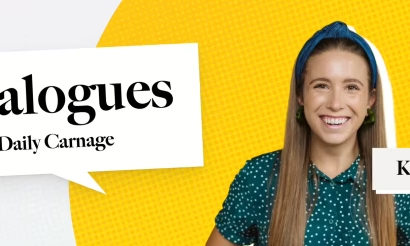
Dialogues: Kimberly Bailey, Head of Marketing at Alpaca
Shannon Sankey
Content2 MIN READ
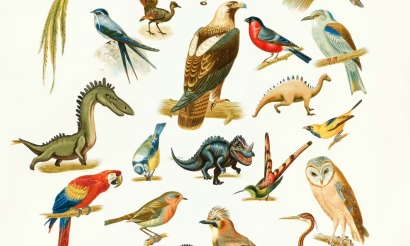
Know Your Audience: Avian & Saurian Edition
Rich O'Donnell
Content3 MIN READ

Which comes first, the copy or the design?
Rich O'Donnell
Content4 MIN READ

How to Speak Like a Customer—Not Your CEO
Rich O'Donnell
Content4 MIN READ

The New Search Paradigm: How Marketers Can Prepare for SGE
Shannon Sankey
Content2 MIN READ
5 Tips for Marketers Who Hate Writing
Shannon Sankey