
The Daily Carnage
The savvy marketer's hub for industry news, insights, resources, and culture.
Today’s Issue
Issues
View All
Make Your Mind Work Like a Million Monkeys
NOVEMBER 28, 2022Writing, creating content, finding new ideas (or better ideas) – these types of things require thought that can be really hard to produce on a daily basis. But, you gotta bring home the bacon somehow, right? So we wanted to share this little thinking theory to help you find better breaking points in your creativity, especially for those who live in team-of-one bubbles.
What is the Infinite Monkey Theorem?
This actually has mathematic origins. It goes like this: A monkey hitting keys at random on a typewriter for an infinite amount of time will almost surely type any given text. The monkey would almost surely type every possible finite text an infinite number of times. “Almost surely” is a mathematical term meaning the event happens with probability 1.
The theory has been altered a little bit to be “a million monkeys on a million keyboards.”

So What?
Imposter Syndrome, that’s what.
When marketers and creators aren’t distracted by negative forces, they make their best work. The million monkeys are your key to tuning everything out, laying down work, and picking out the best parts of it to refine.
Start Monkeying Around:
- Sit down at your laptop or notebook or preferred writing tool
- Close your eyes and clear your mind
- Type the first word that comes to mind. And then the next. And then the next. Type random words without worrying about sentences or any of the words before it.
- Start slow if you have to, but try to develop a rhythm so you don’t distract yourself.
- Go at it for 20-30 minutes.
- Read it back and highlight chunks that stand out to you.
- Now turn your brain back on and polish what you wrote into a fully fledged idea.
To Write with Wild Abandon has a full charming blog all about the best ways to let your creative freak flag fly. Check out the full post for more on how to put your monkeys to work.
How Brands are Using YouTube Shorts
NOVEMBER 27, 2022Shorts are great to entertain your audience and help you to possibly persuade the right peeps to take action with your brand. They’re a little different than TikToks and Reels, so we’re going to break down how to use them properly.
Benefits of YouTube Shorts:
- You can reach a wider audience. YouTube has 774.6 million active mobile users.
- Shorts can tell stories. Use it for highlights, recaps, short observations, or even a multi-part series that can gain traction.
- It’s getting hot. Users are more likely to see Shorts than your longer-form video content hosted on YouTube because brands are just now getting in on the action.
How to Make Shorts:
- Check out the YouTube app. YouTube has native editing tools right in the app.
- Specifically create a Short. You don’t want to just re-upload a TikTok (we know, it’s tempting to reduce steps in your process). PLUS you only have 60 seconds for YouTube Shorts, so make it count.
- Mind Your Ps and Qs. YouTube doesn’t follow trending audio and music in the same way that TikTok and Instagram does. BUT you should still consider adding a music track, text, and filters to improve your video overall. Be sure to make it public.
Check out the full post by Metigy for real examples of successful Shorts that worked for brands and creators.
5 Lessons to Learn From Successful Holiday Marketing Campaigns
NOVEMBER 22, 2022If you are running camapigns specifically for the holidays, you likely have your strategy set in stone by now. But we wanted to recap the core essentials to successful holiday marketing, in case you need to tweak anything before you launch.
- It Needs Emotion. Happy, sad, hopeful, nostalgic. All of the emotions. The holidays are about family, friends, and giving. It’s your chance as a brand to show your soft side. Focus on connecting with your audience through those relatable emotions.
- B2B Has a Place Under the Tree. Holiday marketing isn’t just about shopping deals, it is also about educating your customers. Take chances on your creative for memorable holiday campaigns and gifting for your customers.
- Spread Goodness and Cheer. Like we said, it’s the season of giving. Give through a cause or to your community. It promotes a positive image for your brand, BUT authenticity is key. Do it for causes close to your brand values.
- Reduce Stress. Especially because of the focus on family, shopping, and the year coming to an end, the holiday season can also become stressful time. Find ways to reduce the stress for your customers where you can. That can be through helpful content like guides, quizzes, and freebies.
- It’s Gotta Be Mobile. You cannot ignore the use and importance of mobile shopping. So ensure your user experience is seamless. Engage (and encourage) customers to shop through their smartphone with different communications.
Check out the full blog post by MoEngage for actual campaign examples at work!
Fixing Your Thin Content for Better SEO
NOVEMBER 21, 2022Your website is essential for delivering information to your visitors and capturing new visitors based on its searchability. So then why are we still seeing thin, flimsy, weak af content out there? Let’s help ya out with ways to fix that.
What is thin content? Thin content is generally content that does not provide value to users. So either the quantity or quality (or worse, both) of your page’s content isn’t satisfactory. Common types of thin content include duplicate/repetitive website content, low-quality affiliate pages, and overwhelming pages with too many ads or popups.
How does thin content hurt SEO? Pages with thin content bring your overall website authority down, cannibalize keywords, or get deindexed. The simple solutions are to remove, improve, or consolidate. Let’s break that down a little more.
Top ways to fix and avoid thin content:
- Show that you’re a real company or brand. Your goal with your website is to show that you’re a real person behind a real company that values customers. Start with a well-written and optimized “About” page and showcase some of your real work.
- Use a clean, modern, usable website design. The design and colors of your website have a direct effect on the psychology and experience of your buyers.
- Always write original content that adds value. Original content is received better by your users (and by Google). It doesn’t always have to be entirely new information on the topic – just more helpful.
- Paraphrase content, but never plagiarize it. Google can detect plagiarized content – and isn’t happy about it when it finds it. Instead of directly copying anything, break it down into simpler terms or expand on it in more detail.
- Write 1000-1300 words on articles, 700 words on landing pages. The length by itself isn’t what makes you rank higher. So while 1000 words is not a magical number, in-depth content typically doesn’t happen without a higher word count.
- Redirect shallow pages with no traffic or duplicate content. After an analytical crackdown to identify pages that have no purpose or target keywords, you can decide what pages need to be upgraded or removed. BUT don’t just delete a page. Add a 301 Redirect to it, pointing the URL to the next most relevant page.
Check out the full post by Morning Score to get more tips on how to identify thin content and the full list of 13 ways to fix it.
BFCM is Cool. But What About Cyber Week II?
NOVEMBER 20, 2022The five-day period that runs from Thanksgiving and Black Friday through Cyber Monday is also called the Cyber 5, Cyber Week, or Cyber Weekend. It’s one of the biggest lead ups to Christmas and contributes billions towards holiday shopping. But what do you call the week after Christmas?
Let’s Talk About Cyber Week II
Here are some tips on how to make the most of Cyber Week II and end the year strong:
- Get inside shoppers’ heads. With any marketing, sales, or campaign, understanding a consumers’ mindset is essential. During the holidays, there are common buying scenarios that you need to think about and how they could apply to your brand. That includes underwhelming gifts to exchange, gift cards burning holes in pockets, the year-end deal seekers, and appealing to New Year’s resolutions.
- Make shopper behavior work in your favor. Create a targeted eCommerce strategy by aligning your sales goals with shoppers’ needs and wants during the post-holiday season. Some ways to do that include EOY sales or retargeting your holiday shoppers who are ready to make exchanges or find additional discounts. (Check out the full Channable post for a whole bunch of ad campaign ideas.)
- Have the latest and greatest updates. Keep your shopping streams, social channels, announcements, and product information as up to date as possible. Check that your data is accurate, organized, and optimized to the specifications of each marketplace.
- Maximize your feeds. You have your tried-and-true platforms, and those are cool, but don’t be afraid to experiment with new ones.
- Plan ahead. The time to plan ahead has passed but it’s not to late to end the year with a bang. After reviewing your ad data, set your ads up now or in early December to launch by December 27.
Check out all of the ad, marketing, and strategy tips for Cyber Week II on Channable’s post.
How to Wrap Up 2022 & Create Plans for a Strong 2023
NOVEMBER 16, 2022Q4 is zooooming on by. We’re sharing this checklist as a way for you to see how you’re wrapping up your year-end plans before diving into your new year strategies.
The top 4 areas of 2022 to wrap up:
- Conduct an analytics review for the year
- Identify your BEST clients, customers, and referrals to support in 2023
- Clean up your data and databases
- Speak with stakeholders about 2022 performance and 2023 goals
Questions to ask:
ANALYTICS
- What were our key performance indicators (KPIs) and goals, and are they still the right ones?
- Did we reach our goals?
- What worked? What didn’t?
- How did 2022 compare to past years?
- What are the noticeable trends? Monthly or seasonal changes to the analytics?
- Did you set up your site for GA4?
MARKETING
- Are we reaching the right customers? Do we need to revisit our buyer personas?
- Are we launching any new initiatives or products? What will we need to start marketing those new offerings?
- Do we have the right marketing budget? Do we need to invest more in something?
BIG PICTURE
- What do we want to stop doing, start doing, and keep doing?
- What did we do in 2022 that we would like to improve on? What can we do to create better results?
- Where do we see our business this time next year? 5 years? 10 years?
Check out the full post by Spot On Digital Media for more 2023 planning ideas.
The 6 Best FREE Keyword Research Tools in 2022
NOVEMBER 15, 2022If it’s free, it’s for we.
We love sharing the best freebies around for your SEO and keyword researchin’ needs. Let’s break down the top contenders of 2022:
- Moz Keyword Explorer: This is one of the go-tos for general SEO support and keyword research. While Moz only shows a few metrics for keywords, that’s kinda a good thing. Moz uses a “Priority Score” to simplify keyword research by giving you the bottom line on whether a keyword is worth chasing.
- Google Keyword Planner: It’s no surprise that one of the biggest platforms for paid ads are going to have a tool that is ideal for for researching paid keywords. Even if you don’t buy Google Ads, the Google Keyword Planner is a MUST for in-depth research on search volume, forecasting, and new keyword discovery.
- Semrush: If you need some advanced SEO support, Semrush has a slew of tools to help. If you need initial, low-volume research, that’s free and easy. The more granular you get, the more likely you will have to pay for these tools (watch out for those keyword rabbit holes if you do).
- QuestionDB: Just as the name suggests, this is perfect for finding question-based keywords. This thing sources from forums, social platforms, and search engines to find the how’s, why’s, and what’s that people are asking. Then it’s up to you to answer those big questions.
- Jaaxy: This lean tool is great for affiliate marketers, especially those just getting started. They have valuable access to a keyword’s Alexa/voice rankings and affiliate programs.
- Keyword Surfer: Get keyword insights as you Google around with this easy browser extension. This includes data like search volume and SERPs. Plus they have a Free AI Article Outline Generator to help your SEO hierarchy.
Check out the full post by Zapier for all the pros, cons, and premiums.
I Got 99 Problems … And They’re All Related to Keywords
NOVEMBER 14, 2022SEO isn’t just about keywords, listicles, or interrogative statements these days. (Think: How do I teach my dog to sit?) It’s all about the content, baby. It’s great that the algorithm is picking up on actually useful content, but it can be a little overwhelming to know where to start with your own content.
Search Engine Journal essentially breaks it down to topic modeling and topic clusters.
Don’t worry if that doesn’t immediately click, think of it this way:
Topic modeling
Topic modeling works like this: rather than just hitting on specific terms, you’re providing more context which lets Google know more precisely what and what isn’t covered in your page or article.
Topic cluster
A topic cluster is basically a series of pages with related content that all tie together. You’ll want to start with a main page that flows out to related sub-content.
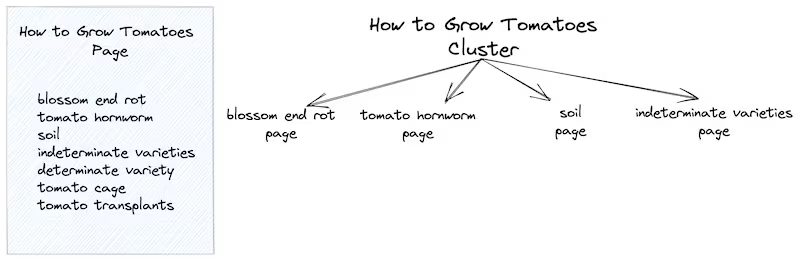
Google is really looking for pages that show that they’re experts in a field or topic, have credibility and will provide the most useful or interesting content. Read the full post from SEO Journal to maximize your SEO and content.
The 2022 TikTok Holiday Marketing Guide
NOVEMBER 7, 2022TikTok is great at providing marketers with educational resources for its platform. They recently published a holiday marketing guide. It provides some insights into user engagement trends around the holidays, and tips for planning content.
We wanted to share some of our favorite bit-sized bits of the guide.
Key dates to keep in mind:
- Nov 24 Thanksgiving
- Nov 24 Black Friday
- Nov 26 Small Business Saturday
- Nov 28 Cyber Monday
- Dec 18 Hanukkah
- Dec 24 Christmas Eve
- Dec 25 Christmas Day
- Dec 26 Kwanzaa
- Dev 26-31 End of Year promotions
- Dec 31 New Year’s Eve
- Jan 1 New Year’s Day
- Jan 1-30 New Year’s sales + resolutions

Planning for your campaigns:

A Breakdown of different TikTok formats:
TikTok provides several tools and templates to help marketers out. Here are tips of when to use each tool based on the type of content you want to share:
- Smart Video: Generally used for combining videos, photos, or both.
- Smart Text: Great when you don’t know what to use for captions.
- Smart Video Soundtracks: Get music inspo right from the source.
- Quick Optimization: Automatically create “TikTok-style” video formats.
- Asset Analysis Report: TikTok’s analytics for all of your creative performance data.
There’s also an overview of TikTok’s various ad options, and how to make best use of each plus key planning tips and approaches. So go ahead and grab this guide for yourself by smashing the button below.
Insights
View AllStrategy7 MIN READ

The AI SEO Checklist: How to Stay Visible in the Age of AI Search
Ana Toigo
Marketing5 MIN READ

Top Marketing Tools That Offer Nonprofit Discounts (2026)
Rich O'Donnell
Strategy4 MIN READ

Sharpen Your Core Skills: Listening, Remembering, and Note Taking
Rich O'Donnell
Uncategorized4 MIN READ
Dialogues: Kimberly Bailey, Head of Marketing at Alpaca
Shannon Sankey
Content2 MIN READ
Know Your Audience: Avian & Saurian Edition
Rich O'Donnell
Content3 MIN READ

Which comes first, the copy or the design?
Rich O'Donnell
Content4 MIN READ

How to Speak Like a Customer—Not Your CEO
Rich O'Donnell
Content4 MIN READ

The New Search Paradigm: How Marketers Can Prepare for SGE
Shannon Sankey
Content2 MIN READ

5 Tips for Marketers Who Hate Writing
Shannon Sankey