
The Daily Carnage
The savvy marketer's hub for industry news, insights, resources, and culture.
Today’s Issue
Issues
View All
3 Retargeting Solutions to Utilize Right Now
NOVEMBER 14, 2021If at first your ad doesn’t succeed, retarget ’em. Retargeting uses a user’s online behavior to serve them relevant ads. This is typically from paid ads, website visits, and search activity.
Now, retargeting takes as much strategy as your general ad strategy because you don’t want to retarget just anyone who happened upon your brand. And because of the changing policies of cookies, pixels, and data privacy, retargeting is not amateur hour.
Here are three expert tools that can get you on the right track for retargeting potential customers.
- Criteo: One of the best practices for retargeting is to personalize it. Criteo is a great tool for giving warm leads personalized offers. With machine-learning, Criteo uses pixel information as a jumping-off point for previously viewed products and related products to make special offers.
- AdRoll: What do you do if someone leaves your form or abandons a cart? AdRoll will fix that up for you. AdRoll uses segments based on behaviors and traits to retarget. They pinpoint users that show genuine interest in your product, ensuring they are as warm as possible instead of every Joe Shmoe that hit your landing page.
- RollWorks: Do you have a lead database? Rather than lead nurturing, RollWorks offers lead scoring and account organization. RollWorks take a different perspective on retargeting by laying out your warm audiences for more in-depth retargeting strategies. They offer easy automation, email retargeting, and pipeline management. They’re also a killer education resource for retargeting and account-based marketing in general.
Learn more about retargeting solutions and examples on What Runs Where’s full post.
12 Paid Advertising Mistakes
NOVEMBER 10, 2021Paid media can be a beast. There are so many variables for what makes or breaks a campaign. Semrush gave a list of 12 common mistakes made when it comes to paid advertising. We can’t fit them all, so we wanted to list the top 6 big fudges that we see in paid ad campaigns that aren’t doing it for clients.
- One and done ad sets: Two big variables in ads are creative and copy. If you aren’t testing out different ad sets with different words or visuals, you could be throwing money at something that isn’t working over and over again.
- Leaning too much on search engine settings: Smart campaigns and default settings are great to try, but they might not be in your campaign’s best interest. While they are easy, automatic settings aren’t always going to help your goals.
- Ignoring competitors: If you aren’t seeing what competitors are doing, how are you standing apart? See what keywords they are bidding on and if they are worth exploring your brand as well.
- Not knowing what to bid on: Now, bidding strategies are a whole world of their own. Determine your goals and then find your best bidding strategy to support them.
- Driving traffic to irrelevant (or icky) content: Listen, your ads are going to be wasted if you’re landing page is bad. And if you aren’t directing traffic to content that aligns with the intentions of a user, they’re gonna bounce.
- Not enough testing!: Unfortunately, paid ads are rarely a 100% hit. There’s going to be some misses, or some slow burns, along the way. You have to continuously test to see how you can influence ad performance.
Read Semrush’s full blog post for the rest of the goofs you could be making with your paid advertising.
Building Your Marketing Team
NOVEMBER 9, 2021You know the saying, “Teamwork makes the dream work.” There are several moving parts and essential roles for your marketing team to operate like a well-oiled machine.
Does your marketing team have these roles covered?
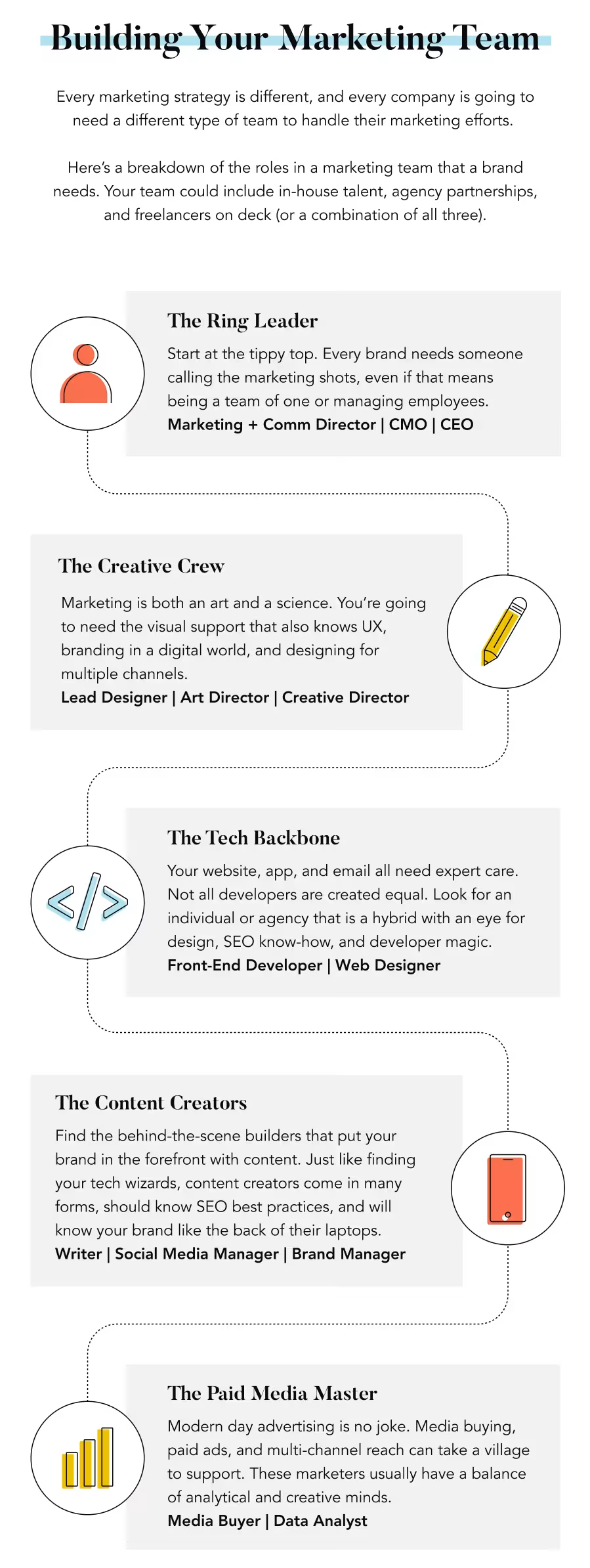
SHARE IT: bit.ly/carnageteams
10 Signs It’s Time for a Website Redesign
NOVEMBER 8, 2021You shouldn’t judge a book by its cover…but you can judge a brand by its website. It’s not enough just to have a website, you have to have a good one. Okay, checkmark. But how long do you keep it as is? Here are the signs that it’s time for a website redesign:
- Leads are Dropping: Now all sorts of variables go into leads, but one of the main purposes for your website is for information potential customers. How are your landing pages and contact forms doin’?
- Low Engagement: Your website quality is a huge driver to people eating up your content, too. If you’re noticing really low levels of engagement for your blogs, videos, etc., it’s time to investigate options.
- Slow Page Loads: People want results NOW. If you’re noticing high bounce rates and slow page speeds…it’s time to optimize.
- Outdated Web Design: You gotta stay with the times! Aesthetics are essential and you don’t want a website that’s too busy.
- Inconsistent Branding: A website redesign is a chance to iron out all branding no-nos.
- Low SERP Rankings: Getting a redesign is a good opportunity for SEO best practices to be baked into your new site.
- Broken Site Elements: We’re not just talking about a redesign for the sake of looks. Your site also might need a boost in functionality.
- Different Experiences on Different Devices: You better be mobile-ready and responsive to make it nowadays.
- You’re Outgrowing Your Current Site: It’s a good problem to have, right? But don’t let the urgency of growth overshadow the need for a new site.
- Outdated or Nonexistent CMS: Content management systems are essential for easy edits and updates, but they are not a one-size-fits all situation. And are you up to date on your CMS updates?
Check out Virtual Image’s full post for more examples of what your site might be experiencing or missing!
Microcopy to Boost Your UX
NOVEMBER 7, 2021Every little bit counts when it comes to UX and what you are saying to your users. That’s where your microcopy comes to play.
We’ve covered this little slice of copywriting before, but let’s give you a refresh on microscopy. Microcopy is every tiny bit of copy on an interface. Some great examples are clever CTA’s (most commonly), product labels, descriptions, placeholders (especially for search bars), basically anywhere with text that isn’t your main attraction of copy.
Reasons to care about microcopy:
- It gives more opportunities to inform your users.
- In turn, that means fewer chances for weak user experiences.
- It helps express your brand voice.
It’s good stuff, right? It’s one of those details for your UX that can set you apart from a competitor with a similar site, product, or packaging. But how do you use microcopy as effectively as possible?
Here are best practices for using microcopy:
- You’re gonna need a crystal ball – Microcopy used well anticipates the needs of users before they know it. Look at your interface and walk yourself through it while asking where you could possibly add guidance or more information.
- Keep your microcopy micro – Short, sweet, and to the point is the mantra for most instances of copy. Microcopy should be as brief as it gets to nudge a user.
- A/B test your microcopy, too – Obviously, A/B testing is your go-to for all things being touched by a user to make sure it’s performing at its best. Test out your different CTAs, banners, and search fills.
Algolia is a developer of a few search-related products, so they know their stuff on UX. See their full post to see prime examples of companies using microcopy.
10 of the Best Email List Cleaning Services
NOVEMBER 3, 2021You could have the sickest-looking email, with the best content you’ve ever written…but it could go to waste being sent to a junk list. Email lists need to be cleaned and reviewed pretty often for a lot of reasons. The top reasons being:
- Lower bounce rate
- Protect domain and improves sender reputation
- Increase email ROI and save your spend
- Lowers spam complaints
- Improves click rates and open rates
So to make sure you’re getting your best possible list of emails, here are some tools and our favorite feature about them:
- Bouncer: Also protects from fake sign ups and spam attacks.
- ListWise: They specialize in high volume lists.
- Bouncify: You can customize veritification results.
- ZeroBounce: Solid monthly subscription and pay as you go options.
- Email Verifier by SendPulse: The best email accuracy tool!
- DeBounce: Easy integrations, and for smaller lists, 500 emails for free!
- Snov.io: Tons of integrations across sales and marketing tools.
- Data Validation: Also great or smaller lists with 500 emails for free.
- NeverBounce: One of the fastest services in the game.
- Bounceless: Some really affordable packages!
MyWPLife takes it even further for you by breaking down each service’s pricing (plus a few honorable mentions), so check out their full list.
How To Use Wikipedia as a SEO & Content Marketing Tool
NOVEMBER 2, 2021Wikipedia is one of the top resources for information online. It has a huge pull on Google, too, for general SEO and especially for Google Knowledge Panels. Wikipedia pages also rank for half of all searches, often because people link to them so often.
Here are the main ways your business can use Wikipedia as a content and SEO tool:
- Topic Research: Google has been moving away from phrase matches and keywords in favor of topics. You can still gauge interest based on Wikipedia article traffic. Try it out for yourself with http://stats.grok.se/
- Keyword Research: Now hold on, keywords still have their SEO value. Wikipedia is known for being a rabbit hole, and that goes for all of the related terms that can come with a given article as well. It’s perfect for marketers trying to figure out the most-used terms for related keywords.
Wanna use Wikipedia to your SEO advantage? Here are two ways how, but let’s keep it ethical out there, guys (everyone wants to keep Wikipedia as promotion-free as possible):
- Help a Wiki Out: You can add links to your content for broken and missing citations. Do this by searching Google for “site:wikipedia.org [keyword] intext:“dead link” (or “citation needed”)” and see if your link is relevant.
- Make a Company Wikipedia Page: Does every business need a page on Wiki? No. But if you think yours does, there are a lot of advantages to using it for overall awareness and search crawls. And as we mentioned, Wikipedia is a major source for Google Knowledge Panels.
Shivar Web gives a whole lot more details on Wiki links, content strategy ideas, and how to use Wikipedia with Keyword Planner in their full post, so check it out!
The Litmus 2021 State of Email Report
NOVEMBER 1, 20212021 is a big year for data. After Covid-19, metrics that marketers held near and dear to their hearts are nearly irrelevant. The pandemic shifted the shopping and consumption habits of the world, and 2021 was the year of adapting to those changes.
Litmus, the top dog of email data and testing, has been a guiding light to navigating privacy changes and best practices moving forward. So we just gotta share their 2021 State of Email report. The report explores personalization, privacy, adaption, and overall successful emails.
Here are some stats that we are keeping in our minds for a while:
- Over 90% of survey participants said that email marketing is critical to the overall success of their company.
- Over 40% of companies intend to increase their investment in email marketing in 2022….but on the other side of that coin, only 60% said they have a full grasp of their email ROI.
- BIMI, or Brand Indicators for Message Identification, is becoming increasingly important to markets with over half of the responders saying they plan to incorporate them in 2022.
- Almost 60% of marketers want to expand their email automation efforts.
- Over 60% of responders say they use email threads or comments for proofing as opposed to messaging apps or video calls.
Litmus also covered how to prepare for privacy and tracking changes in the near future. If you want to see how to get your emails ready for Apple Mail’s Privacy Protection, see their post here.
Check out the full report for yourself to see where your brand lands among the surveys.
Tips from a Pro Copywriter
OCTOBER 31, 2021The Digital Marketing Institute had copywriting expert Kate Toon on their “Ahead of the Game” podcast to discuss everything on good copy. We broke down the takeaways from the discussion so you can start cranking out your best copy and content (and yes, they discuss the difference between the two).
- 1:45 Copywriting’s Place in the Marketing Funnel: So at its core, copywriting is about persuasion, and persuasion involves relationship building. Copywriting really is at every stage that involves trust and CTA’s (and “micro-copy”), but it’s definitely essential to customer consideration.
- 10:00 That Tricky Tone of Voice: Think of what you stand for, and what you don’t. Now take that and think about how you want those values to be talked about, and literally write it down. Then break it down into smaller pieces. The big thing to know is that Tone of Voice documents are living, breathing, and not set in stone.
- 35:30 Tips for Hiring Copywriters: For the business owners and agencies out there needing writers, this is for you. Be clear in briefs on deliverables, but more importantly the “why” behind those deliverables. Stalk the work! Get examples from a writer, but also get the briefs behind them to see if they understood the assignment.
- 40:15 Five Things to Improve Your Copywriting: 1) Don’t get stuck in formal writing. 2) Talk it out, write it all down, and read it back. 3) Try turning your “we’s” into “you’s.” 4) Kate loves the Hemingway app to take a pulse on your writing. 5) Push the fun boundaries and don’t let mistakes get you down.
Check out Digital Marketing Institute’s full 45-minute podcast for more writing tools and industry tips.
Insights
View AllStrategy7 MIN READ

The AI SEO Checklist: How to Stay Visible in the Age of AI Search
Ana Toigo
Marketing5 MIN READ

Top Marketing Tools That Offer Nonprofit Discounts (2026)
Rich O'Donnell
Strategy4 MIN READ

Sharpen Your Core Skills: Listening, Remembering, and Note Taking
Rich O'Donnell
Uncategorized4 MIN READ
Dialogues: Kimberly Bailey, Head of Marketing at Alpaca
Shannon Sankey
Content2 MIN READ
Know Your Audience: Avian & Saurian Edition
Rich O'Donnell
Content3 MIN READ

Which comes first, the copy or the design?
Rich O'Donnell
Content4 MIN READ

How to Speak Like a Customer—Not Your CEO
Rich O'Donnell
Content4 MIN READ

The New Search Paradigm: How Marketers Can Prepare for SGE
Shannon Sankey
Content2 MIN READ

5 Tips for Marketers Who Hate Writing
Shannon Sankey