Be in The Know
🤖 Google says its AI-powered ads help some brands lift online sales by 80 percent.
🎬 Netflix launches ad-free playground for kids.
🍎 Apple Maps’ ads shift focus to context and intent.
💼 How LinkedIn became a top source for ChatGPT and other LLMs.
💧 Liquid Death lets incrementality decide what tactics to kill and what to keep.
👻 Snapchat users visit the app for health and medical advice.
Why Internal Search Fails
Users routinely abandon a website’s built-in search in favor of external engines like Google, even when looking for content on the same site. This happens because most internal search systems still behave like rigid indexes, requiring exact keyword matches rather than understanding intent. This is a “syntax tax.”
When a search bar can’t handle synonyms, typos, or natural language, users just leave. Meanwhile, large search engines succeed because they interpret meaning (through techniques like stemming and context modeling), not just strings.
Improving findability—through better labeling, semantic relationships, and “fuzzy” matching—can dramatically improve outcomes without changing algorithms.
Here’s what to know:
- Internal search often fails due to exact-match logic, not lack of data
- The “syntax tax” forces users to guess system vocabulary
- Users quickly abandon sites after failed searches
- Semantic understanding (not keywords) is what makes Google effective
- Poor IA (labels, metadata, taxonomy) hides otherwise valuable content
- Designing for “maybe” results (fuzzy matches, suggestions) keeps users engaged
- Search should act like a concierge, not an index
- Fixing search is often an IA problem, not an engineering one
Head to Smashing Magazine for more.

Smash or Pass
Semrush extinguishes the red fireball in a logo redesign (right).

Google Chrome Vertical Tabs
Google Chrome has launched vertical tabs and an upgraded reading mode to improve focus and navigation.
Instead of cramming tabs across the top, vertical tabs stack them along the side, making titles fully visible and far easier to scan.
The enhanced reading mode strips away ads, sidebars, and unnecessary UI and turns any article into a more immersive experience, closer to reading a document than browsing a webpage.
Now Streaming
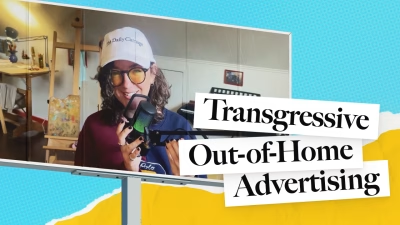
✨ Don’t miss the latest episode of The Daily Carnage Show, Transgressive Out-of-Home Advertising (18:45).
Shannon gives a brief history of OOH—all the way from ancient murals to Mail Pouch Tobacco barns to augmented reality. Then, we deep dive into 12 examples of transgressive OOH in the 21st century that changed or challenged how we as a public move through space and time.
Catch up on Season 2:
- Your Brain on AI (12:33)
- Meta, McDonald’s Mukbang, and The OpenAI Mess (14:41)
- Ethics in the AI Era (18:33)
🎙️ Now streaming on Youtube, Spotify, Amazon Music, and Apple Music.

Woman of The House
The “Woman of the House” campaign by L’Oréal Paris, created with FP7 McCann, reframes the traditional label of “housewife” (sit bait) into a title of pride, leadership, and authority (Sit Al Bait).
By adding just two letters (“al”), the campaign transforms a limiting term into one that recognizes women as decision-makers and leaders within and without the home.
r/TheDailyCarnage
Weigh in on The Daily Carnage Subreddit:
- The Daily Carnage Show Ep 2.9 Discussion: “If AI agents become the primary interface to knowledge, what happens to the humans and businesses that knowledge originally came from? What does it mean for the internet to quietly transition from an open ecosystem of destinations into a closed ecosystem of gate-kept answers? Are we speeding toward a future where people stop visiting the web directly? If that behavior ends, we ever be able to rebuild it?”
Ads from The Past
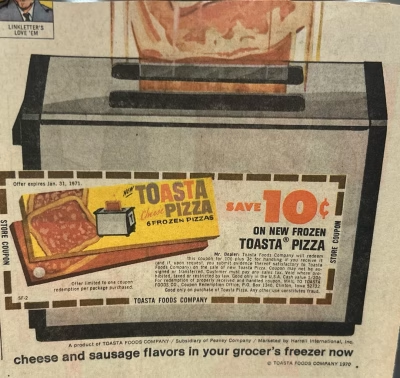
Toasta Pizza, 1970