
The Daily Carnage
The savvy marketer's hub for industry news, insights, resources, and culture.
Today’s Issue
Trending
Issues
View All
How Do AI Detectors Work?
JULY 28, 2025AI detectors work by analyzing two key traits:
- Perplexity: Measures how predictable the text is. AI content is often low in perplexity. So, smooth and logical, but sometimes too perfect.
- Burstiness: Evaluates sentence length and variation. AI tends to maintain uniform sentence structures with little variation in rhythm and complexity.
Modern detectors also use tactics like machine learning classifiers, embeddings, and experimental watermarks.
Despite their sophistication, AI detectors are not infallible. Accuracy ranges from 65% to 85%, and they can be tricked by paraphrasing or editing.
Here’s what AI detectors look for:
- Repetitive phrases or structure
- Predictable next-word choices
- Limited variation in sentence length
- Unnatural tone or flow
- Lack of idioms or figurative language
Keep in mind these limitations:
- False positives (human writing flagged as AI)
- Inconsistent results between tools
- Bias against non-native English writing
- Vulnerability to basic editing tricks
The takeaway here? Detectors aren’t definitive. Always pair scores with context and good old judgment to make informed decisions.
TikTok SEO in 2025
JULY 28, 2025TikTok has become a full-fledged search engine, reshaping how we discover brands, tutorials, and ideas.
If your content isn’t optimized for TikTok search, you’re missing out on long-term visibility. That’s where TikTok SEO comes in.
To stand out, you have to speak your keywords, include them in captions and on-screen text, and understand how TikTok’s algorithm tailors content based on search behavior, engagement, and context.
Here are 7 best practices for TikTok SEO in 2025:
- 📄 Use keyword-rich captions. Write exactly what your audience would search.
- ✍️ Overlay relevant on-screen text. Reinforces search terms visually.
- 🎙 Say your keywords out loud. TikTok indexes spoken phrases.
- 🏷 Use niche, relevant hashtags. Avoid overloading with generic tags.
- 📁 Rename your video file. TikTok reads filenames before upload.
- 💬 Engage in the comments with keywords. Strengthens context.
- 📊 Track and iterate. Use analytics to double down on what works.
Check out EmbedSocial’s guide to TikTok SEO for more.
Localization SEO That Works
JULY 28, 2025Localizing your content is about aligning with how real people search, think, and trust in each market. But what is localization SEO?
- Translation: Word-for-word conversion from one language to another. Accurate, but often literal.
- Transcreation: Rewriting with intent, tone, and emotion adapted to the target culture. Think: slogan rewrites or marketing angles.
- Localization: A holistic approach. It includes translation, but also adapts idioms, examples, formats, visuals, even strategy—so your content feels native.
A well-localized article builds brand authority, earns natural backlinks, and even beats Google’s own auto-translations in the SERPs.
Here are 10 hard-won localization lessons that actually move the needle:
- ✅ Localize before Google auto-translates your content. Claim the traffic before Google does.
- ✅ Prioritize high-impact markets based on billing, search volume, and local adoption.
- ✅ Always do local keyword research. Don’t assume direct translations will rank.
- ✅ Be strategic. Translate content that performs; rewrite when it makes more sense.
- ✅ Cultural relevance earns trust. Adapt examples, platforms, and tone to each market.
- ✅ Refresh localized content to regain lost rankings and show Google you’re still relevant.
- ✅ Automate wisely. Use AI for speed, but always involve humans for nuance.
- ✅ Create and follow voice and terminology guides for consistency across languages.
- ✅ Keep updates in sync. Track changes in the source and reflect them in localized versions.
- ✅ Invest in your technical setup. From hreflang tags to URL structure, the right foundation matters.
Head to Ahrefs for more.
Do LinkedIn Videos Work Better Than Blogs?
JUNE 25, 2025LinkedIn is nudging us all toward short-form video… but is it actually more effective than regular old blogging?
Over 90 days, Scott Gillum tested both formats across a range of performance tiers, from impressions to actual business results.
Here’s what the test found:
- Reach: Virtually the same — 60% for video, 57% for blogs.
- Engagement: Video saw more reactions and shares, but blogs received more comments, suggesting deeper interest.
- Consumption: Videos (with autoplay) inflated “view” metrics — 70% for video vs. just 12% for blogs.
- View/Read Time: Video still won out (35% vs. 20%), but averages were skewed by short watch times.
- Profile Views: Blogs were twice as likely to generate them — a higher intent signal.
- Web and Company Page Visits: Minimal change, with company page traffic actually dropping 18%.
- Conversions (Tier 1): Neither format resulted in any form fills or DMs.
Even with a big spike in impressions and engagement, especially in the final 28 days, there was no increase in audience growth.
Almost all activity came from first-degree connections, and paid ads didn’t move the needle either (CTR: 0.13%, no conversions).
So, the takeaway is that videos may boost visibility and vanity metrics, but blogs may create deeper engagement.
Still, neither format delivered clear ROI. If you’re chasing actual business outcomes, the real question isn’t “video or blog?” It’s whether LinkedIn is the right channel at all.
Check out MarTech’s breakdown of the data.
The Future of Search is Visual
JUNE 24, 2025A recent Adobe study found that 73% of users believe Pinterest’s visual search delivers better results than traditional text-based search.
Plus, 36% of users now start their searches on Pinterest rather than a traditional search engine. This marks a major shift in user behavior, especially among younger audiences.
Pinterest turns passive browsing into active exploration. A search that starts with “green sofa” can evolve into a perfect-match “Parisian-chic ruffled velvet loveseat” just by tapping an image.
So, what does this mean for brands?
- Keep your product catalogue current. Upload a detailed catalogue including product names, pricing, sizing, and color.
- Use lifestyle imagery. Pins with lifestyle backdrops appear in more visual searches.
- Enable Pinterest Performance+ targeting. This AI-powered targeting expands your reach based on the visual context of your Pins, not just keywords.
Get the full scoop on new tools from Pinterest.
Neurodivergent Talent Drives Creativity
JUNE 23, 2025Neurodivergent individuals make up nearly half of the advertising workforce, according to a recent study by Understood.org and the 4A’s.
Despite this, many remain unsupported or even marginalized by outdated workplace structures and expectations.
We have to stop assuming how neurodivergent minds work and start adapting to how they actually operate.
Here are five ways to unlock neurodivergent creativity:
- Design for difference. Use universal design principles to create systems that benefit everyone.
- Rethink collaboration. Offer solo brainstorm time and pre-read briefs.
- Normalize accommodations. Clearly communicate available tools and ensure psychological safety in asking for them.
- Leverage AI. Use tech to remove friction. Automate admin tasks, generate ideas, and support productivity.
- Lead by example. Plan proactively, not reactively.
Read the full post by AdAge.
8 Tips to Rank in AI Search
JUNE 23, 2025LLM SEO is all about making your content easier for AI to understand and recommend in responses.
Here’s how to rank in ChatGPT or other AI search platforms like Claude, Grok, or Perplexity:
- Set up Bing Webmaster Tools – Since Bing powers ChatGPT, getting indexed and optimized there gives you a head start in AI search visibility.
- Add schema markup – Use structured data on your site and blog posts so LLMs can easily parse your content.
- Write for both Google and Bing – Many LLM citations come from content already ranking high in traditional search.
- Use autocomplete and NLP formats – Use tools like Google’s “People Also Ask” or ChatGPT’s autocomplete to surface questions, then answer them clearly and concisely.
- Update publish dates often – Freshness matters. Regular updates (and refreshed schema) help LLMs prioritize your content.
- Don’t use AI to generate content – LLMs crave original thought. Publishing AI-generated copy can tank your credibility with both humans and machines. Irony alert.
- Get mentioned on other sites – Brand mentions (even without backlinks) help you show up in AI answers.
- Grow branded search volume – Invest in awareness so people search your name. It snowballs into better rankings and more citations.
Check out Marketer Milk for more on this.
Each Platform’s AI Tools for Advertisers
JUNE 17, 2025All the major platforms are racing to integrate AI-powered tools directly into their ad products to streamline everything from copy and image generation to full campaign automation (often with just a URL or product description).
Here’s how each platform is approaching AI for advertisers:
Meta
- Text-to-image and image-to-video generation tools
- AI-generated copy suggestions
- Advantage+ automates full ad creation and delivery
- Branding in AI-generated video clips
- Business AIs to respond to customer queries
TikTok
- Symphony suite includes video, script, and visual generation
- Aligns content with trending TikTok formats
- Boosts potential for higher engagement
X
- Uses Grok chatbot to create ad variations and content from prompts or URLs
- xAI integration improves targeting and relevance
- Performance+ suite automates creative resizing and campaign setup
- Features background generation and smart targeting tools
- Offers AI-powered visuals via Microsoft Designer
- Predictive audience targeting
- Campaign summaries and content generation
Snapchat
- AR-focused Gen AI tools
- Text-to-AR object generation
- Sponsored Lenses and smart creative generation
- Performance Max campaigns offer end-to-end automation
- AI-generated visuals and assets
- New AI agent supports marketers across Google Ads
Check out Social Media Today for a closer look.
New IG Features: Quiet Posts, Grid Shake-up, More
JUNE 15, 2025To celebrate Instagram’s 15th anniversary, the platform is rolling out new features and initiatives to stimulate creativity while reducing performance anxiety (aka cringe).
✨ New features:
- Trial Reels for all: As we covered last week, creators can now test Reels with non-followers first, making it easier to experiment. 40% post more often, and 80% of those saw increased reach.
- Quiet posts: Now, you can post content to your profile without sending it to the feed.
- Grid reordering: Hallelujah. Soon we’ll be able to rearrange profile posts.
- Edits app upgrades: AI-powered tools like the new restyle feature are meant to help creators quickly change the look of videos.
- Spotify integration in Notes: Users can share what they’re listening to directly in Notes.
- Rosalía font: A new font inspired by Rosalía’s handwriting comes to Stories and Reels.
- “Drafts” program: Instagram will provide financial and collaborative support for emerging talent.
- Creative campaign: Instagram is spotlighting creators like Tyler, the Creator and Rosalía in a new film series about taking creative chances.
Check out the full announcement from Instagram.
Insights
View AllStrategy7 MIN READ

The AI SEO Checklist: How to Stay Visible in the Age of AI Search
Ana Toigo
Marketing5 MIN READ

Top Marketing Tools That Offer Nonprofit Discounts (2026)
Rich O'Donnell
Strategy4 MIN READ

Sharpen Your Core Skills: Listening, Remembering, and Note Taking
Rich O'Donnell
Uncategorized4 MIN READ
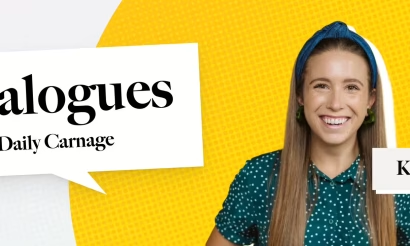
Dialogues: Kimberly Bailey, Head of Marketing at Alpaca
Shannon Sankey
Content2 MIN READ
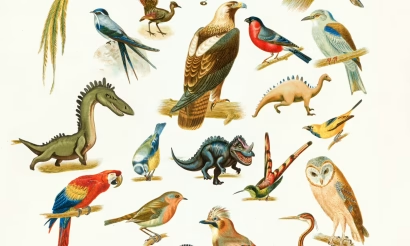
Know Your Audience: Avian & Saurian Edition
Rich O'Donnell
Content3 MIN READ

Which comes first, the copy or the design?
Rich O'Donnell
Content4 MIN READ
How to Speak Like a Customer—Not Your CEO
Rich O'Donnell
Content4 MIN READ

The New Search Paradigm: How Marketers Can Prepare for SGE
Shannon Sankey
Content2 MIN READ
5 Tips for Marketers Who Hate Writing
Shannon Sankey