
The Daily Carnage
The savvy marketer's hub for industry news, insights, resources, and culture.
Today’s Issue
Issues
View All
Best Practices for Reels
SEPTEMBER 18, 2023It’s about time for a refresh on Reels best practices. Here’s the skinny:
Consistency: Post your content on the same time and day to signal to the algorithm that you’re committed to providing valuable content regularly.
Trending Audio: Use medium-popular trending audio ( < 10k usage count), even at a low volume for narration videos.
Hashtags: Use 3 to 8 hashtags with usage counts from 10,000 to 500,000. Avoid hashtags with volumes over 1 million.
Editing: No surprise here, the algorithm prioritizes Reels that use in-app features, so edit within Instagram whenever possible. Always avoid watermarks!
Length: Find what works for you, but ~30 seconds is best for capturing attention.
Comments: Like and reply to comments within the first hour of posting.
Republishing: It’s allowed AND encouraged! Repost your best Reels every 3 to 6 months.
CTAs: You might be penalized for encouraging users to leave the app. Opt for “share this with a friend” over “subscribe to my newsletter!”
Check out Nick Gray’s post for more insight from a Meta rep.
5 Strategies for Effective Brainstorming
SEPTEMBER 17, 2023Group brainstorming is a difficult dance. We expect a movie montage of whiteboards and breakthroughs, but we often end up with one or two people taking the wheel while the rest of us try to gather and articulate our thoughts. Adding a little structure to the agenda goes a long way. These 5 techniques can help you get the most out of the thinkers on your team:
Nominal Group Technique (NGT)
Each person generates ideas on their own before reconvening with the group for discussion. This technique limits interruptions, ensures that everyone has space to contribute, and allows for the group to refine ideas together.
Electronic Brainstorming
This approach is well suited for a remote environment. Participants use a shared digital platform—like FigJam—to contribute ideas simultaneously.
Brainwriting
This is a generative exercise that prioritizes solo brainstorming without a structured group discussion. Participants work through ideas on paper or digitally without external influences, focusing on the thorough exploration and expansion of their thought processes. These ideas can then be passed along to other collaborators for review and feedback.
Structured Brainstorming
The approach optimizes the brainstorming process by implementing guidelines to keep participants on track. A common technique is to divide the session into phases—an initial period in which participants may freely express ideas without judgment, followed by a discussion and evaluation phase to generate feedback.
Stepladder Technique
This technique begins with participants generating ideas on their own. Next, two participants share their ideas with each other. Then, a third person joins the group for discussion, and the group gradually continues to grow until all individuals have joined and shared their ideas. This provides a controlled environment that privileges the input of each participant and builds upon the collective wisdom of the group.
Check out Jess Eddy’s tips for more effective brainstorms.
Key Takeaways From Our GA4 Survey
SEPTEMBER 13, 2023Last week, we launched The GA4 User Experience Survey to get a read on the room as we near the end of Q3. Here are some key takeaways from the data:
- 60% of respondents transitioned to GA4 some time in 2023.
- 37.5% of respondents use GA4 on a weekly basis, and 32.5% use it daily.
- 40% of respondents say they’re unsatisfied with GA4.
- The vast majority of respondents feel that GA4 has not enhanced their workflow.
- Users’ most commonly reported issues were UI / design (75%), missing reports and metrics (70%), report creation (60%), and data discrepancies / sampling (57.5%).
The general consensus?
“UA was highly intuitive, GA4 is much less so. It wasn’t a simple upgrade—it was a complete overhaul requiring training and adapting time that no one has time for.”
“It’s like learning an entirely new language. The refinement of metrics is nice but to change the reporting style and naming makes it incredibly challenging.”
“When I compare GA4 to UA we see troubling discrepancies, and other analytics tools point at UA as being correct.”
Is GA4 an opportunity for growth or a failed experiment? Check out MarTech to explore 5 common criticisms of GA4—and how to move forward.
7 Common GA4 Mistakes to Avoid
SEPTEMBER 12, 2023It’s easy to make some common errors when configuring your GA4 account. Make sure you take these 7 early actions:
- Extend your data retention period. Data from your custom reports will be automatically deleted after two months, which will screw up your YoY reporting. Change the setting to save data for up to 14 months by navigating to Data Settings > Data Retention.
- Mitigate the impact of high cardinality dimensions. These are dimensions that more than 500 unique values within a single day, which can negatively affect your data. For example, if you’re using word count as a custom dimension, bucket your values into ranges (<500, 500–1000, 1001–1500, and so on).
- Link to a BigQuery account. Set this up right away to begin collecting historical data. Unlike GA4 custom reports, BigQuery data is never sampled, even if there are more than 10M events in the exploration report.
- Set up custom audiences. Create target audiences—like engaged users, subscribed users, or users who made a purchase in the last 30 days—to get valuable insights from specific segments. Audience dates are not retroactive, so do this early on.
- Don’t auto-migrate from UA. You’re better off rethinking your analytics and event collection architecture than trying to retrofit your system into a totally different data model.
- Exclude unwanted referrals. Ecomm sites often have third-party processors hosted under different domains, but redirects from these domains shouldn’t be counted as new sessions. Add these to your exclusion list to avoid distorting your data.
- Choose the correct reporting identity. If you don’t have login and user IDs on your site, 99% of cases should go with “device-based” over the other options, “Blended” and “Observed.”
Take a closer look at Search Engine Journal.
GA4 & Bounce Rate
SEPTEMBER 11, 2023Remember bounce rate from Universal Analytics? It’s the handy metric that represents the number of bounces on your site divided by the number of sessions. It’s the inverse of engagement rate.
Bounce rate is not wiped from GA4, but users must now customize reports or create exploration reports to view this metric. GA4 calculates bounce rate based on the percentage of sessions that were not considered “engaged,” which are sessions less than 10 seconds long or those that didn’t convert.
That said, there are alternative metrics to consider when measuring engagement. Let’s break it down:
- Engagement rate is a more positive metric that reflects user interest in your content and offers. Engaged sessions are longer than 10 seconds, include two or more page views, and result in at least one conversion.
- Views per user can help you understand the average number of times users engage with each page on your website.
- Non-engagement rate is a comparable custom metric you can create by dividing the number of non-engaged sessions by the total number of sessions.
Dig into the guide at Loves Data to get a better read on your GA4 reports.
The GA4 Event Types
SEPTEMBER 10, 2023In Universal Analytics, interactions were tracked simply as “hits.” Now, in GA4, any engagement with your site or app is referred to as an “event.” Let’s break down event types.
- Automatically collected events are gathered automatically without additional configuration upon setup. You don’t need to turn them on, set them up, or customize them. These include session_start event, first_visit event, and user_engagement event.
- Enhanced measurement events are captured when you enable enhanced measurement upon setup. These include page views, scrolls to the bottom of a page, outbound link clicks, site searches, engagement with embedded videos, file downloads, and form interactions.
- Recommended events are implemented with predefined names and parameters. Google recommends a set of events based on your business vertical.
- Custom events can be implemented when no other pre-existing event suits your measurement needs. You will need to create custom reports or explorations to analyze these events.
Check out the GA4 Glossary at Segmentify to get up to speed on GA4 terms.
The GA4 User Experience Survey
SEPTEMBER 6, 2023Google has been replacing Universal Analytics with Google Analytics 4 since July 1, 2023.
So, how is it going for you? Take 3 minutes to tell us about what you love, what you hate, your FAQs, and everything on your wishlist.

Your feedback will inform our upcoming webinar, GA4 Like a Pro: Build Confidence in The New Age of Analytics on September 20 at 1 p.m. EST with Steve Lamar, founder of Really Good Data.
4 Things We Learned From Merriam-Webster’s Social Director
SEPTEMBER 5, 2023John Sabine is the social director for Merriam-Webster, a brand known for lightly roasting cultural moments on social media with linguistic wit. Here’s what we learned from a recent interview with the man behind the dictionary:
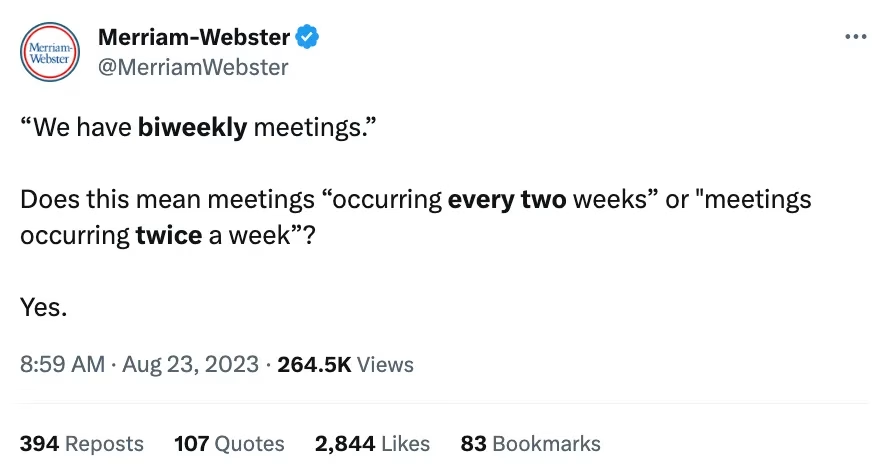
- Social is like Jupiter—there are no seasons, only storms. Your back-to-school content won’t go viral, but you’re more likely to make an impression when you jump onto trends or create your own. Embrace the chaos.
- Craft a strategy that you enjoy. There’s no use trying to recreate someone else’s magic. Follow your taste and find your own voice. But try not to rely wholly on emojis and slang.
- Your brand account should feel alive. Social isn’t just a bulletin board for brand announcements. Get creative in the replies and take the liberty of sounding more like a person/persona.
- Embrace the absurd. It’s ridiculous that a dictionary has a Twitter account. Sometimes we’re too close to the industry to appreciate the humor. Don’t take yourself too seriously… unless that’s your whole thing.
Read Rachel Karten’s full interview with John Sabine at Link in Bio.
The Trifecta of Keyword Research
SEPTEMBER 4, 2023To craft a successful keyword strategy, carefully consider these three data points:
- Volume. This is the number of times a keyword is searched for in a specific time frame. High volume keywords can attract significant organic traffic, but you’ll want to balance them out with other niche, low-volume keywords that have less competition.
- Difficulty. This measures how challenging it is to rank for a keyword based on factors like competition, SERP features, etc. Aim to stay within 10 points of your current domain authority.
- Intent. This is the art of SEO—identifying the purpose behind a search query. Intent can be…
- Informational: Seeking answers and solutions.
- Navigational: Seeking a specific website or brand.
- Commercial: Seeking product comparisons, reviews, and pricing in order to consider a purchase.
- Transactional: Seeking to make a purchase.
Check out best practices for each data point at Search Engine Land.
Insights
View AllStrategy7 MIN READ

The AI SEO Checklist: How to Stay Visible in the Age of AI Search
Ana Toigo
Marketing5 MIN READ

Top Marketing Tools That Offer Nonprofit Discounts (2026)
Rich O'Donnell
Strategy4 MIN READ

Sharpen Your Core Skills: Listening, Remembering, and Note Taking
Rich O'Donnell
Uncategorized4 MIN READ

Dialogues: Kimberly Bailey, Head of Marketing at Alpaca
Shannon Sankey
Content2 MIN READ

Know Your Audience: Avian & Saurian Edition
Rich O'Donnell
Content3 MIN READ

Which comes first, the copy or the design?
Rich O'Donnell
Content4 MIN READ

How to Speak Like a Customer—Not Your CEO
Rich O'Donnell
Content4 MIN READ

The New Search Paradigm: How Marketers Can Prepare for SGE
Shannon Sankey
Content2 MIN READ

5 Tips for Marketers Who Hate Writing
Shannon Sankey