Be in The Know
▶️ YouTube tests an AI search mode.
👻 Snap launches AI Sponsored Snaps for conversational ads.
💼 LinkedIn expands Event Ads beyond its own platform.
🔋 Meta announces a solar-power project to offset AI initiatives.
🎨 Adobe relies on Firefly to win over creators.
Cheaper Clicks Aren’t Always Better
Rising cost-per-click can actually signal improving campaign quality rather than declining performance.
With smart bidding, we’re no longer paying for clicks indiscriminately, instead bidding on the likelihood of conversion. Algorithms evaluate signals like intent, behavior, and context, and then bid more aggressively for users who are more likely to convert.
As a result, higher CPCs often mean you’re winning auctions for the most valuable prospects, not wasting spend.
Cheap clicks are often cheap because they’re low intent, ignored by competitors, or tied to irrelevant queries.
Here’s what to know:
- High CPC can indicate high intent. You’re paying more to reach users closer to conversion.
- Smart bidding prioritizes value, not volume. Algorithms optimize for outcomes like conversions or revenue.
- Low CPC can signal poor traffic quality. “Leftover” clicks often don’t convert.
- Business economics matter more than click cost. Metrics like CPA and ROAS are more meaningful than CPC alone.
- Context is critical. High CPC is good only if conversion rates and profitability follow.
- And there are limits. High CPC becomes a problem when it exceeds the value of a customer or reflects inefficiencies.
Head to Search Engine Journal for more on the high CPC paradox.

Q for You
How concerned are you about the environmental impact of AI?
Audiense
Audiense is an audience intelligence tool that analyzes large volumes of social data to reveal interests, behaviors, cultural affinities, and even personality traits.
Its segmentation engine groups audiences based on shared characteristics and relationships instead of filters.
Then, these segments are enriched with insights like media consumption, influencer affinities, and online habits.
You translate all of this into personas, targeting strategies, and content decisions.
Now Streaming 🎙️
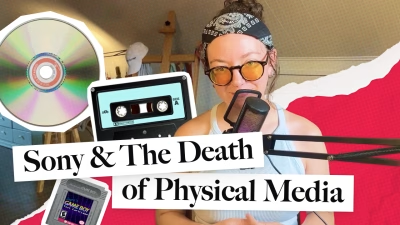
Don’t miss the latest episode of The Daily Carnage Show, “Sony & The Death of Physical Media” to learn more about Sony’s controversial decision to end disc production, the subsequent backlash, and the ongoing debate about consumer ownership.
🎙️ Plus, catch up on Season 2:
- Brand vs. Planet: The Marketer’s AI Footprint (12:14)
- Silent Spring: Is Rainbox Capitalism Dead? (11:41)
- The Future of Google Search (9:56)
- GLP-1s are Disrupting Every Sector (9:56)
- Spirit Airlines 2.0: Will it Fly? (11:08)
- Transgressive OOH (18:45)
- Your Brain on AI (12:33)
- Ethics in the AI Era (18:33)
🎙️ Now streaming on Youtube, Spotify, Amazon Music, and Apple Music.
Sponsor The Daily Carnage
“The Daily Carnage was the newsletter that brought us the most meaningful demo clicks and new trials.” — Digital Summit
“Open rate was nearly 50% and CTR was relatively high, especially considering this newsletter’s audience was likely being exposed to our event for the first time.” — Adweek
Hop on our 2026 sponsorship calendar to get your content in front of 25,000 marketers.
Book a $99 Classified ad instantly, or ask us about our custom sponsorship packages tailored to your campaign objectives.

r/TheDailyCarnage
Weigh in on The Daily Carnage Subreddit:
- The Daily Carnage Show Ep 2.9 Discussion: “If AI agents become the primary interface to knowledge, what happens to the humans and businesses that knowledge originally came from? What does it mean for the internet to quietly transition from an open ecosystem of destinations into a closed ecosystem of gate-kept answers? Are we speeding toward a future where people stop visiting the web directly? If that behavior ends, we ever be able to rebuild it?”
Ads from The Past
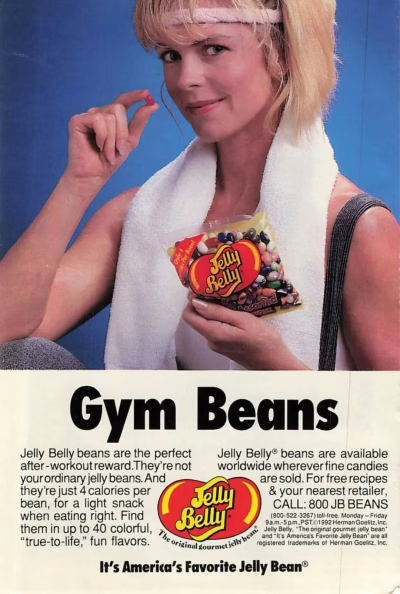
Jelly Belly, 1993