Be in The Know
📺 The 2025 Upfronts grapple with the strangest market in years. (What are TV Upfronts?)
🗂️ Catch up on Upfronts from NBCU, Fox, Amazon, and Disney.
🎧 How Audible turns audiobooks into compelling social content.
✈️ Why Airbnb booked a social-first campaign for its experiences relaunch.
🤖 Google tests replacing “I’m Feeling Lucky” with “AI Mode.”
🧠 Opinion: Brand archetypes. Effective or useless pseudoscience?
🩸 And Liquid Death decapitates Tony Hawk.
Still using spreadsheets for time tracking?
According to EARLY, tracking time in spreadsheets is a hidden money sink. It might work for a while, but as your team grows and projects scale, things unravel quickly.
For small teams, this outdated method can easily waste over $100,000 a year.
So, where is all that money going?
- Lost billable hours
Even 15 minutes underreported per person per day costs $65,000 a year for a 10-person team – and it often goes unnoticed. - Time-consuming admin work
Managers spend about 2 hours weekly chasing down and fixing timesheets. That adds up to 100 hours and $10,000 yearly of admin work that a tool could handle in minutes. - Productivity drain
Manual timesheets eat up 25 minutes a day. For 10 people, that’s about 1,084 hours and $108,000 lost to admin instead of real work. - No insights, just data
You’ve got hours logged, but no clue how your team is really spending time or where to improve. Spreadsheets don’t show what’s billable, or wasted, or where to focus. - Team frustration
Nobody loves filling out timesheets. It’s boring, it’s easy to forget, and it’s easy to mess up. As soon as tracking becomes a chore, accuracy drops off the cliff.
The fix?
Tracking time with EARLY. It automates time tracking, gives you real insights, keeps your team on track, and makes reporting a breeze. Whether you’re a startup, agency, or growing team, EARLY is the tool you need to ditch spreadsheets for good.

👉 Read the full breakdown → The real cost of spreadsheet time tracking

Q for You
Weigh in. Brand archetypes are…
Endless Tools
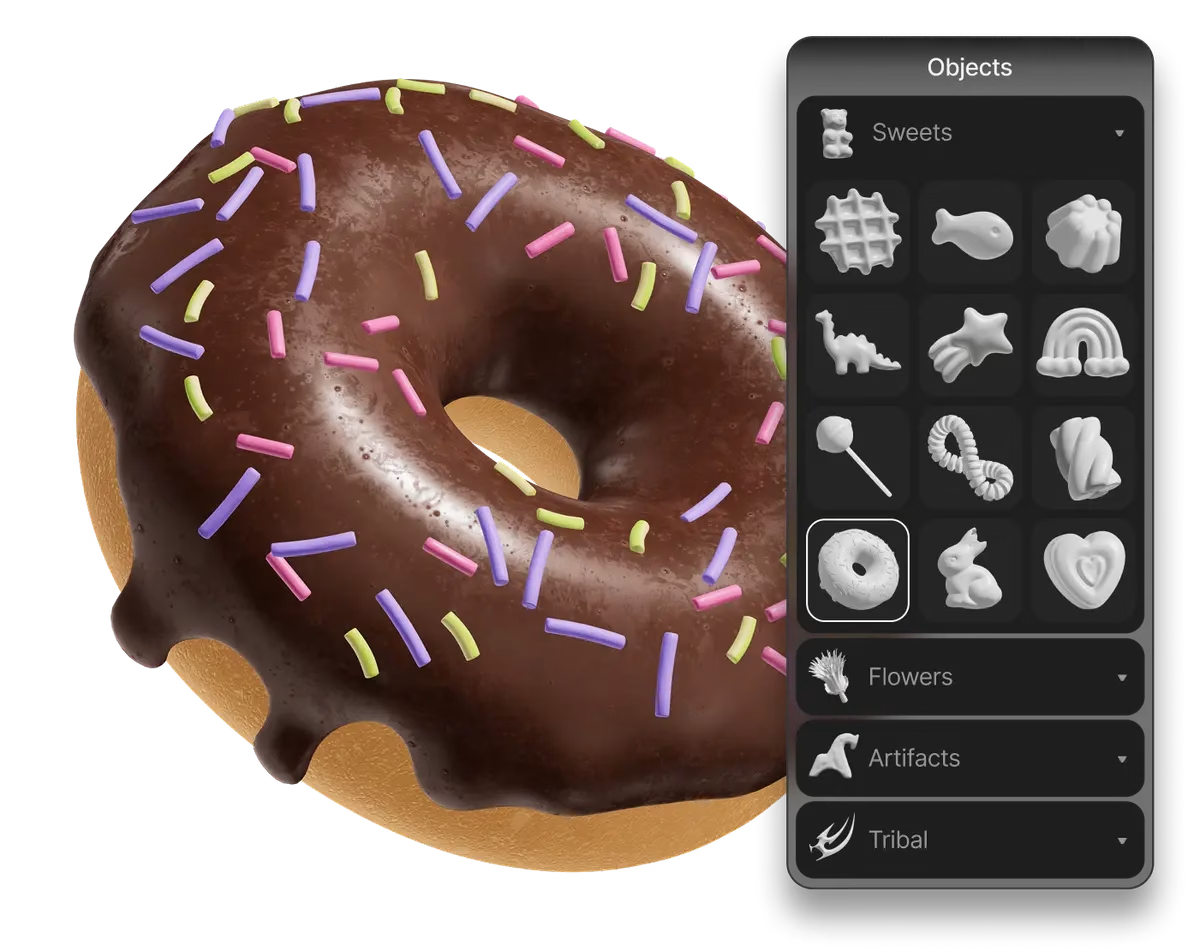
Endless Tools is a browser-based resource that makes it easy to build polished 3D visuals, animations, and interactive effects without any code.
It’s especially useful for marketers and designers who need high-impact graphics without relying on a full production team.
The platform supports MP4 animation exports, 4K image rendering, and interactive embeds, plus features like 3D typography, SVG-to-3D conversion, and a growing library of curated 3D objects and materials.
It’s great for campaign key visuals, web graphics, or even lightweight prototypes. Newbies can stick to presets, but 3D nerds can customize accordingly.
It’s a Love Story

A lot of Gen Z-ers would rather scroll BookTok for romance fiction than bother with a dating app IRL.
So, Hinge took a page out of their book.
The dating app has launched its second installment of its unique “No Ordinary Love” campaign.
Each week, Hinge publishes a real love story on Substack, featuring real Hinge users and written by contemporary authors like Hunter Harriz and Tomasz Jedrowski.
A limited-edition hardcover anthology of the campaign will be distributed to book clubs in New York and London, with OOH placements and creator partnerships rounding out the push.
Ads from the Past

Kellogg’s, 1970