Keyword Research: The Complete Beginner’s Guide

We write about keyword research all the time in the Daily Carnage because it’s crucial to your content’s success. But, we never really talk about how to do keyword research.
So let’s do that today. We’re diving right in because there’s a ton to this.
Let’s first talk about the types of keywords. There are three general buckets that we place keywords into:
- Short tail keywords are usually made up of one or two words. Example: ‘WordPress themes’.
- Middle tail keywords are typically three or four words. Example: ‘WordPress themes for blog’.
- Long tail keywords usually consist of four or more words. Example: ‘free responsive WordPress themes for blog’.
When doing keyword research, it’s really easy to get sucked into the short tail keywords because they get a ton of monthly searches. The problem is, they’re also super competitive. That’s why we typically focus on middle tail and long tail keywords.
The keyword research process
Part 1 – Find the seed. You gotta find a starting point. Go to where the people in your industry hang out. Try forums, review websites, Reddit, Facebook Groups, etc. From there, you need to find the words people use.
For example, go to Amazon, search for a popular book in your industry, and read the reviews. Make notes of the consistent words and phrases that people use. These are your seed ideas. You can do this same thing on Reddit or Quora or Wikipedia even.
Part 2 – Search for keywords. Hokay, so you’ve got your ideas. Let’s head over to KWFinder to analyze them. Enter your keyword in the search box and you’ll see a few things:
- Trend – The search volume trend (mini graph) in the last 12 months.
- Search – The average monthly search volume in the last 12 months.
- CPC – The average cost per click of the listed keyword in Google Adwords.
- PPC – The level of competition in PPC advertising (min = 0; max = 100).
- KD – The SEO difficulty of a keyword.
These stats will help you figure out which keywords to target.
There are still two really important parts to keyword research that you need to learn about, but we are truly out of room here…

Podcast Advertising 101: 4 Tips to Get You Started

Podcasting is becoming its own force to reckon with. According to WordStream, “42 Million Americans listen to a podcast every week.” To put it in perspective, Michigan Stadium is the largest in the US (107,601 capacity) and it would take almost 400 stadiums to fit the number of podcast listeners.
The audience is there, so how do you get to them? It’s by doing what we do best. Advertising. This isn’t a “what mic do I use” type of entry, but Wordstream wants to spread the love and teach you how to put a ring on it.
Get it? Hint, hint. We mean engagement. WordStream goes through 4 reasonable advertising strategies you can implement today as well as terminology 101, and average ad rates.
Let the class begin!
Terms to know:
- Direct response: Track that, all on the floor. Track that, give me some more. Track that, ’til you get sore. Track that, oh-oh-oh-oh-oh. Okay, but really, it’s just advertising that can be measured.
- CPM rate: It’s an expense measurement meaning cost per thousand listens of a podcast. Does it drive anyone else insane that thousand gets an M?
We’re only giving you two here but there’s 9 total.
Advertising in a podcast 101:
- Find your fit. Podcast listeners are unique in that 75% will pay attention to ads and follow CTAs. The key? Connect with your audience in an authentic way. For example, the Girl Boss podcast partners with Sephora, Pinterest, Bumble, and others that make sense with a largely female demographic. It’s not forced.
- Refine your approach. There are two ways to advertise in a podcast. One is baked in, (or read live within the podcast) and the other is dynamically inserted (inserted after podcast ends via ad server). Like any strategy, we can’t tell you which is better. Dynamically inserted tends to be better when you need to a/b test or if content is time sensitive. Baked in ads tend to be 3.5x more efficient.
- Define your investment. WordStream recommends having firm decisions on your quantifiable objectives along with a realistic budget. Use AdvertiseCast to identify the right podcasts and how they charge advertisers.
- Track your ROI. Here are some ways to track ROI on your ads. One, include a vanity URL. Two, draw a direct line with a promo code specifically for podcast listeners. Three, simply ask subscribers/buyers how they heard about your brand.
Nuts for a Healthier World
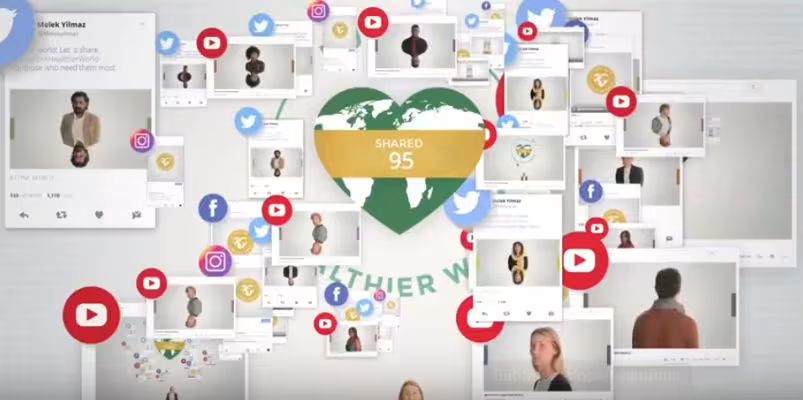
“This is the best video that you can share today.”
First of all, that is one intense opening line. It gives us a Joey Tribbiani “how you doin’,” kind of vibe.
Okay, okay. Before we get ahead of ourselves. Let’s break down the good, bad, and ugly in this campaign. Admittedly, there isn’t really bad or ugly in this one. Instead, they directly address the fact that trending things like kittens, or goosebump feelings aren’t involved in this ad.
So the worst thing, the ad may not be Super Bowl-worthy entertaining but they know it. The good? Every time a user shares this commercial, they are sharing a bag that contains 16 nuts from different countries to those suffering from malnutrition or health problems. Lead by the International Nut Council (sounds like a…nutty…group. Sorrynotsorry for that terrible pun), their goal is to donate 1 ton of nuts.
If there were any reason to share an ad, this is the reason. Smash that button and see what people are going nuts over.
“If people believe they share values with a company, they will stay loyal to the brand.”
Howard Schultz
Ads from the Past