Does Visitor Time-On-Site Make for Better Ad Traffic?
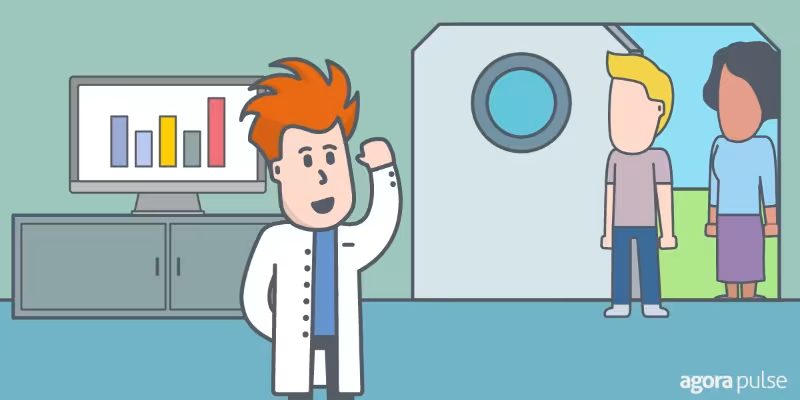
We were gushing about Agorapulse’s blog a few weeks ago. It’s too good. They run in-depth social media experiments so you don’t have to. And, since they’re data scientists, they do it with a very scientific approach. Makes us trust their results a whole lot. No fake news here.
They’ve done it again in today’s Listen. Agorapulse decided to test the theory that time-on-site is a valuable metric for Facebook ads. Basically, they wanted to know if someone spends a lot of time on their website, would they be more likely to convert into a free trial user.
Here’s what they found:
- (00:20) Two years ago, Facebook launched an ad targeting feature where advertisers can retarget people based on the amount of time they spend on your website.
- (01:21) This raises the question, are people who spend more time on your website more likely to convert?
- (01:35) There’s plenty of anecdotal evidence that people who spend more time on your website are more engaged, and therefore more likely to convert. But, there’s not much actual data on that point.
- (03:04) Their hypothesis was that time-on-site does not affect the likelihood of someone signing up for a free trial.
- (03:21) To test this, they set up two ad campaigns. One targeted the top 25% of visitors who spent the most time-on-site. The other targeted the bottom 75%.
- (04:28) They set a $1,000 budget.
- (05:18) In the 28-day test, they gained 25 free trial signups from both ad campaigns.
- (05:54) The CTR winner? The ad targeting the top 25%. Makes sense.
- (06:02) The top 25% did convert to free trial users more than the bottom 75%. Well, that’s a clear winner, right? Not so fast…
- (06:48) The problem? The winning audience (top 25%) was a much smaller audience, which actually cost them more ad-spend per person.
- (08:18) Interestingly, the one paid customer they got from this campaign came from the bottom 75%.
- (08:57) If you’re going to retarget website visitors based on time-on-site, you’ll have the most success by retargeting based on specific pages on your website.
Get all of their insights, including the actual ads they used in this test, by punching the button below.

10 of the Greatest Email Tactics from the Greatest Onboarding Emails
Second impressions. You don’t really get one of those—unless you black out and don’t remember the first time.
Welcome emails are your first—and sometimes last—chance to make a good and lasting impression on prospective customers. So, make that welcome a good one.
The author of today’s Read wants to help you make the best one possible. He also happens to be Buffer’s marketing director, so he knows what’s up.
He spent 35 days with 13 different brands learning how they approach onboarding a new user via email. He looked at several different industries: e-commerce, SaaS, entertainment, etc., each bringing something unique and different (and effective) to the table.
Let’s check out some of these takeaways, trends, and tips observed from some particularly amazing email campaigns.
1) Give your email address an avatar.
Putting a face to your name will no doubt build a stronger connection between you and the reader.
2) Longform is okay, especially if it’s from a person.
Keep in mind: Many people’s authenticity radar is pretty well tuned. If you’re going to send a plain-text email from a real person, it’s probably best to have that real person write it.
3) Use emojis in your subject lines.
Hehe, we love this one. Naturally, they’re best used when relevant to the text, though. Otherwise, you’re kind of just hopping on a bandwagon without knowing where you’re going. Awkward…
4) Make your own “cart abandonment” email.
Not every online business has shopping carts to fill. But most online businesses do have a key element in their onboarding that they’d love to drive home. AKA, we can all have cart abandonment emails, even if we don’t have carts! Here’s one that Treehouse sends to people who make it partway through the trial start process but don’t actually finish.
5) What one job does your email do?
Every email should have one job. And only one! If you want to say a couple things in your email, then send a couple different emails.
Five more golden nuggets to unearth! →
Fantastic Beasts & Where to Drive Them
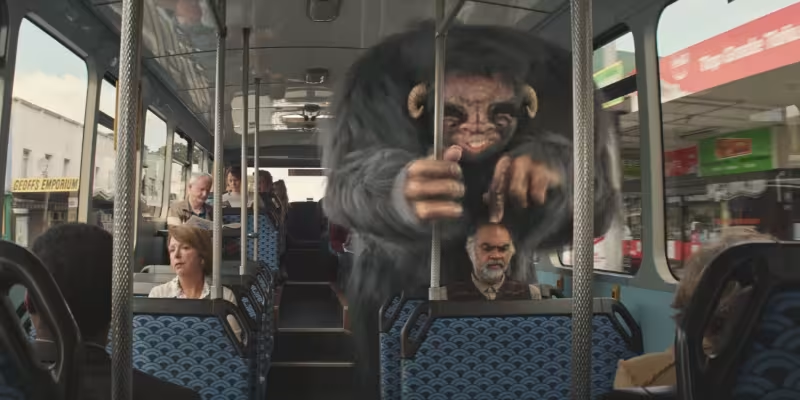
Toyota is bringing car-buying burdens to life in the form of pesky (yet subjectively adorable) monsters! Their latest ad is coming all way from New Zealand, but the woes expressed are definitely universal.
In the ad, we see various people on the verge of making that big car purchase—and on the verge of mental breakdowns. Beasts both big and small show up as anxieties and nagging emotions associated with car buying. For example, the “pressure to buy before it’s gone” is a noisy nuisance on the bus. The actors and monsters give this bit a healthy dose of humor, too.
But why has Toyota made car buying look so…monstrous? Well, the ad promotes their “Drive Happy Project,” which aims to take the angst out of purchasing a car. Beasts be gone!
“When people feel insecure about something, they look around for validation. Show them that other people trust you.”
Francisco Rosales
Ads from the Past